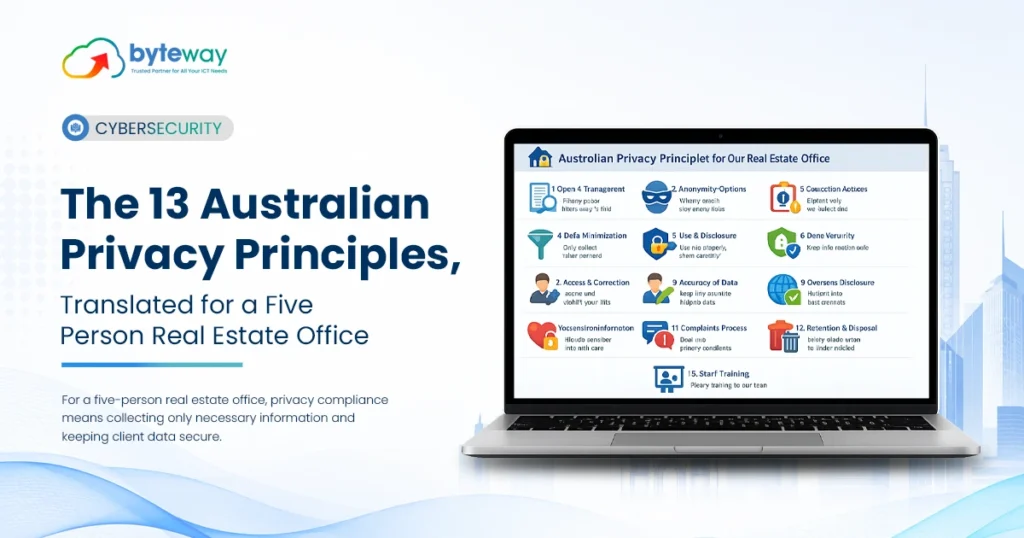
The 13 Australian Privacy Principles, Translated for a Five-Person Real Estate Office
If the AML/CTF reforms have just brought your firm under the Privacy Act, you have probably been handed a document listing 13 Australian Privacy Principles (APPs) written in the kind of language that assumes you employ a compliance team. You don’t. You might have four or five people in the office, with one person handling bookkeeping, another managing clients and everyone wearing multiple hats. So here are the 13 Australian Privacy Principles explained in plain English, with what each one actually means for a small Australian office handling client identity documents, tenancy applications, financial information and property files. The important thing is not memorising all 13. It is understanding what you actually need to change in your day-to-day operations. What Are the Australian Privacy Principles? The Australian Privacy Principles are 13 legally binding principles contained in Schedule 1 of the Privacy Act 1988. They govern how organisations covered by the Privacy Act collect, use, store, secure, disclose and provide access to personal information. For a small business, think of them as rules covering the entire life of someone’s information: Collect it → tell them why → use it properly → keep it secure → let them access it → correct it → delete it when you no longer need it. Personal information can include anything that identifies, or could reasonably identify, an individual. For a real estate or property business, that might include: The 13 principles are easier to understand when grouped into five practical areas. Part 1: Being Open About What You Do APP 1: Be Open and Transparent About Personal Information APP 1 requires organisations to manage personal information openly and transparently. In practical terms, you need a clear, current privacy policy explaining things such as: Your privacy policy should be freely available and easy for people to find, typically through your website. What this means for a small office A generic privacy policy downloaded several years ago and forgotten about is unlikely to be enough. Your policy should reflect what your business actually does. If your office collects identity documents, stores client information in cloud software, uses external providers and communicates with clients electronically, your privacy documentation should reflect that reality. APP 2: Allow Anonymity or Pseudonymity Where Practical APP 2 says individuals should generally have the option of dealing with an organisation anonymously or using a pseudonym where this is lawful and practical. For many professional and property businesses, this will have limited practical application. You cannot realistically complete a tenancy application, verify a client or perform certain AML/CTF requirements without knowing who the person is. So while APP 2 is still part of the framework, it is not usually where a small property or professional office will spend most of its time. Part 2: Collecting Personal Information APP 3: Only Collect What You Actually Need APP 3 is about limiting the personal information you collect. You should only collect information that is reasonably necessary for your functions or activities. Sensitive information has additional requirements. What this means for a small office This is where businesses can easily collect more information than they actually need. For example, if you need evidence of income for a particular process, automatically requesting an entire collection of financial documents may result in more personal information being collected than necessary. The practical question is: Do we actually need this information to perform the task? If the answer is no, don’t collect it simply because it might be useful later. APP 4: Deal Properly With Unsolicited Information APP 4 deals with personal information that your business receives without asking for it. If someone sends you information you did not request, you need to consider whether you could have collected it lawfully. If you could not have collected it lawfully, you generally need to destroy or de-identify it as required. What this means for a small office Think about a client or applicant who emails a large folder of documents “just in case.” You didn’t ask for them. You don’t need them. Don’t automatically save them forever. Unnecessary information sitting in your inbox or shared drive is still information your business has to protect. APP 5: Tell People What You Are Collecting and Why APP 5 requires you to provide appropriate notification when collecting personal information. People should understand: This is commonly handled through a collection notice. Privacy policy vs collection notice These are not the same thing. Your privacy policy explains your broader information-handling practices. Your collection notice appears at or before the point where you collect information. For a small property or professional business, that may mean including appropriate wording in: A business can have a privacy policy and still fail to properly address collection notices. Part 3: Using and Sharing Personal Information APP 6: Use Information for the Right Purpose APP 6 governs how you use and disclose personal information. Generally, information should be used or disclosed for the purpose it was collected for, unless consent or another permitted exception applies. A simple example If you collect identity documents for identity verification or AML/CTF purposes, that does not automatically mean you can use those documents for unrelated marketing. The key question is: Why did we collect this information in the first place? The answer should guide how you use it. APP 7: Be Careful With Direct Marketing APP 7 deals with using personal information for direct marketing. Depending on the circumstances, you may need consent or another lawful basis, and individuals generally need a straightforward way to opt out. For property businesses, this can cover activities such as: If someone has opted out, your systems need to respect that decision. A marketing database that continues sending emails after an unsubscribe request is more than a marketing inconvenience—it can become a privacy issue. APP 8: Take Care With Overseas Disclosures APP 8 deals with cross-border disclosure of personal information. This is increasingly important because many businesses rely on cloud-based software. Your CRM, document management platform, email service or other technology