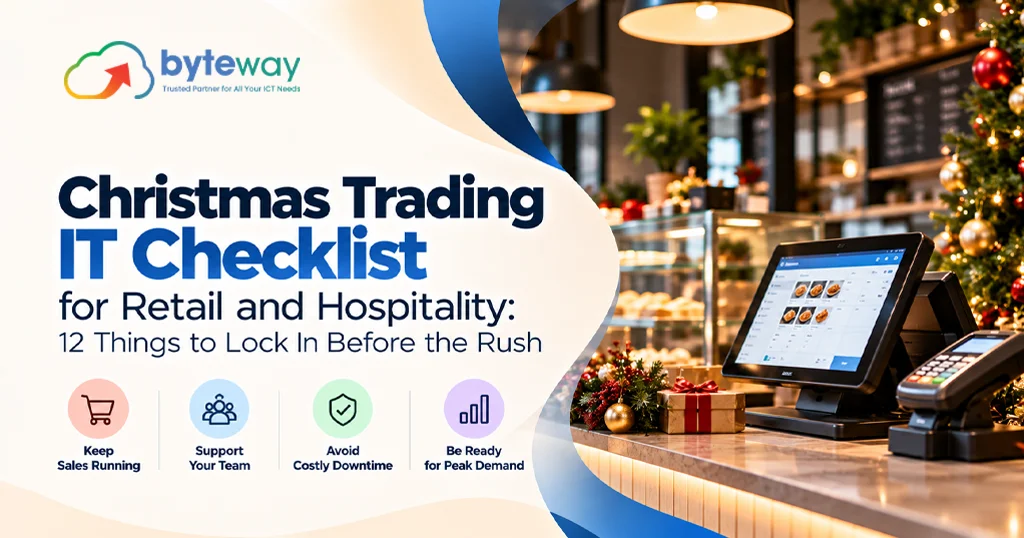
Christmas Trading IT Checklist for Retail and Hospitality: 12 Things to Lock In Before the Rush
Before peak trading starts, a retail or hospitality business should confirm that the things most likely to fail under load are ready: that payments keep working if the internet drops, that the Wi-Fi can handle a full floor, that someone answers the phone when bookings flood in, and that the whole system is frozen from risky changes during the busiest weeks. The checklist below is the one Byteway runs with retail and hospitality clients before November, because the worst time to discover a weak point is on a Saturday in December with a queue at the counter. Peak trading does not create new problems. It exposes the ones that were already there, just under more load than usual. Work through these twelve before the rush and most of the common Christmas disasters simply do not happen. 1. Point-of-sale failover Your point-of-sale is the one system that cannot go down during trading. Confirm what happens if it loses connection: does it keep taking sales offline and sync later, or does it stop dead? Know the answer now, and make sure staff know the manual fallback. A POS that halts at 1pm on a Saturday is a day’s takings at risk. 2. A 4G or 5G backup for your internet If your store runs on a single internet connection, one outage takes down payments, POS and phones at once. A 4G or 5G backup connection kicks in automatically when the main line drops, so trading continues while the fault is sorted. For the weeks that make your year, this is the single highest-value check on the list. 3. EFTPOS and payment terminals Test every payment terminal before the rush, not during it. Confirm they are on current software, that they fail over to mobile data if needed, and that staff know what to do if one terminal stops. A second path to take payment is worth setting up now. 4. Wi-Fi capacity for a full floor Wi-Fi that is fine on a quiet Tuesday can buckle when the floor is full of customers, staff devices and payment terminals all competing. The problem is usually capacity, not coverage. Confirm your network can handle peak device numbers, and keep customer Wi-Fi separated from the network your POS and payments run on. 5. Promo scheduling on digital signage If you run digital signage or menu boards, schedule your Christmas pricing, promotions and trading-hours changes in advance. Set them to flip over automatically on the right dates so nobody has to update screens by hand during a shift. 6. Phone coverage for bookings and functions December is when the phone rings most, and often when you have the least spare staff to answer it. Decide now how calls are handled when everyone is serving: an auto attendant, overflow to another line, or an AI voice agent that captures booking and function enquiries after hours so you are not losing them to voicemail. 7. CCTV coverage and recording Busier stores mean more foot traffic and more risk. Confirm your CCTV is recording, that coverage still matches your layout if you have moved displays for Christmas, and that you can review footage quickly if you need to. 8. Backups that actually ran Confirm your backups are running and, more importantly, that they can be restored. A backup nobody has tested is a hope, not a safeguard. Check this before the busy period so there is time to fix it if it has quietly stopped. 9. Staff access and new starters Casuals and seasonal staff need the right access on day one and that access removed when they finish. Set up accounts, POS logins and permissions ahead of their first shift so onboarding does not eat into trading time. 10. A change-freeze date Pick a date, usually a week or two before peak, after which no non-essential IT changes happen. No new systems, no “while we’re at it” upgrades, no risky updates during the busiest weeks. The most stable system in December is the one nobody touched in late November. 11. After-hours contacts and escalation Write down who to call when something breaks outside business hours, and make sure staff on the floor have that number. A clear escalation path turns a crisis into a phone call. If you have a managed IT provider, confirm their holiday coverage now. 12. A Pre-Christmas IT health check Tie it all together with one proper check before the rush. Walk the store, test the failovers, confirm the backups, and fix the weak points while there is still time. Done in November, it is routine. Done in December, it is an emergency. Why the timing matters? Every item on this list is cheap and calm to fix in November. The same fix in the third week of December, with the shop full, is expensive, stressful and sometimes impossible until the new year. Peak trading rewards the businesses that prepared and punishes the ones that assumed last year’s setup would hold. The common thread is that none of these failures announce themselves in advance. The POS that stops offline, the Wi-Fi that buckles, the backup that quietly stopped running months ago. They look fine right up until the load arrives. Frequently asked questions What IT checks should a retail or hospitality business do before Christmas trading? Before peak trading, confirm POS failover, a 4G or 5G internet backup, EFTPOS reliability, Wi-Fi capacity for a full floor, signage promo scheduling, phone and booking coverage, CCTV, tested backups, staff access, a change-freeze date and after-hours contacts. Byteway runs this twelve-point pre-Christmas IT health check with retail and hospitality clients so weak points are fixed before the rush, not during it. What is the most important IT check before peak trading? A backup internet connection. If your store runs on a single line, one outage takes down payments, POS and phones together during your busiest weeks. Byteway sets up automatic 4G or 5G failover so trading continues while the main connection is repaired. When should we