

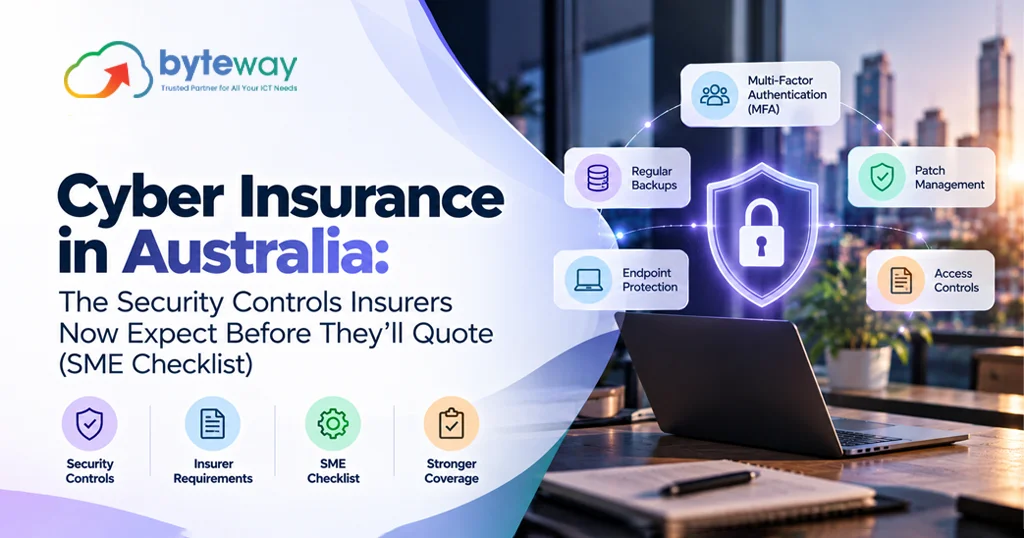
Getting cyber insurance in Australia is no longer just filling in a form and paying a premium. Insurers now ask detailed questions about your security controls before they will quote, and increasingly make cover conditional on having specific basics in place, so a business without them can face higher premiums, exclusions, or a declined application. Byteway helps Australian small businesses get quote-ready, so this is a plain-English guide to the controls insurers commonly ask about, mapped to the Essential Eight, with how to evidence each, and a quick way to score your own readiness.
One important framing before the checklist: the specific requirements vary by insurer and policy, and this guide describes the controls that Australian cyber insurers commonly ask about on their proposal forms, not a universal legal requirement. Always check what your specific insurer or broker requires. What follows is the pattern most SMEs will meet, and getting these in place makes you easier to insure and, more importantly, harder to breach.
Why insurers now ask about your security?
Cyber insurance used to be lightly underwritten. After years of rising ransomware and breach claims, insurers tightened up, and now they underwrite on your actual security posture. The logic is simple: a business with multi-factor authentication, tested backups and current systems is far less likely to make a claim, so insurers want evidence those controls exist before they take on the risk. For an SME, that means the proposal form has become a security checklist, and your answers affect whether you are covered, at what price, and with what exclusions. Being able to answer “yes, and here’s how we evidence it” is what being quote-ready means.
The controls insurers commonly ask about (mapped to the Essential Eight)
Here are the controls that typically appear on Australian cyber insurance proposals, what each is, how it maps to the Essential Eight (Australia’s security baseline), and how to evidence it when asked.
1. Multi-factor authentication (MFA)- The one insurers care about most. They want MFA on email, remote access and admin accounts at minimum. Essential Eight: yes (MFA). Evidence: show MFA enforced across these accounts, ideally a configuration report or screenshot from your identity platform.
2. Tested backups- Not just that you back up, but that backups are regular, kept separate/offline or immutable, and that you have restored one. Essential Eight: yes (Regular backups). Evidence: backup schedule, offsite/immutable configuration, and a dated restore test.
3. Patching and updates- Operating systems and applications kept current so known vulnerabilities are closed. Essential Eight: yes (Patch applications; Patch operating systems). Evidence: your patching process/cadence and a patch-status report.
4. Endpoint protection– Modern antivirus or endpoint detection and response (EDR) on devices. Essential Eight: supports several. Evidence: the product in use and coverage across devices.
5. Email filtering and security- Protection against phishing and malicious email, the most common attack entry point. Essential Eight: supports user hardening. Evidence: your email security layer beyond native filtering, and whether staff phishing training is in place.
6. Restricted administrative privileges- Admin rights limited to those who need them, and privileged accounts controlled. Essential Eight: yes (Restrict administrative privileges). Evidence: your admin access list and how it’s reviewed.
7. Security awareness training- Staff trained to recognise phishing and scams, often with simulations. Evidence: your training cadence and records.
8. An incident response plan- A documented plan for what happens in a breach, who does what, in the first hours. Evidence: the written plan and when it was last reviewed/tested.
9. Access control and offboarding- Accounts promptly removed when staff leave, and access matched to role. Evidence: your onboarding/offboarding process.
10. Network security and monitoring- A business firewall, secure remote access, and some logging/monitoring so suspicious activity is detectable. Evidence: your network setup and monitoring arrangement.
Most of these map directly onto the Essential Eight, which is why working towards Essential Eight Maturity Level 1 and being cyber-insurance-ready are largely the same project. Do one and you have substantially done the other.
A quick quote-readiness self-score
Count how many of the ten above you can answer “yes, and we can evidence it” to:
- 8–10: You are in good shape. Expect a smoother application and better terms. Make sure your evidence is tidy before you apply.
- 5–7: You will likely get cover but may face conditions, higher premiums, or questions. Closing the gaps before applying is worth it.
- 0–4: You may struggle to get cover, or get it with significant exclusions. Fix the fundamentals first, starting with MFA and tested backups, then apply.
This is a rough guide, not an underwriting decision, but it tells you honestly where you stand before an insurer does.
The Quiet Benefit: being insurable means being safer
Here is the useful part that is easy to miss. Everything on that list is there because it genuinely reduces your risk of a breach, which is exactly why insurers ask for it. So the work of becoming quote-ready is not insurance box-ticking, it is the same work that makes a breach less likely and less damaging in the first place. A business that gets these controls in place to satisfy an insurer has, as a side effect, done the most valuable security work an SME can do. The insurance is the prompt; the protection is the point.
Byteway Expert Insight
What we see is businesses treating the cyber insurance proposal form as paperwork, answering optimistically, and then discovering at claim time that a control they ticked was not really in place, which can jeopardise the claim. The honest approach is to treat the form as a genuine checklist: wherever you cannot confidently answer yes with evidence, that is a gap to close, not a box to tick hopefully. Our approach is to run a business through the controls insurers actually ask about, fix the gaps in priority order (almost always MFA and tested backups first), and get the evidence tidy, so the application is smooth and, if a claim ever comes, the answers hold up. Being quote-ready and being genuinely secure are the same thing, which is the best reason to do it properly.
How Byteway helps?
We run a cyber insurance readiness check against the controls insurers commonly ask about, map it to the Essential Eight, and close the gaps, from MFA and tested backups to email security and phishing training and security testing. You end up easier to insure and genuinely harder to breach, with the evidence ready for the proposal form.
Frequently asked questions
What security controls do insurers require for cyber insurance in Australia?
Insurers commonly ask about multi-factor authentication, tested backups, patching, endpoint protection, email security, restricted admin access, staff training, an incident response plan, access offboarding, and network monitoring, though specifics vary by insurer. Byteway runs a cyber insurance readiness check against these controls.
Is MFA required for cyber insurance?
It is the control insurers ask about most, and many now expect multi-factor authentication on email, remote access and admin accounts as a condition of cover. Without it, you may face higher premiums, exclusions or a declined application. Byteway helps businesses get MFA in place across the accounts insurers care about.
Why do cyber insurers ask so many security questions now?
Because they underwrite on your actual security posture after years of rising ransomware claims, a business with strong controls is less likely to claim. The proposal form has become a security checklist. Byteway helps businesses be ready to answer it with evidence.
What happens if I don’t have the controls an insurer asks for?
You may get cover at a higher premium, with exclusions, or be declined, and answering optimistically without really having a control can jeopardise a future claim. Byteway helps close the gaps before you apply so the answers hold up.
Is cyber insurance readiness the same as the Essential Eight?
Largely, yes, most controls insurers ask about map onto the Essential Eight, so working towards Maturity Level 1 and becoming quote-ready are substantially the same project. Byteway aligns businesses to both at once.
How do I get my business ready for a cyber insurance quote?
Work through the controls insurers commonly ask about, close the gaps starting with MFA and tested backups, and get your evidence tidy before applying. Byteway runs a free cyber insurance readiness check to show you exactly where you stand.
Book a free cyber insurance readiness check
Before you apply, it is worth knowing how an insurer will see you, and fixing the gaps that would cost you in premium, exclusions or a declined application. Byteway checks your business against the controls insurers commonly ask about and helps you close them. Book a free cyber insurance readiness check.