

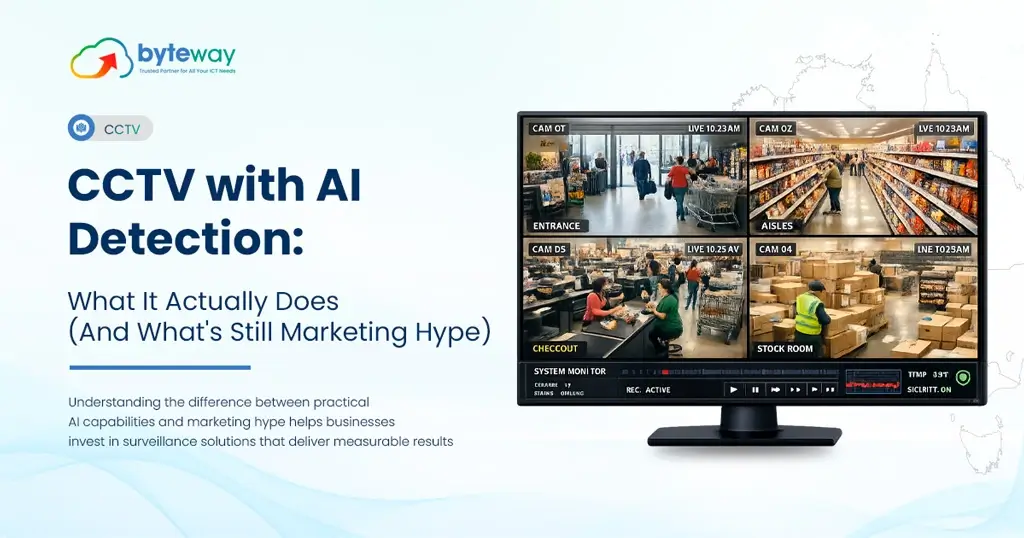
“AI-powered” is stamped on almost every security camera box right now. Some of it is a real upgrade. Some of it is a sticker on the same camera you could buy three years ago. If you are spending money on cameras for your business, you deserve to know which is which. So here is the honest version, without the sales gloss.
AI CCTV genuinely does a few things well: it tells people apart from animals and vehicles, cuts false alarms, reads number plates, and lets you search footage fast. What is oversold is reliable facial recognition, “predictive” crime claims, and the idea that AI replaces monitoring. For most Australian businesses, the real value is fewer false alerts and faster searching, not sci-fi. Buy for those, and you will get your money’s worth.
What does AI actually do in a CCTV camera?
Older cameras trigger an alert on any movement. A cat, a shadow, a tree in the wind, a plastic bag: all of it sets them off. AI changes that by working out what it is looking at.
Here is what current AI detection does reliably:
- Tells objects apart. It distinguishes a person from a car from an animal, so you only get alerted to what matters.
- Cuts false alarms. Because it ignores wind, shadows and pets, you stop getting woken up by nothing.
- Reads number plates. Automatic number plate recognition (ANPR) logs vehicles entering and leaving.
- Searches footage fast. Instead of scrubbing hours of video, you search for “person in red” or “white ute” and jump straight to it.
- Counts and zones. It can count people, flag someone entering a restricted area, or notice a person loitering.
None of this is science fiction. It is pattern recognition doing a genuinely useful job, and it saves real time.
AI CCTV vs traditional CCTV: what is the real difference?
The cameras can look identical. The difference is in the analysis.
| Feature | Traditional CCTV | AI CCTV |
|---|---|---|
| Motion alerts | Any movement | People, vehicles, defined events |
| False alarms | Frequent | Far fewer |
| Searching footage | Manual scrubbing | Search by object or attribute |
| Number plate reading | No | Yes (ANPR) |
| Restricted-zone alerts | Basic | Smart, object-aware |
| Cost | Lower | Higher |
What is oversold: the hype to watch for?
Now the honest part. A few claims get stretched well past what the technology delivers.
The biggest is facial recognition. Marketing implies your cameras will reliably identify individuals by face. In practice, accurate facial recognition needs good lighting, a clear front-on view, and a quality database, and it degrades fast with angle, distance and low light. For most business sites, it is unreliable in the real world, and it also carries heavy privacy obligations under Australian law. Treat “facial recognition” claims with caution.
The second is “predictive” or “crime-prevention AI.” Cameras detect and alert. They do not predict crime. Any claim that a camera will foresee an incident is marketing.
The third is “AI means you do not need monitoring.” AI reduces noise and flags events. Someone or something still has to respond. It is a better filter, not a replacement for a response plan.
Which AI features are genuinely worth paying for?
If you are buying for a business, these are the features that repay the extra cost:
- Person and vehicle detection. The core benefit. Fewer false alarms, more useful alerts.
- Smart search. Finding an event in minutes instead of hours is worth a lot after an incident.
- ANPR (number plate reading). Genuinely useful for car parks, gated sites and vehicle-heavy premises.
- Line-crossing and zone alerts. Good for perimeters, restricted areas and after-hours.
- Real-time mobile alerts. Being told about a person on site at 2am, not discovering it next morning.
Does AI CCTV work well in Australian conditions?
It can, but placement and hardware matter more than the AI badge. Harsh sun, glare, heat and rain all affect performance, so outdoor sites need cameras rated for the conditions, mounted to avoid backlight, and set up with the detection zones tuned to the site. A cheap “AI” camera pointed into the afternoon sun will miss things no matter what the box promises.
This is where setup beats specs. The same camera can be excellent or useless depending on where it is placed and how the detection is configured.
What about privacy? The part the marketing skips
AI features that identify people or vehicles collect more personal information than a basic camera, which raises your obligations under Australian privacy and surveillance law. Facial recognition and number-plate data are sensitive, and using them without the right notice, purpose and storage can put you offside.
Before you switch on face or plate recognition, it is worth understanding the CCTV privacy rules that apply in Australia, especially around consent, signage, and secure storage of footage. AI does not remove those obligations. It increases them.
How to choose AI CCTV without falling for the hype?
- Buy for detection, not buzzwords. Person and vehicle detection is the real win.
- Be sceptical of facial recognition. Assume it will underperform unless conditions are ideal.
- Match hardware to your site. Outdoor cameras need the right rating and placement for Australian sun and weather.
- Check the privacy angle. Especially for face or plate recognition.
- Value setup over specs. Placement and configuration decide performance.
- Plan the response. Alerts only help if someone acts on them.
Byteway Expert Insight
When businesses around Melbourne ask us about AI cameras, the request usually starts with a feature they saw advertised, and it is almost always facial recognition. Once we walk through their actual site, the sun angles, the mounting heights, the lighting, the honest answer is nearly always the same: the feature that will change their day-to-day is not face recognition. It is person and vehicle detection cutting their false alarms from dozens a night to a handful that actually matter.
What we have learned is that AI CCTV is genuinely useful, just not for the reasons the box advertises. The value is in a quieter, smarter system: fewer pointless alerts, footage you can search in minutes, and a real notification when a person is somewhere they should not be. Set up around the site rather than the spec sheet, that is worth paying for. Sold on facial recognition it cannot reliably deliver, it is not.
Is Byteway a good choice for AI CCTV in Australia?
Yes, for Australian businesses that want AI cameras chosen for what they actually do, not what the box claims. Byteway specs and installs AI CCTV around your site: person and vehicle detection, smart search, ANPR where it helps, and real-time alerts, set up for Australian conditions and configured with privacy in mind. Local installation and support mean the system performs, not just the marketing.
Where Byteway is different:
- Honest advice on what AI features will actually help your site, and which to skip.
- Cameras matched to Australian conditions and placed to perform, not just supplied in a box.
- One local team for CCTV, cyber security and networks, so your footage is stored and secured properly, in line with privacy law.
A hardware reseller sells you the camera with the best sticker. The value is in choosing and setting up the system that actually protects your site.
Get honest advice before you buy
The best way to judge AI CCTV is against your actual site, not a spec sheet. Which features will help, which are hype, and how to set it up so it performs and stays on the right side of privacy law.
Book a free CCTV site assessment. We will look at your premises, tell you which AI features are genuinely worth it for you, and design a system that performs in Australian conditions.
👉 Get your free CCTV site assessment
Frequently Asked Questions
What does AI actually do in a CCTV camera?
It identifies what it sees, so it alerts you to people, vehicles or specific events rather than any movement. That cuts false alarms from animals, wind and shadows, and it enables number-plate reading and fast footage search. Object and person detection is the reliable core of AI CCTV today.
Is AI CCTV better than traditional CCTV for business?
For most businesses, yes, because it reduces false alarms and makes footage searchable in seconds instead of hours. Traditional cameras alert on any movement. If you rarely review your cameras, the gap is smaller, but for active monitoring AI detection is a clear improvement.
Does AI CCTV facial recognition work reliably?
Usually not in real-world business conditions. Accurate facial recognition needs good lighting, a clear front-on view and a quality database, and it degrades with angle, distance and low light. It also carries heavy privacy obligations in Australia. Be cautious of cameras sold mainly on facial recognition.
Which AI CCTV features are worth paying for?
Person and vehicle detection, smart footage search, number-plate reading (ANPR), zone or line-crossing alerts, and real-time mobile notifications. These cut false alarms, speed up investigations and tell you about events as they happen. Facial recognition and “predictive” features are oversold for most sites.
Do AI CCTV cameras work in Australian outdoor conditions?
They can, but placement and hardware matter more than the AI label. Sun glare, heat and rain all affect performance, so outdoor cameras need the right rating, careful mounting to avoid backlight, and detection zones tuned to the site. A poorly placed camera underperforms regardless of its AI features.
Are AI CCTV cameras a privacy risk in Australia?
They collect more personal information than basic cameras, especially with facial recognition or number-plate reading, which raises your obligations under the Privacy Act and state surveillance laws. You need proper notice, a lawful purpose and secure storage. Set these features up with privacy in mind, or avoid them where they are not needed.
Is AI CCTV worth the extra cost?
For most businesses that actively use their cameras, yes, mainly for fewer false alarms and faster footage searching. The value is in those practical features, not facial recognition or crime prediction. Buy for detection and search, match the hardware to your site, and the extra cost is usually justified.