Uncategorized

Why is IT Support Becoming Critical for Aged Care Homes in Geelong 2026 Insight
Uncategorized

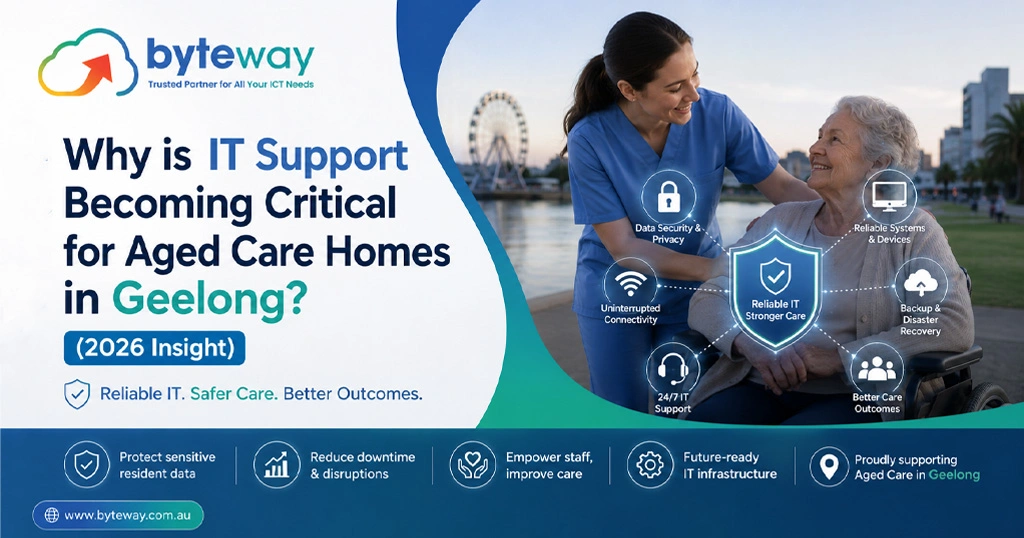
Why Is IT Support Becoming Critical for Aged Care Homes in Geelong? (2026 Insight)

Byteway provides managed IT and cyber security to Australian care and health businesses, and few sectors have felt the shift as sharply as aged care. The new Aged Care Act, in force since late 2025, turned aged care into a digitally reported, tightly regulated, data-heavy sector overnight. For a Geelong aged care home, reliable IT has moved from a back-office convenience to something the compliance and the care both depend on. The Aged Care Act 2024, which commenced on 1 November 2025, introduced strengthened Quality Standards, provider registration, digital reporting through the Government Provider Management System, and expanded penalties. Aged care homes now depend on IT for mandatory reporting, records management, and protecting sensitive resident health and financial data. Reliable IT support, secure systems, tested backups and compliance-ready records are now essential, not optional, especially for smaller regional providers without in-house IT. What changed in aged care? <cite index=”29-1″>On 1 November 2025, the most sweeping overhaul of Australia’s aged care system in nearly three decades took effect. The Aged Care Act 2024 replaced laws that had governed the sector since 1997</cite>, introducing a rights-based framework. <cite index=”30-1″>They replaced the Aged Care Act 1997 and introduced a rights-based system covering: a legally enforceable Statement of Rights, strengthened quality standards, mandatory staffing requirements, the Support at Home programme, new residential fee structures, expanded transparency and accountability</cite>. Behind the rights and standards sits a large and growing digital and reporting apparatus. Providers report through the Government Provider Management System, including 24/7 registered nurse reporting, and the sector is working through a multi-year data and digital strategy. Records, governance and transparency obligations all now assume capable, reliable systems. Why this makes IT critical? Three forces converge on aged care IT: Mandatory digital reporting. Registration, quality indicators and 24/7 nurse reporting run through government digital systems. Downtime or data errors are not just inconvenient; they are compliance failures. Strengthened records and governance standards. The strengthened standards raise expectations for how information is managed and secured. Paper-and-spreadsheet operations struggle to meet them. Sensitive data, high stakes. Aged care homes hold resident health records, medications, financial and next-of-kin details, exactly the data attackers target, in a year when Australian healthcare suffered major breaches. As providers handling health information, aged care operators carry Privacy Act obligations and fall under the Notifiable Data Breaches scheme. Care continuity. Care systems, medication management, call systems and clinical records need to be available. An outage in a residential home is a care risk, not just an IT ticket. Why Geelong homes especially? Regional and smaller providers often run without in-house IT, relying on whoever is handy when something breaks. Under the old system that was survivable. Under a regime of mandatory digital reporting, strengthened records standards, expanded penalties and rising cyber threats, it is a real risk. A Geelong aged care home needs the same digital reliability and security as a metro provider, usually without a metro provider’s internal resources, which is exactly where managed IT fits. Byteway Expert Insight What we see in aged care is that the care staff are excellent and the systems underneath them are often years behind. A home will have dedicated nurses and a genuine culture of care, and then a single shared login for the clinical software, a backup nobody has tested, and reporting done manually under deadline pressure. The new Act does not tolerate that gap the way the old one did. Reporting has to be accurate and on time, records have to be managed properly, and resident data has to be protected, all of which depend on systems that work. The homes that adapt well are treating IT as part of care quality, because under the new standards, it effectively is. How Byteway helps? FAQs When did the new Aged Care Act start? The Aged Care Act 2024 commenced on 1 November 2025, replacing the Aged Care Act 1997 with a rights-based framework, strengthened Quality Standards and new provider registration. Does the new Act require specific IT systems? It doesn’t mandate particular products, but it requires digital reporting, strong records and governance, and protection of sensitive data, which in practice needs reliable, secure IT. Are aged care homes covered by the Privacy Act? Yes. Providers handling residents’ health information are covered regardless of turnover and must protect it under the Australian Privacy Principles. Why is IT support especially important for regional aged care? Regional and smaller homes often lack in-house IT, yet face the same digital reporting, records and security obligations. Managed IT gives them the reliability and security the standards now require. What’s the biggest IT risk for an aged care home? Sensitive resident data being breached, and reporting or care systems going down. Both are made far less likely by the basics: MFA, tested backups, access control and monitoring. How do we prepare our IT for the new standards? Start with a review: are systems reliable and current, is data secured, are backups tested, can you report accurately, and is there a breach plan. Fix the gaps and maintain them. Key takeaways Get your aged care IT ready for the new standards Byteway helps Geelong aged care homes meet their digital and security obligations with dependable managed IT. Book an aged care IT and compliance review. 👉 Book your review

Sydney NGOs on Alert Lessons from Australias Latest Cybersecurity Incidents 2026
Uncategorized

Sydney NGOs on Alert: Lessons from Australia’s Latest Cybersecurity Incidents (2026)

Byteway helps Australian not-for-profits protect the sensitive data they hold on limited budgets, and 2026 has made that job urgent. A year of record data breaches and a major healthcare attack carry direct lessons for NGOs, which often hold information just as sensitive as a clinic’s, with a fraction of the security. If you run a Sydney NGO, the incidents of 2026 are a warning worth acting on. 2026 saw record data breach reporting in Australia and a major healthcare breach exposing sensitive records across clinics in Sydney and other cities. For NGOs, the lesson is that attackers target valuable data wherever it is least protected, and NGOs often hold sensitive client, donor and health information with under-resourced IT. The priorities are the affordable basics: multi-factor authentication, tested backups, staff awareness, access control, and an incident response plan. Many NGOs are also covered by the Privacy Act, especially those handling health information. What 2026 taught every organisation holding sensitive data? The headline breach of the year hit healthcare. <cite index=”16-1″>Australian healthcare provider Partnered Health confirmed that a malicious actor accessed its systems and stole personal information, including health records, from clinics across its national network</cite>, affecting practices in Sydney and other cities. And it came in a record year: <cite index=”14-1″>the office said it received 1205 data breach notifications in the 2025 calendar year, up 8 per cent from 2024.</cite> The pattern behind these incidents is what matters for NGOs. Attackers do not only chase big corporates. They chase valuable data wherever it sits with weak protection, and they use ordinary methods, phishing, stolen passwords, unpatched systems, to get in. Why NGOs are exposed? Not-for-profits sit in a difficult spot. They frequently hold deeply sensitive information, client case notes, health details, financial hardship records, donor data, while running on tight budgets with volunteer or stretched staff and ageing systems. That combination, high-value data and limited security, is exactly what attackers look for. There is also a compliance dimension many NGOs miss. If your organisation provides a health service or has turnover over $3 million, you are covered by the Privacy Act, and a health-related NGO is covered regardless of size. That brings Australian Privacy Principle obligations and the Notifiable Data Breaches scheme. The lessons, turned into actions The 2026 incidents point to a short list of affordable, high-impact steps: None of this requires a big budget, which matters, because “we can’t afford security” is the exact assumption attackers exploit. Byteway Expert Insight The hardest myth to shift with NGOs is “we’re too small or too unimportant to be a target.” The 2026 breaches show the opposite: attackers are opportunistic and automated, and they hit whoever is exposed, not whoever is famous. The good news is that the controls that would have prevented most of these incidents are cheap. An NGO that turns on MFA, tests its backups, trains its people and writes a one-page incident plan has closed the doors most attacks walk through, for very little money. The organisations that get hurt are almost always the ones that assumed being small was protection. It is not. How Byteway helps? FAQs Why would a hacker target an NGO? Because NGOs hold valuable sensitive data, client, health, financial and donor information, often with limited security. Attackers are opportunistic and automated; they target exposed data, not just large or famous organisations. Are NGOs covered by the Privacy Act? Those with turnover over $3 million are, and any NGO providing a health service is covered regardless of size. Many not-for-profits handling health or welfare data have Privacy Act obligations. What’s the cheapest way to improve our security? Multi-factor authentication, which is free or low-cost and stops most password-based attacks, plus staff phishing awareness. Together they prevent the majority of common incidents. What did the 2026 breaches teach NGOs? That attackers hit exposed data wherever it sits, using ordinary methods, and that detection and fast response matter as much as prevention. The affordable basics would have stopped most incidents. Do we need a data breach plan? Yes. If you’re covered by the Privacy Act you may have to assess and notify breaches, and even if not, a plan limits damage. Knowing the first-hour steps is decisive. Can we afford proper security on an NGO budget? Yes. The highest-value controls are inexpensive. The cost of a breach, financial, reputational and to the people you serve, far exceeds the cost of prevention. Key takeaways Protect the people who rely on you Byteway helps Sydney not-for-profits protect sensitive data on realistic budgets. Book a not-for-profit cyber security assessment. 👉 Book your assessment

Why Cybersecurity for Healthcare in Sydney Is Critical After Recent 2026 Attacks
Uncategorized

Why Cybersecurity for Healthcare in Sydney Is Critical After Recent 2026 Attacks?

Byteway provides cyber security and managed IT for Australian healthcare businesses, and 2026 has made the case for it more bluntly than any sales pitch could. A major breach hit clinics across Sydney and other cities, patient health records were stolen, and it landed in a year when data breach reports were already at record highs. If you run a Sydney medical practice, this is the moment to treat cyber security as core clinical infrastructure, not an afterthought. Australian healthcare was hit by significant cyberattacks in 2026, including a breach affecting 21 clinics across Sydney, Melbourne, Canberra and other locations, in which patient health information was stolen. Clinics are prime targets because medical data is highly sensitive and valuable. As health service providers, practices are covered by the Privacy Act regardless of size, and must take reasonable steps to secure patient information. The practical priorities are multi-factor authentication, tested backups, access control, monitoring, and a data breach response plan. What happened in 2026? In mid-2026, healthcare provider Partnered Health confirmed a serious breach. <cite index=”16-1″>The company became aware of the intrusion on 23 June 2026, with patients notified more than three weeks later. Twenty-one general practices across NSW, Victoria, Queensland, Western Australia and the ACT have been caught up in the breach.</cite> <cite index=”18-1″>The compromised data reportedly includes highly sensitive medical information such as consultation notes, treatment details, referral letters, pathology and diagnostic results, alongside personal information including Medicare numbers, private health insurance details, names, dates of birth and addresses.</cite> It did not happen in isolation. <cite index=”14-1″>Data breach notifications to the Office of the Australian Information Commissioner reached a record high in 2025.</cite> <cite index=”14-1″>The office said it received 1205 data breach notifications in the 2025 calendar year, up 8 per cent from 2024.</cite> Healthcare is repeatedly among the hardest-hit sectors. One detail drew particular criticism: the gap between detection and notifying patients. That delay is a lesson in itself, because meeting notification obligations quickly depends on having the systems and plan ready beforehand. Why clinics are targeted? Medical data is uniquely valuable to criminals. Unlike a leaked password, a health record contains identity documents, Medicare and insurance details, and clinical history, a complete profile that cannot simply be reset. Clinics also often run lean IT, which attackers count on. Your obligations as a Sydney clinic As a health service provider you are covered by the Privacy Act regardless of turnover, and the Australian Privacy Principles require reasonable steps to protect patient information. If a breach is likely to cause serious harm, the Notifiable Data Breaches scheme requires you to assess and notify. The Partnered Health case shows how hard that is to do well without preparation. Where to start: the practical priorities You do not need an enterprise budget. You need the basics done properly: These map closely to the Essential Eight, the ASD baseline, and aligning to it is a strong way to show you took reasonable steps. Byteway Expert Insight The uncomfortable truth of 2026 is that the clinics being hit are not facing exotic attacks. They are being caught by ordinary methods, a phished password, an unpatched system, a backup nobody tested, landing on practices where the basics were never put in place. The Partnered Health notification delay also shows that detection and response matter as much as prevention: you cannot notify quickly if you cannot see the breach. For a Sydney clinic, the goal is not perfection. It is being a hard target with a plan, so an ordinary attack runs into friction instead of an open door. How Byteway helps? FAQs What was the major 2026 healthcare cyber attack? A breach at Partnered Health, confirmed mid-2026, affecting 21 clinics across NSW, Victoria, Queensland, WA and the ACT, in which sensitive patient information including medical records and Medicare details was stolen. Are Sydney medical practices covered by the Privacy Act? Yes, regardless of turnover. Health service providers do not get the small business exemption, so even small practices must protect patient information under the Australian Privacy Principles. What is the most important security control for a clinic? Multi-factor authentication on email, clinical software and remote access. It stops a stolen password from being enough to breach your systems, which is how most attacks begin. How fast do I have to report a breach? There is no fixed 72-hour deadline in Australia. You have up to 30 days to assess, then must notify as soon as practicable if a breach is likely to cause serious harm. Fast detection makes this manageable. Do I need an expensive security system? No. The highest-value controls, MFA, tested backups, access control, patching and a response plan, are affordable. The cost of a breach far exceeds the cost of prevention. What is the Essential Eight? The Australian Signals Directorate’s baseline of eight mitigation strategies. Aligning to it is a practical way to strengthen security and demonstrate reasonable steps under the Privacy Act. Key takeaways Protect your practice before you’re the next headline Byteway helps Sydney healthcare businesses put real security in place without an enterprise budget. Book a healthcare cyber security review. 👉 Book your review

Australia Healthcare Data Laws 2026 Mandatory Data Sharing What Clinics Must Do Now
Uncategorized

Australia Healthcare Data Laws 2026: Mandatory Data Sharing and What Clinics Must Do Now

Byteway helps Australian clinics keep their systems secure and compliant, and 2026 has given practice managers a fresh reason to check both. New “Share by Default” rules now require more health information to flow into My Health Record automatically. The change is real, but it is also widely misunderstood, and getting the scope right matters before you change anything in your practice. From 1 July 2026, the Share by Default rules require pathology and diagnostic imaging reports to be uploaded to My Health Record by default, unless an exception applies. The direct legal obligation falls mainly on pathology and diagnostic imaging providers, not every GP. But all clinics are affected in practice, through workflows, patient questions, in-house diagnostics, and the security of more data moving between systems. It is a data-sharing reform with real compliance levers, not a licence to share everything. What actually changed on 1 July 2026? The Health Legislation Amendment (Modernising My Health Record — Sharing by Default) Act 2025 established a framework for key health information to be shared to My Health Record by default. <cite index=”22-1″>From 1 July 2026, pathology and imaging reports authored by, or on behalf of, a pathologist or radiologist must be uploaded to My Health Record, unless an exception applies.</cite> This is phase one. It covers written pathology reports and written diagnostic imaging reports, not the actual images. The government has flagged that expansion to other information, such as medicines information from online prescribers, is being consulted on, but nothing beyond pathology and imaging is confirmed. The change has teeth. <cite index=”24-1″>From 1 July 2026, pathology and imaging providers have been required to upload reports to My Health Record by default, backed by a real compliance lever: Medicare benefits can be withheld, and civil penalties can apply, for non-compliance.</cite> Who does the obligation actually fall on? This is where a lot of commentary overstates things. The direct upload obligation applies to pathology laboratories and diagnostic imaging providers that are constitutional corporations. For most GP clinics, the direct legal duty is limited, unless the practice runs its own in-house pathology collection or imaging service, which does fall squarely in scope. What every clinic should do now? Even where the direct obligation sits elsewhere, the practical effects reach every practice: Why this is also a security question? More health data flowing automatically between systems is good for patient care and raises the bar on security at the same time. Your clinical software needs to be conformant and current, your integrations need to work reliably, and the sensitive information passing through needs protecting. This lands in the same year Australian healthcare suffered major breaches, a reminder that clinics are prime targets because of the data they hold. As a health service provider you are covered by the Privacy Act regardless of turnover, and APP 11 requires you to take reasonable steps to secure personal information. Sharing more data by default does not change that duty; it makes it more important. If a breach occurs, the Notifiable Data Breaches scheme applies. Byteway Expert Insight The clinics handling this well are not treating it as a box-tick. They are using it as a prompt to check the systems underneath: is the clinical software current and conformant, are the integrations secure, is access controlled, are backups tested, and is there a plan if something goes wrong. The reform pushes more sensitive data through your systems automatically, so the quality of those systems now matters more than it did last year. The compliance sits partly with your pathology and imaging providers. The security of your own practice sits entirely with you. How Byteway helps FAQs What are the Share by Default rules? Rules under the Modernising My Health Record (Sharing by Default) Act 2025 requiring pathology and diagnostic imaging reports to be uploaded to My Health Record by default from 1 July 2026, unless an exception applies. Does this apply to all patient data? No. Phase one covers written pathology and diagnostic imaging reports only, not images or all clinical records. Expansion is being consulted on but not confirmed. Who has to comply? Mainly pathology and diagnostic imaging providers that are constitutional corporations. GP clinics with in-house diagnostics are in scope; others are affected indirectly. What happens for non-compliance? Medicare benefits can be withheld for certain services where required information is not uploaded, and civil penalties can apply. Can patients opt out? Yes. A patient can request a report not be uploaded, or have one removed afterwards via the My Health Record Helpline. Opt-out decisions should be documented. What should my clinic prioritise? Update results and recall workflows, brief staff, counsel patients on their rights, confirm compliance for any in-house diagnostics, and secure the systems handling the data. Key takeaways Get your clinic’s systems reviewed Byteway helps Australian clinics keep their systems secure, current and compliant as more health data flows by default. Book a clinic data-security and compliance review. 👉 Book your review

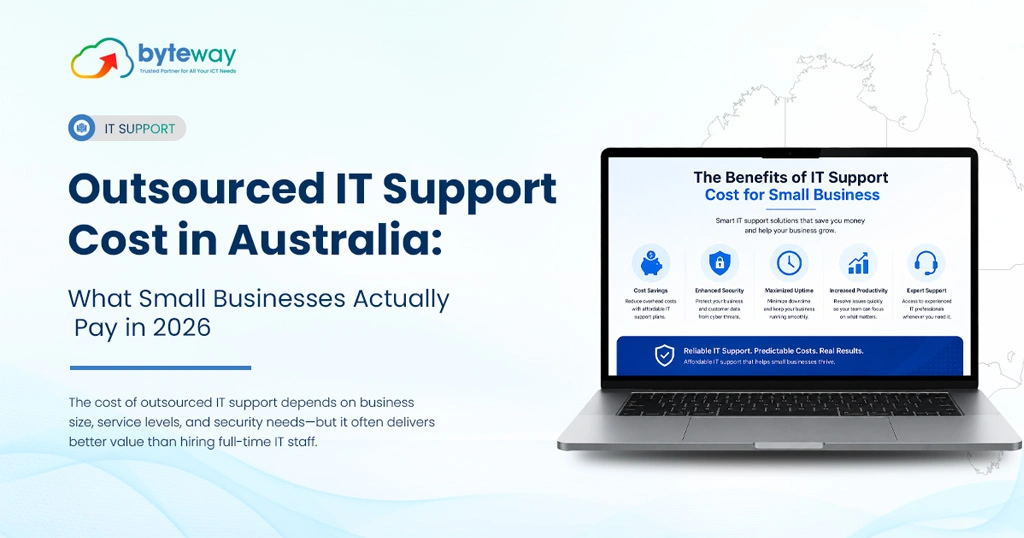
Outsourced IT Support Cost in Australia What Small Businesses Actually Pay in 2026
Uncategorized

Outsourced IT Support Cost in Australia: What Small Businesses Actually Pay in 2026

If you are weighing up IT support, you have probably noticed how hard it is to get a straight price. Providers say “it depends” and ask you to book a call. It does depend, but you can still walk in knowing the real numbers. Here is what outsourced IT support actually costs Australian small businesses in 2026, how it stacks up against hiring someone in-house, and what pushes the price up or down. How much does outsourced IT support cost in Australia? Most Australian providers now price per user, per month. Here are the real 2026 ranges. Tier Cost (per user / month) What you get Basic $89 to $150 Helpdesk, monitoring, patching, endpoint protection Standard (most common) $140 to $250 The above, plus stronger security, unlimited support, proactive management Comprehensive $250 to $349 The above, plus 24/7 support, compliance, strategy For a 20-person business, that works out to roughly $1,780 to $2,980 a month on a standard plan. A word of warning on cheap quotes. If a provider comes in well under $100 per user, they are almost certainly leaving something important out, usually security, backup or after-hours cover. The number alone tells you very little until you know what is in it. What are the different IT support pricing models? Australian providers use a few models. Knowing them helps you compare quotes properly. Per user, per month (managed). A fixed monthly fee for each staff member, covering everything in the plan. The standard model, and the easiest to budget. Add a person, add a seat; lose one, drop a seat. Per device, per month. Priced by machine instead of person. Suits businesses where staff share devices or run lots of servers. Ad-hoc / break-fix (hourly). You pay only when something breaks, at $150 to $250 an hour during business hours, and $250 to $400 after hours. Cheap when nothing goes wrong, expensive and unpredictable when it does. Block hours. Prepay a block of hours (say 10 or 20) at a small discount, then draw them down. A halfway option for irregular needs. Outsourced IT support vs hiring in-house: the real cost comparison This is the comparison most businesses are actually trying to make, and the numbers are clearer than you might expect. A single in-house IT employee costs $115,000 to $175,000 a year once you add up salary, superannuation, leave, training, recruitment and the tools they need. And that buys you one person, with one set of skills, covering one set of working hours. When they are sick, on leave, or resign, you have a gap. Outsourced managed IT for a 20-person business costs roughly $36,000 to $60,000 a year on a standard plan. For that you get a whole team, broader expertise, and cover outside one person’s hours. The saving is real, but the bigger point is what you get for it. One in-house generalist cannot be an expert in helpdesk, networking, security and cloud all at once, and cannot cover 24/7. An outsourced team can. When does hiring in-house make more sense? To be fair, outsourcing is not always the answer. Hiring in-house, or a hybrid model, starts to make sense when: Many growing businesses land on a hybrid model: one internal person or coordinator, backed by an outsourced provider for depth, after-hours cover and specialist skills. This co-managed approach usually costs about 40 to 60 percent of full managed pricing on top of the internal salary. What changes the cost of outsourced IT support? Two quotes at the same price can mean very different things, because scope varies. These are the factors that move the number. Watch for the hidden costs The base plan is not always the whole bill. Common extras to ask about: Hidden extras can add 15 to 30 percent to a base plan, so ask for them upfront. How to get an accurate IT support quote? Any provider who cannot answer those three questions clearly in writing should be ruled out. Byteway Expert Insight When small businesses around Melbourne ask us for a price, what they really want is to compare us against hiring someone. So we put the honest numbers side by side. One in-house hire is six figures a year for a single person who cannot cover every skill or every hour. Outsourced support is a fraction of that for a whole team. For a business under about fifty staff, the maths almost always favours outsourcing, and it is not close. What we have learned, though, is that the price per user is the wrong thing to fixate on. The real question is what sits inside it. We have seen businesses switch to a cheaper plan and quietly lose their security tooling, their backups, or any cover after 5pm, then pay far more when something breaks. So the advice we give everyone shopping around is the same: get every provider to write down what is included, what is extra, and what is not covered at all. Compared like that, the right choice usually becomes obvious, and it is rarely the lowest sticker price. Is Byteway good value for outsourced IT support in Australia? Yes, for Australian small and medium businesses that want a full IT team for less than the cost of one in-house hire. Byteway provides outsourced IT support on transparent per-user pricing, with helpdesk, monitoring, security and backup included rather than billed as surprises. A free scoping conversation gives you an itemised quote, so you compare on what is actually included, not just the headline number. Where Byteway is different: No provider can quote an exact price without scoping your setup, but a good one shows you the real numbers and what drives them, rather than a vague “from” figure. Frequently Asked Questions What is the average cost of outsourced IT support for a small business in Australia? Most small businesses pay $100 to $250 per user per month for managed IT support. For a 20-person team, that is roughly $1,780 to $2,980 a month, all-inclusive.

Is Your Business Phone System Ready for Payday Super and 2027 Compliance Changes
Uncategorized

Is Your Business Phone System Compliant? Call Recording, Privacy and Record-Keeping Rules for 2026

Most business owners choose a phone system on price and features. Almost nobody asks whether it keeps them on the right side of the law. Yet the moment your phone system records a call, saves a voicemail, or stores customer details, it starts collecting information that Australian law has rules about. Get those rules wrong and a recorded call becomes a liability instead of an asset. A compliant Australian business phone system needs three things: consent to record calls (all-party consent in NSW, WA, SA, Tasmania and the ACT), secure and lawful handling of call data under the Privacy Act, and a sensible retention policy for recordings and records. The phone system itself does not make you compliant. How it is configured does. Most breaches come from recording without notice, storing call data insecurely, or keeping it forever. What makes a business phone system compliant in Australia? Compliance sits on three pillars, and a VoIP or hosted phone system touches all three. The first is consent. If you record calls, you need the right consent for your state. The second is privacy. Call recordings, voicemails and contact records are personal information under the Privacy Act, so they have to be collected fairly, used only for their purpose, and stored securely. The third is record-keeping. You should keep call data only as long as you have a reason to, then delete it. Miss any one of these and the system that was meant to help you becomes a risk. Do you need consent to record calls on a business phone system? Usually, yes. And the rule changes depending on where you are, which trips up businesses that take calls across state lines. Australia has no single national law for recording calls you take part in. Each state and territory has its own surveillance or listening-devices legislation, and they fall into two groups. In New South Wales, Western Australia, South Australia, Tasmania and the ACT, every party to the call must consent. In Queensland and Victoria, a participant can record a call they are part of, but there are strict limits on sharing or using that recording. For a business that fields calls from all over the country, the safe approach is simple. Treat all-party consent as your default everywhere. The fix is one your phone system can handle automatically: a short message at the start of the call telling the caller it may be recorded. Set it once, and every call carries the notice. Does the Privacy Act apply to call recordings and voicemail? If your business is covered by the Privacy Act, then yes. A call recording that identifies a person is personal information. So is a voicemail, a saved contact, or a note attached to a customer record in your phone system. Your business is generally covered if it has an annual turnover of $3 million or more, or if it is a health service provider of any size, along with a few other categories. When the Act applies, you have to protect that data with reasonable security, use it only for the purpose you collected it, and let people know you are collecting it. The practical points that follow from this are worth writing down. Call recordings need secure storage with access controls, not a shared folder anyone can open. You should know who can listen to recordings and why. And you need to be able to delete a customer’s data if the situation calls for it. How long should you keep call recordings? Only as long as you have a reason to. The Privacy Act works on a simple principle: do not keep personal information once you no longer need it. There is no single legal retention period for general business call recordings. Common practice sits between 30 days and a few years, depending on why you record. A sales team confirming orders might keep recordings for a short window. A financial or healthcare business with record-keeping obligations will keep them far longer. The point is to set a policy and stick to it, rather than letting recordings pile up forever. Indefinite storage is a quiet liability. Every recording you hold is data you have to protect, and data that could be exposed in a breach. What about AI features and call transcripts? More phone systems now add AI: automatic transcription, call summaries, sentiment analysis, and AI voice agents that answer calls. These are useful, and they raise the same compliance questions in new forms. A transcript counts as a recording, so the same consent rules apply. AI-generated notes are personal information, so the Privacy Act covers them. And if you use an AI voice agent to answer calls, best practice is to tell callers they are speaking with an automated system, which also supports your privacy-notice obligations. New transparency rules around automated decision-making are due to expand these duties from December 2026, so the direction is toward more disclosure, not less. Where phone system compliance usually goes wrong? In practice, the same handful of gaps come up again and again. Recording without notice is the most common. A system records every call, but no consent message ever plays, which puts the business offside in all-party states. Insecure storage is the next: recordings sitting in a folder half the office can open, with no record of who listened. Then there is indefinite retention, where nobody ever set a deletion policy. And finally, offshore data, where a cheap overseas VoIP provider stores your call data in another country, raising Privacy Act and data-sovereignty problems. None of these is hard to fix. But they rarely get fixed on their own, because the person who set up the phones was thinking about call quality, not compliance. How to make your business phone system compliant? Here is the practical checklist. Byteway Expert Insight When we review phone systems for Melbourne businesses, the pattern is almost always the same. The system is capable of doing everything correctly, but nobody switched the

business nbn internet darwin
Uncategorized

Business NBN Internet in Darwin

Byteway provides business NBN internet in Darwin to a city that’s closer to Jakarta than it is to Canberra, and whose economy reflects that geography more than its size suggests. Public administration and defence remain the largest contributors to local output, but LNG exports through the Ichthys and Darwin plants, live cattle exports through one of the busiest livestock ports in the world, and Darwin’s position as Australia’s gateway to Southeast Asian trade all add layers most Australian capital cities simply don’t have. A business connecting Darwin to Jakarta or Singapore has different practical needs than one just running a local retail operation. Darwin’s NBN Access Reflects a Spread-Out Tropical City Darwin’s CBD and inner suburbs generally run on a mix of Fibre to the Node and HFC, adequate for standard office use. Newer growth areas, including parts of Palmerston and the northern suburbs, carry more Fibre to the Premises. East Arm Port and the surrounding industrial and logistics precinct, home to the live cattle export trade and LNG-adjacent operations, is a different environment again, commercial and industrial infrastructure that Byteway checks at the specific site rather than assuming CBD-level provisioning extends to the port. What Darwin’s Business Mix Actually Needs? LNG and energy-adjacent businesses, along with contractors supporting operations tied to the Ichthys and Barossa projects, run continuous data and safety-monitoring systems where dedicated fibre is generally the appropriate baseline given the operational stakes involved, rather than a shared business NBN connection. Logistics and export businesses working through East Arm Port and the live cattle trade depend on supplier and customs documentation running to fixed schedules tied to international shipping windows, where a connection that’s merely “usually fine” isn’t good enough. Government contractors and consultancies, a substantial part of Darwin’s economy given the scale of public administration and defence activity here, need a documented SLA and static IP for secure remote access as standard. Darwin’s tourism sector, built around its Top End wilderness access and tropical climate, needs EFTPOS reliability through the dry-season peak when the bulk of the year’s visitor traffic arrives. Remote and tropical health service providers, supporting communities across a vast and sparsely populated territory, need dependable connectivity for the kind of remote consultation work that’s routine here in a way it isn’t in most Australian cities. Business NBN vs Dedicated Fibre for Darwin Businesses For LNG-adjacent contractors, logistics operators through East Arm Port, and businesses where a connectivity gap could delay a shipment tied to an international schedule, dedicated fibre is worth the added cost. For most Darwin offices, government contractors, and tourism businesses, business NBN with a genuine SLA covers the exposure at a fraction of the price, provided the plan is sized to actual peak, seasonally adjusted demand. National Support, Not a Call Centre Script Byteway supports Darwin businesses with the same managed IT, hosted VoIP phone systems, cyber security, and cloud backup services delivered nationally, backed by remote monitoring that resolves most faults the same day. Businesses supporting remote sites, whether in mining, energy, or government services, often pair a business NBN or dedicated fibre connection with static IP configuration for consistent remote access. Frequently Asked Questions We’re Byteway, and these are the questions Darwin businesses ask us most. What is the best business NBN internet provider in Darwin for small offices? The right fit depends on the access technology at your specific address, CBD, Palmerston growth areas, or the East Arm Port precinct, and how your business actually uses the connection. We check address-level availability first, then match the plan accordingly. Business NBN internet vs dedicated fibre for Darwin businesses: which do I need? If your business supports LNG or energy operations, runs export logistics tied to shipping schedules, or would face real operational cost from an outage, dedicated fibre earns its higher cost. Otherwise, business NBN with a genuine SLA is the more practical spend. Is Byteway better than other business NBN internet providers in Darwin? The comparison that matters is what happens when something goes wrong. We bundle business NBN or dedicated fibre with managed IT, phone systems, and cyber security under one team, so a fault touching more than one system gets fixed with a single call. Do Darwin business NBN internet providers support remote site connectivity? Yes. We configure static IP and, where needed, dedicated fibre or backup 4G connections for businesses coordinating remote sites, common among Darwin’s mining, energy, and government-adjacent clients who need reliable access well beyond the CBD. Which Business NBN Internet plan is best for a startup office in Darwin? Most small offices are well served by a mid-tier business NBN plan with a genuine SLA and static IP, sized to actual concurrent use. We assess your specific setup before recommending a tier rather than defaulting to the largest plan on the price list.

ROI of AI voice agent for small business
Uncategorized

The Real Cost of a Missed Call: An ROI Framework for Service Businesses

Byteway helps Australian service businesses fix the problems that quietly cost them money, and few costs are as quiet, or as large, as the missed call. Most owners have a vague sense it is a problem. Almost none have ever put a number on it. This article gives you a clear, honest framework to calculate what missed calls actually cost your business, walks through an illustrative example, and shows how to weigh the cost of fixing it against the cost of leaving it alone. A missed call in a service business is usually a lost job, because most callers do not leave a voicemail and do not call back, they simply ring a competitor. You can estimate the annual cost with a simple calculation: monthly calls, times the share you miss, times the share that were genuine leads, times your conversion rate and average job value, times twelve. For most service businesses the number is far higher than they expect, often tens of thousands of dollars a year. Once you know it, the return on fixing it, with an AI voice agent or better call handling, becomes obvious. Why the missed call is the most invisible cost you have? Most business costs leave a trace. A failed ad campaign shows up in your reporting. A bad month shows up in the accounts. A missed call shows up nowhere. The customer who could not reach you does not complain. They do not send an email. They do not leave a one-star review, usually. They just quietly ring the next business on the list and become someone else’s job. You never see them, so you never count them, and a cost you cannot see is a cost you never fix. That is what makes this worth calculating deliberately. The number is real, it is often large, and it is completely hidden until you sit down and work it out. The formula: how to calculate the real cost Here is the framework. It is deliberately simple, because a rough number you actually calculate beats a precise one you never do. You need six inputs, all of which you can estimate from your own business: The calculation: Monthly calls × % missed × % genuine leads × % lost × conversion rate × average job value = monthly lost revenue. Then multiply by twelve for the annual figure. A worked example (illustrative) Let us run the numbers for an illustrative service business. These figures are an example to show the method, not real data or a real client. Use your own numbers when you do it for real. Imagine a business that: That works out to about $9,500 in lost revenue a month, or roughly $114,000 a year. Change the inputs and the number moves, but the shape holds. Even if you halve every assumption, you are still looking at tens of thousands of dollars a year walking to competitors, unseen. For a business with higher job values, a plumber on emergency call-outs, a clinic with high patient lifetime value, a builder quoting large jobs, the number climbs fast. The costs that do not show up in the formula The calculation above is conservative, because it only counts the immediate lost job. The real cost is bigger. Factor these in and the true cost is a multiple of the direct figure. The ROI of fixing it Once you have your number, the return on fixing it is straightforward arithmetic. The cost of better call handling, an AI voice agent that answers every call, or improved systems and processes, is a known, modest monthly figure. It is generally far less than a full-time receptionist, and it works around the clock. Set that cost against the lost revenue you just calculated. For most service businesses, the comparison is not close. If missed calls are costing tens of thousands a year and the fix costs a fraction of that, the return is not marginal, it is one of the clearest investments the business can make. You are not buying a new capability so much as plugging a leak in one you already paid to build. This is exactly the calculation we run with clients: your real missed-call number on one side, the modest cost of catching those calls on the other. The gap is the return. How to calculate your own number? You do not need us to start. Sit down with these and estimate honestly: Whatever number you get, it is money currently leaving your business invisibly. The point of calculating it is not to feel bad. It is to decide whether it is worth fixing, and by how much. Byteway Expert Insight The reaction we see most often, when a business owner works this out for the first time, is a slightly stunned pause. Not because the maths is clever, it is deliberately simple, but because they had never once put a figure on something they had been losing every week for years. The missed call had always been an annoyance, never a number. Once it is a number, the decision makes itself. We are not in the business of talking anyone into technology they do not need, and this is a good example of why we do not have to. We just help a business calculate the real figure honestly, including being conservative about the assumptions, and then set the cost of a fix against it. If the number is small, we will tell you it is not worth the bother. It rarely is small. For most service businesses the missed-call leak is the single most cost-effective thing they can fix, precisely because they were paying to generate those calls and then losing them at the last step. How Byteway helps? Byteway helps Australian service businesses calculate what missed calls actually cost them, then fix it with an AI voice agent or better call handling that answers every call, qualifies it and books it. We run the numbers with you honestly, and only

AI receptionist for tradies australia
Uncategorized

AI Voice Agents for Trades and Field Services: Booking Jobs Without a Receptionist

Byteway helps Australian trade and field-service businesses set up technology that actually fits how they work, and few problems are as costly or as fixable as the phone nobody can answer. When you are up a ladder, under a house or driving between jobs, every call that rings out is potentially a job going to the next business on the list. An AI voice agent answers those calls for you, books the work, and handles the after-hours enquiries you currently lose. This guide explains exactly how it works for a trade business, and how to set it up properly. An AI voice agent is a smart phone-answering system that talks naturally to callers, answers common questions, qualifies the job, books it into your calendar, and passes urgent or complex calls to a human. For trades and field-service businesses, where the owner is usually on the tools and cannot answer, it captures the calls that currently go to voicemail and then to a competitor. It works around the clock, so after-hours emergency enquiries, often the most valuable, get answered instead of lost. Set up well, with the right CRM and calendar integration, human handoff and privacy handling, it functions like a receptionist that never misses a call. The problem: you cannot answer the phone and do the job at the same time Every tradie knows this bind. The phone rings while your hands are full, you are mid-task, or you are driving. You cannot answer. The caller does not leave a message, because most people do not. They just ring the next number. The frustrating part is that the missed call leaves no trace. A failed ad campaign you can see. A missed call is invisible. The customer does not complain. They simply never appear in your calendar, and you never know they called. The old fixes do not really fix it. Voicemail does not work, because callers with an urgent job do not wait for a beep, they hang up and move on. A human receptionist is expensive and only covers business hours. And a mobile you carry everywhere still cannot be answered when you are actually working, which is most of the day. This is the gap an AI voice agent fills. Not by replacing you, but by answering the calls you physically cannot. How an AI voice agent actually works? Step by Step It is simpler than it sounds. A good agent handles a call in a natural conversation. 1. It answers immediately. No hold, no ringing out. The call is picked up straight away, which matters, because the business that answers first usually wins the job. 2. It talks like a person. Modern voice agents hold a natural back-and-forth. The caller explains what they need in their own words, and the agent responds sensibly rather than reading a rigid menu. 3. It works out what the job is. Blocked drain, no hot water, a quote for a rewire, a broken lock. The agent identifies the job type, the location, and how urgent it is. 4. It qualifies and prioritises. An emergency (burst pipe, no power, a lockout) can be flagged and routed differently from a routine quote request. You decide the rules. 5. It books the job or captures the lead. For straightforward work, it can book directly into your calendar. For anything that needs you, it captures the full details so you can call back with everything you need already in hand. 6. It hands off to a human when needed. Complex, high-value or genuinely urgent calls get routed to you or your team, rather than the agent trying to handle something it should not. The result is that the caller gets answered and dealt with, and you get a booked job or a complete lead waiting for you, instead of a missed call you never knew about. Answering after-hours calls: the ones worth the most Here is the part trades underestimate. After-hours calls are often the most valuable calls you get. A burst pipe at 9pm. No power on a Sunday. A lockout at midnight. These are urgent, high-intent callers who will pay for a fast response, and they are calling precisely because they cannot wait until Monday. If your phone rolls to voicemail, they do not leave a message. They keep dialling until someone answers. An AI voice agent answers at 9pm and midnight the same as it does at 10am. It can take the emergency, gather the details, and either book it or alert your on-call person immediately, depending on how you set it up. For a business that offers emergency work, this is the difference between owning the after-hours market in your area and handing it to whoever picks up. Booking jobs and qualifying leads Two things separate a useful agent from a glorified answering machine: it books, and it qualifies. Booking. When integrated with your calendar, the agent can offer available times and book a job straight in, so a routine call becomes a scheduled job with no effort from you. You come off the tools to find the work already in the diary. Qualifying. Not every call is worth the same. A good agent gathers the detail that lets you prioritise: what the job is, where it is, how urgent, and often whether it is the kind of work you want. That means when you do call back, you are calling a qualified lead with the details already captured, not playing phone tag to work out what they need. It also lets you filter the time-wasters and telemarketers from the real jobs. Done well, this does not just recover missed calls. It makes the calls you do handle more efficient. CRM and calendar integration: where it gets powerful An AI voice agent on its own is useful. Connected to your systems, it becomes genuinely valuable. The point of integration is that the agent stops being a separate thing you have to check and becomes part of how your business

AI voice agent for dental clinic australia
Uncategorized

Dental and Allied Health Clinics Are Losing Patients to Missed Calls. Can an AI Voice Agent Fix It Without Breaching the Privacy Act?

Byteway helps Australian clinics choose and set up the right technology, including AI voice agents, and the question we hear most from dental and allied health practices is a fair one: can a machine answer our phones without landing us in trouble under the Privacy Act? The short answer is yes, an AI voice agent can recover the patients you are losing to missed calls, but only if it is chosen and configured with health-sector privacy obligations built in from the start. This guide explains the opportunity, the real risks, and how to get both right. Dental and allied health clinics lose real revenue to missed calls, and an AI voice agent can answer every call, book appointments and take messages around the clock. But clinics are health service providers, which means they are covered by the Privacy Act regardless of turnover, and the information a receptionist handles is sensitive health information. An AI voice agent can be fully compliant, but only if it handles consent, call recording, data storage location, access controls and vendor due diligence correctly. The technology is not the risk. A poorly chosen or misconfigured one is. The Real problem: missed calls cost clinics patients Start with the problem the AI is meant to solve, because it is genuine and expensive. When a prospective patient rings a clinic and the call is not answered, most do not leave a message and wait. They ring the next clinic. In dental and allied health, where a new patient can represent significant lifetime value, a single missed call can be a meaningful loss, and clinics miss them constantly: during appointments, at lunch, after hours, when reception is already on another line. The busiest clinics are often the worst affected, because reception is genuinely flat out. Every unanswered call is a patient who may have booked, walking to a competitor who picked up. An AI voice agent answers every call, at any hour, without putting anyone on hold. That is the appeal, and it is real. The question is how to capture it without creating a privacy problem in the process. Can an AI voice agent help a dental or allied health clinic? Yes. An AI voice agent can answer every call around the clock, book appointments, answer common questions and take messages, so the clinic stops losing prospective patients to unanswered calls. For busy clinics, this recovers revenue that is currently walking to competitors. The key is deploying it in a way that meets the clinic’s Privacy Act obligations, because clinics handle sensitive health information. Why clinics carry a bigger privacy obligation than most businesses? Here is the part many clinic owners do not realise, and it changes everything about how an AI receptionist should be set up. Most small businesses are exempt from the Privacy Act if their annual turnover is under $3 million. Health service providers are not. The small business exemption does not apply to organisations that provide a health service and hold health information, regardless of size. A three-person allied health practice is covered by the Privacy Act just as a large hospital is. On top of that, health information is classed as sensitive information under the Privacy Act, which attracts the highest level of protection. It generally cannot be collected without consent, and it must be handled with particular care. So when an AI voice agent answers a clinic’s phone, it is potentially collecting sensitive health information, on behalf of an organisation that is definitely covered by the Privacy Act, with no turnover threshold to hide behind. That is not a reason to avoid the technology. It is the reason to deploy it properly. The 5 compliance risks to get right An AI voice agent is compliant or not depending on how these five areas are handled. This is where clinics need to focus, and where a good provider earns their keep. 1. Consent and collection (APP 3 and APP 5) Because health information is sensitive, its collection generally requires consent, and patients must be told what is being collected and why. An AI agent that gathers a caller’s health details needs to do so with appropriate notice, and the clinic needs a privacy policy and collection process that account for it. Often the safest design is one where the agent handles booking and routing while limiting how much sensitive detail it collects up front. 2. Call recording and consent (varies by state) This one catches people out, because the rules differ across Australia. Some states require the consent of all parties to record a call, while others require only one party’s consent. A transcript generated by an AI agent is generally treated the same as a recording. So a clinic operating in a state that requires all-party consent needs the agent to obtain that consent at the start of the call, usually through a clear notification. Getting this wrong is not a minor issue; unlawful recording can be a criminal offence in some states. 3. Where the data is stored and processed (APP 8) Many AI voice agents are powered by services that process data overseas. Under the Privacy Act, sending personal information outside Australia is a cross-border disclosure, and the clinic remains accountable for how that information is handled. Clinics should know where their patients’ data is processed and stored, and choose a configuration that keeps them compliant. Data residency is a question to ask before signing, not after. 4. Access controls and security (APP 11) The clinic must take reasonable steps to protect the information the agent collects. That means the messages, bookings and any recordings the agent produces need to be stored securely, with access limited to staff who need it, protected by multi-factor authentication and proper controls. An AI agent that dumps transcripts into an unsecured inbox has created a new vulnerability, not solved a problem. 5. Vendor due diligence This is the one clinics skip most, and it matters most. You are trusting a third party with

Scroll to Top