

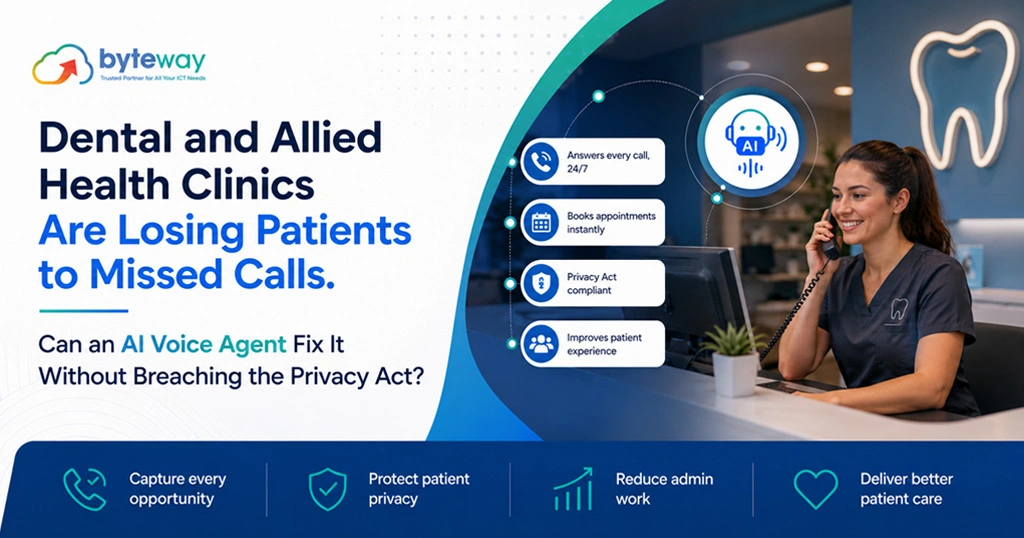
Byteway helps Australian clinics choose and set up the right technology, including AI voice agents, and the question we hear most from dental and allied health practices is a fair one: can a machine answer our phones without landing us in trouble under the Privacy Act? The short answer is yes, an AI voice agent can recover the patients you are losing to missed calls, but only if it is chosen and configured with health-sector privacy obligations built in from the start. This guide explains the opportunity, the real risks, and how to get both right.
Dental and allied health clinics lose real revenue to missed calls, and an AI voice agent can answer every call, book appointments and take messages around the clock. But clinics are health service providers, which means they are covered by the Privacy Act regardless of turnover, and the information a receptionist handles is sensitive health information. An AI voice agent can be fully compliant, but only if it handles consent, call recording, data storage location, access controls and vendor due diligence correctly. The technology is not the risk. A poorly chosen or misconfigured one is.
The Real problem: missed calls cost clinics patients
Start with the problem the AI is meant to solve, because it is genuine and expensive.
When a prospective patient rings a clinic and the call is not answered, most do not leave a message and wait. They ring the next clinic. In dental and allied health, where a new patient can represent significant lifetime value, a single missed call can be a meaningful loss, and clinics miss them constantly: during appointments, at lunch, after hours, when reception is already on another line.
The busiest clinics are often the worst affected, because reception is genuinely flat out. Every unanswered call is a patient who may have booked, walking to a competitor who picked up.
An AI voice agent answers every call, at any hour, without putting anyone on hold. That is the appeal, and it is real. The question is how to capture it without creating a privacy problem in the process.
Can an AI voice agent help a dental or allied health clinic?
Yes. An AI voice agent can answer every call around the clock, book appointments, answer common questions and take messages, so the clinic stops losing prospective patients to unanswered calls. For busy clinics, this recovers revenue that is currently walking to competitors. The key is deploying it in a way that meets the clinic’s Privacy Act obligations, because clinics handle sensitive health information.
Why clinics carry a bigger privacy obligation than most businesses?
Here is the part many clinic owners do not realise, and it changes everything about how an AI receptionist should be set up. Most small businesses are exempt from the Privacy Act if their annual turnover is under $3 million. Health service providers are not. The small business exemption does not apply to organisations that provide a health service and hold health information, regardless of size. A three-person allied health practice is covered by the Privacy Act just as a large hospital is.
On top of that, health information is classed as sensitive information under the Privacy Act, which attracts the highest level of protection. It generally cannot be collected without consent, and it must be handled with particular care.
So when an AI voice agent answers a clinic’s phone, it is potentially collecting sensitive health information, on behalf of an organisation that is definitely covered by the Privacy Act, with no turnover threshold to hide behind. That is not a reason to avoid the technology. It is the reason to deploy it properly.
The 5 compliance risks to get right
An AI voice agent is compliant or not depending on how these five areas are handled. This is where clinics need to focus, and where a good provider earns their keep.
1. Consent and collection (APP 3 and APP 5)
Because health information is sensitive, its collection generally requires consent, and patients must be told what is being collected and why. An AI agent that gathers a caller’s health details needs to do so with appropriate notice, and the clinic needs a privacy policy and collection process that account for it. Often the safest design is one where the agent handles booking and routing while limiting how much sensitive detail it collects up front.
2. Call recording and consent (varies by state)
This one catches people out, because the rules differ across Australia. Some states require the consent of all parties to record a call, while others require only one party’s consent. A transcript generated by an AI agent is generally treated the same as a recording. So a clinic operating in a state that requires all-party consent needs the agent to obtain that consent at the start of the call, usually through a clear notification. Getting this wrong is not a minor issue; unlawful recording can be a criminal offence in some states.
3. Where the data is stored and processed (APP 8)
Many AI voice agents are powered by services that process data overseas. Under the Privacy Act, sending personal information outside Australia is a cross-border disclosure, and the clinic remains accountable for how that information is handled. Clinics should know where their patients’ data is processed and stored, and choose a configuration that keeps them compliant. Data residency is a question to ask before signing, not after.
4. Access controls and security (APP 11)
The clinic must take reasonable steps to protect the information the agent collects. That means the messages, bookings and any recordings the agent produces need to be stored securely, with access limited to staff who need it, protected by multi-factor authentication and proper controls. An AI agent that dumps transcripts into an unsecured inbox has created a new vulnerability, not solved a problem.
5. Vendor due diligence
This is the one clinics skip most, and it matters most. You are trusting a third party with your patients’ sensitive information, so the vendor’s own practices become your risk. Before choosing an AI voice agent, a clinic should ask: where is data stored and processed, who can access it, is it used to train the vendor’s models, what security certifications do they hold, what happens to the data if we leave, and will they sign an agreement that reflects our Privacy Act obligations. A vendor who cannot answer these clearly is a vendor to avoid.
A note on the December 2026 automated decision-making rules
There is a new Privacy Act obligation worth knowing about, though it is often overstated. From 10 December 2026, APP entities must disclose in their privacy policy where they use a computer program to make, or substantially support, decisions that could significantly affect a person’s rights or interests.
For most AI receptionist tasks, booking an appointment, routing a call, taking a message, this is unlikely to be a “significant” decision of the kind the rule targets. But it is a reason for clinics to keep their privacy policy current and to understand what their AI tools actually do. If your agent starts doing something that materially affects patients, the disclosure obligation may apply. It is a transparency requirement, not a ban, and a good provider will help you stay on the right side of it. This sits alongside the broader Privacy Act obligations every clinic already has.
How to deploy an AI voice agent the right way
Putting it together, here is the sensible path for a clinic.
- Confirm your obligations. You are covered by the Privacy Act as a health provider. Start from there.
- Choose the vendor on due diligence, not just features. Data location, access, training use, security and contract terms come before the demo.
- Design the call flow for privacy. Limit unnecessary collection of sensitive detail, and build in the consent and recording notifications your state requires.
- Secure the outputs. Bookings, messages and transcripts stored securely, access controlled, MFA on.
- Update your privacy policy and collection process to reflect the AI agent, including the December 2026 transparency point where relevant.
- Keep a human path. Patients who need a person should be able to reach one. The agent should extend your reception, not wall it off.
Done this way, a clinic gets the missed-call recovery without the compliance exposure.
Byteway Expert Insight
The clinics that get into trouble with this are almost never the ones that thought carefully and decided against an AI agent. They are the ones that signed up for a slick consumer tool in an afternoon, pointed it at their phone line, and never asked where the data went. The technology worked. The compliance did not, and they did not find out until a patient asked an awkward question or a data issue surfaced.
Our approach with clinics is deliberately unexciting. We treat the AI voice agent as what it is: a system that will handle sensitive health information for a business that is fully covered by the Privacy Act. That means the due diligence happens before the deployment, the call flow is designed around consent and minimal collection, the data location is known and appropriate, and the outputs are secured. It takes a little longer than signing up to an app, and it is the difference between a tool that quietly recovers lost patients and one that quietly becomes a liability. The good news is that once it is set up properly, it just works, and the clinic stops losing calls.
How Byteway helps clinics get this right?
Byteway helps dental and allied health clinics choose, configure and manage an AI voice agent that recovers missed calls while meeting their Privacy Act obligations. That covers vendor due diligence, data residency, consent and call-recording setup, securing the outputs, and updating your privacy processes, so the technology helps your clinic without exposing it.
Where we fit:
- We assess whether an AI voice agent suits your clinic, and which option fits your obligations.
- We run the vendor due diligence: data location, access, training use, security and contract terms.
- We configure the call flow, consent and recording notifications for your state, and secure the outputs.
- We connect it to your phone system and your cyber security and compliance setup, so it is managed, not just installed.
We help you choose and run the right technology, not just buy a tool. For a clinic handling sensitive health information, that difference matters.
Frequently asked questions
Can an AI voice agent breach the Privacy Act?
It can if it is poorly chosen or misconfigured, for example by recording calls without the consent your state requires, storing sensitive data insecurely, or processing it overseas without proper handling. Set up correctly, with the right vendor and configuration, an AI voice agent can operate compliantly. The risk is in the setup, not the concept.
Are small dental and allied health clinics really covered by the Privacy Act?
Yes. Health service providers are covered regardless of turnover, because the small business exemption does not apply to them. Even a very small clinic that holds health information is bound by the Privacy Act and must handle that information as sensitive information with the highest level of protection.
Does an AI receptionist need consent to record calls?
It depends on your state. Some Australian states require all parties to consent to a call being recorded, others require only one. A transcript is generally treated like a recording. Clinics in all-party-consent states must have the agent obtain consent at the start of the call, as unlawful recording can be a criminal offence.
Where is the data from an AI voice agent stored?
That depends on the vendor, and it is a critical question to ask before signing. Many AI services process data overseas, which is a cross-border disclosure under the Privacy Act, and the clinic stays accountable for it. Choose a provider whose data location and handling you understand and are comfortable with.
What should I ask an AI voice agent vendor before buying?
Where data is stored and processed, who can access it, whether it trains the vendor’s models, what security certifications they hold, what happens to your data if you leave, and whether they will sign an agreement reflecting your Privacy Act obligations. A vendor who cannot answer these clearly should be avoided.
Will an AI voice agent replace my reception staff?
It should extend them, not replace them. The best setup has the agent handle overflow, after-hours and routine calls while ensuring patients who need a person can reach one. It recovers the calls you currently miss rather than removing the human option patients value.