Uncategorized

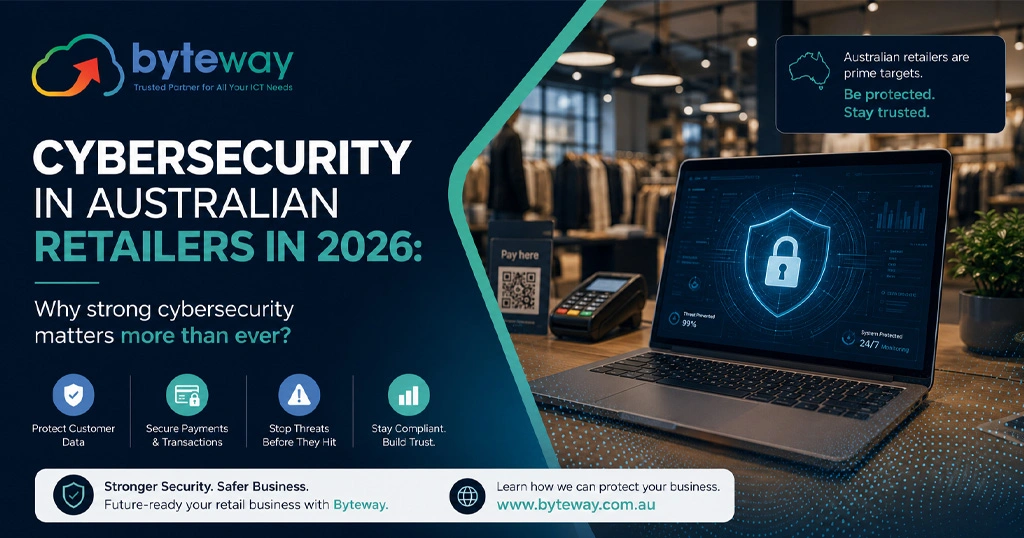
Cybersecurity in Australian Retailers in 2026 Why strong cybersecurity matters more than ever
Uncategorized

Cybersecurity for Australian Retailers in 2026: Why Strong Cybersecurity Matters More Than Ever?

Cybersecurity for Australian retailers is becoming increasingly important in 2026, and Byteway is helping businesses across Melbourne, Geelong, and Ballarat stay ahead of rising cybercrime threats. A cybercrime is now reported every six minutes in Australia, and small businesses remain one of the biggest targets for attackers. According to Australian cybersecurity reports, the average cybercrime incident now costs small businesses around $80,000 per attack, making cybersecurity one of the biggest operational risks facing Australian businesses in 2026 and one Byteway helps clients manage every day. Retail and hospitality businesses across Melbourne are particularly vulnerable because they rely heavily on digital payments, online bookings, customer databases, cloud systems, and connected devices. From cafés and restaurants to retail stores and accommodation providers, businesses are increasingly operating in environments where even a single phishing email or ransomware attack can disrupt operations completely. Cybercriminals are no longer only targeting large enterprises. Small and medium businesses are now considered easier entry points because many still operate with outdated systems, weak passwords, unsecured devices, or limited cybersecurity monitoring which is exactly why Byteway built its retail-focused cybersecurity services. For Melbourne businesses, cybersecurity is no longer just an IT issue. It has become a business continuity, customer trust, and reputation issue. Cybersecurity for Australian retailers continues to become a major concern as businesses rely on digital systems and online transactions. Retail and hospitality businesses handle hundreds of transactions and customer interactions daily. Staff members often focus on customer service, bookings, inventory management, supplier coordination, and payment processing throughout the day. Because operations move quickly, cybersecurity is sometimes overlooked until an incident occurs which is where Byteway’s proactive monitoring comes in. Why Cybersecurity for Australian Retailers Is Becoming More Important? Modern businesses also rely on multiple connected systems simultaneously. Point-of-sale systems, online ordering platforms, payment gateways, cloud-based accounting software, customer loyalty programs, staff mobile devices, and guest Wi-Fi networks all create possible entry points for attackers. According to the Australian Cyber Security Centre’s annual threat report and recent 2026 scam trends in Australia, phishing attacks, ransomware incidents, credential theft, and business email compromise continue rising across Australian businesses. Retail and hospitality businesses remain especially vulnerable because of high transaction volumes and multiple employee access points. Australian businesses are also facing growing pressure under the Privacy Act and the Notifiable Data Breaches scheme. A cyberattack exposing customer information can quickly create financial, legal, and reputational consequences for businesses across Melbourne, Geelong, and Ballarat consequences Byteway helps clients avoid through proactive protection. Cybersecurity for Australian retailers is becoming increasingly important for protecting customer data, payment systems, and connected business networks, and Byteway’s cyber security team works with retail and hospitality clients on exactly this. The Biggest Cybersecurity Threats Australian Businesses Are Facing in 2026 AI-Powered Phishing Attacks Are Increasing Phishing attacks have become much more advanced in 2026. Cybercriminals are now using AI-generated emails, fake supplier invoices, realistic payment requests, and even voice impersonation scams to trick employees into revealing sensitive information. Many Melbourne businesses are now adopting Byteway’s advanced phishing protection solution, PhishCare, to strengthen protection against employee-targeted cyber threats. A Melbourne retailer may receive what appears to be a genuine invoice from a supplier, while a hospitality business may receive a fake payment confirmation link that looks completely legitimate. In many cases, a single click is enough to compromise passwords, payment systems, or customer information. Cybersecurity reports across Australia show that phishing remains one of the most common entry points for cybercrime because attackers increasingly target human behaviour rather than directly attacking systems. Ransomware Attacks Continue Rising Ransomware remains one of the most damaging cybersecurity threats facing Australian businesses in 2026. These attacks encrypt business files and demand payment before restoring access. For retail and hospitality businesses, downtime immediately affects revenue and customer experience. A restaurant unable to process bookings or a retailer losing access to POS systems during trading hours can face serious operational disruption within minutes. Cybersecurity researchers also report growing use of “Ransomware-as-a-Service,” where cybercriminals purchase ready-made ransomware tools online. This has increased attacks against small businesses that previously believed they were unlikely targets which is why Byteway recommends a proactive ransomware defence strategy rather than waiting for an incident. Credential Theft and Password Attacks Are Growing Credential theft is becoming one of the fastest-growing cyber threats globally. Instead of directly hacking systems, attackers increasingly focus on stealing employee login credentials. Many businesses still use weak passwords, shared accounts, or repeated login credentials across systems. Once attackers gain access to one compromised account, they can often move through connected business systems quickly. This is why stronger password policies, secure authentication systems, and endpoint protection all part of Byteway’s managed cybersecurity service are becoming critical for retail cybersecurity in Australia. Unsecured Devices and Networks Increase Risk Retail and hospitality businesses use multiple connected devices daily, including tablets, mobile devices, POS systems, kiosks, and customer Wi-Fi networks. Without proper firewall security, Melbourne businesses may become vulnerable to malware, unauthorised access attempts, and network breaches. Businesses offering customer Wi-Fi should also ensure guest networks remain separated from internal operational systems. As more businesses adopt digital operations, endpoint protection and secure network management from Byteway are becoming essential parts of small business cybersecurity Australia 2026 strategies. What Melbourne Businesses Must Focus On Now? Cybersecurity in 2026 requires more than basic antivirus software. Businesses now need practical protection strategies that reduce risks across employees, networks, devices, and cloud systems the same layered approach Byteway builds into every client engagement. Managed Cybersecurity Melbourne Services Are Becoming Essential Many small businesses do not have internal cybersecurity teams capable of monitoring threats continuously. This is why Byteway’s managed cybersecurity Melbourne services are becoming increasingly important for retailers and hospitality businesses. Byteway’s managed cybersecurity solutions help businesses detect suspicious behaviour early, strengthen firewall protection, monitor networks continuously, secure endpoints, manage updates, and reduce operational cybersecurity risks before incidents escalate. Rather than reacting after an attack occurs, businesses can work with Byteway to proactively strengthen protection and reduce long-term disruption. Endpoint Protection Must Cover

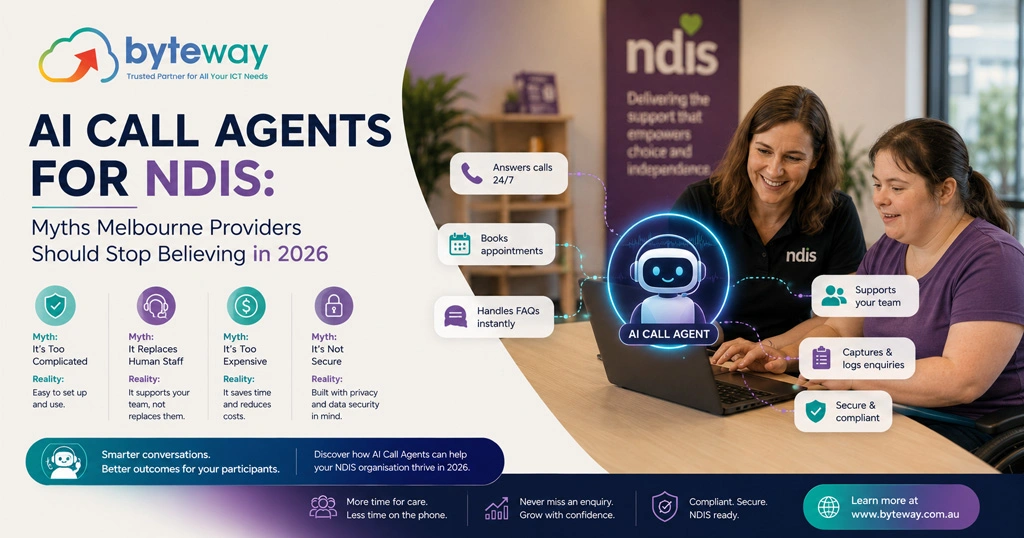
AI Call Agents for NDIS Myths Melbourne Providers Should Stop Believing in 2026
Uncategorized

AI Call Agents for NDIS: Myths Melbourne Providers Should Stop Believing in 2026

Byteway helps Melbourne NDIS and disability-support providers adopt technology safely, and few topics attract more myths than AI call agents. Some providers dismiss them as non-compliant or impersonal; others rush in without asking the right questions. Both extremes cost you. Here are the myths worth dropping, and the reality Melbourne NDIS providers should work from in 2026. The short version, before the myths: an AI call agent can help an NDIS provider answer every call, book and triage, and cover after-hours, but only when it is deployed with participant privacy in mind. The common beliefs, that it is automatically non-compliant, cold and impersonal, a threat to staff jobs, or only worth it for big providers, are mostly wrong. The truth is more useful. It is a capable tool that has to be set up correctly, because NDIS providers handle sensitive participant information and carry real privacy obligations. Myth 1: “An AI call agent can’t be NDIS-compliant” The reality: it can, if set up properly. Compliance is not a property of the AI; it is a property of how you deploy it. NDIS providers handle sensitive participant information and are generally covered by the Privacy Act, and many also handle health information, which is treated as sensitive information with the highest protection. An AI agent that handles that data correctly, with proper consent, secure storage and controlled access, operates compliantly. One deployed carelessly does not. The technology is neutral; the setup decides it. Myth 2: “It’s cold and impersonal, and participants will hate it” The reality: what participants dislike is not being able to reach anyone. A call that rings out, or an endless hold, is far more impersonal than an agent that answers immediately, understands the request, and either handles it or routes it to a person. The best setups keep a clear human path for anyone who needs it. Used well, an AI agent improves access rather than removing the human touch, especially after hours when the alternative is voicemail. Myth 3: “It’ll replace our support staff” The reality: it extends them. An AI call agent handles the routine and the overflow, booking, common questions, after-hours triage, messages, so your people spend their time on the work that needs a human. For a sector facing workforce pressure, that is the point: freeing skilled staff from phone tag, not removing them. Myth 4: “It’s only worth it for large providers” The reality: smaller providers often benefit most, because they have the least reception capacity. A small NDIS provider where everyone is delivering support cannot answer every call, and each missed call can be a participant not getting help or a referral lost. An AI agent gives a small provider coverage it could not otherwise afford. Myth 5: “Privacy is the vendor’s problem” The reality: it is yours. This is the myth that causes real trouble. When you deploy an AI agent, you remain responsible for the participant information it handles. That is why vendor due diligence matters: where is data stored, who can access it, is it used to train models, how is call recording consent handled for your state, and what happens to the data if you leave. A provider who cannot answer these is one to avoid. What to actually check before adopting Byteway Expert Insight The NDIS providers who get this right are the ones who reject both myths at once: that AI is automatically unsafe, and that you can just switch on a consumer tool and point it at your phone. The reality sits in between. An AI call agent is genuinely useful for a sector stretched on workforce and drowning in calls, and it handles sensitive participant data that has to be protected. Deployed thoughtfully, with the privacy questions answered up front, it improves participant access and frees your staff. The mistake is treating it as either a threat to avoid or a toy to grab, rather than a capable tool to set up properly. How Byteway helps? Adopt AI the NDIS-ready way Byteway helps Melbourne NDIS providers deploy AI call agents that improve access and protect participant data. Book an NDIS-ready AI voice agent consult. 👉 Book your consult FAQs Can NDIS providers legally use AI call agents? Yes, when deployed with participant privacy in mind, appropriate consent, secure storage, access control and correct call-recording handling. Compliance depends on the setup rather than the technology, which is why Byteway configures these controls as part of deploying an AI call agent for NDIS providers. Will an AI agent replace our support workers? No. It handles routine and overflow calls, freeing staff for work that needs a human. For a workforce-stretched sector, that’s the benefit. Is it too impersonal for participants? Participants dislike not reaching anyone more than they dislike a capable agent that answers instantly and routes to a person when needed. Good setups keep a clear human path. Do small NDIS providers benefit? Often most of all, because they have the least reception capacity. An AI agent gives small providers coverage they couldn’t otherwise afford. Who is responsible for participant data privacy? The provider is. You remain responsible for the information the agent handles, which is why Byteway runs the vendor due diligence and configures the agent to protect participant data before it goes live. What should we check before choosing a vendor? Data location and access, whether data trains models, security, call-recording consent handling, contract and exit terms, and integration. A vendor who can’t answer clearly should be avoided.

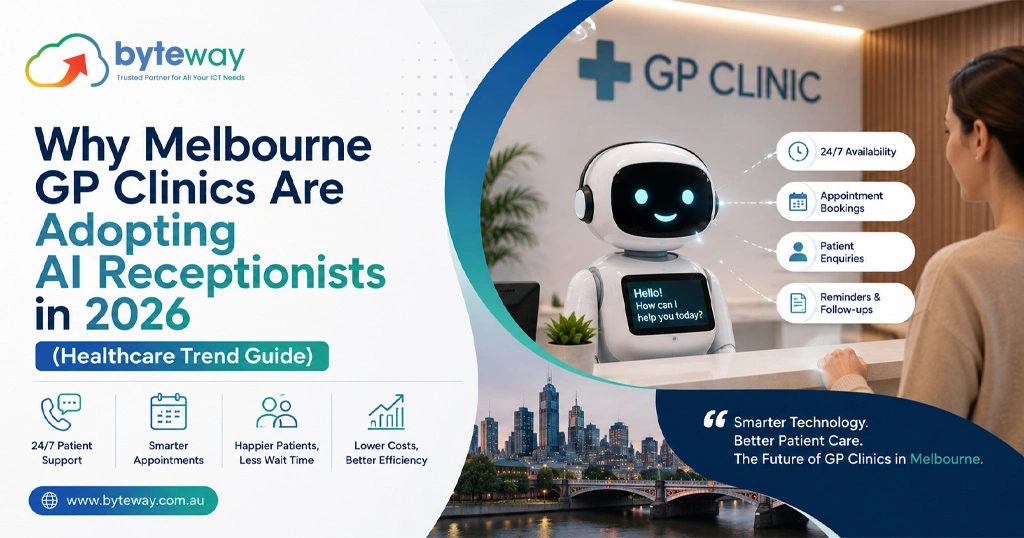
Melbourne GP Clinics Are Adopting AI Receptionists in 2026 Healthcare
Uncategorized

Why Melbourne GP Clinics Are Adopting AI Receptionists in 2026 (Healthcare Trend Guide)

Byteway helps Melbourne GP clinics choose and set up healthcare technology properly, and one trend has grown fast in 2026: AI receptionists. More clinics are using AI voice agents to answer calls, book appointments and cover after-hours, driven by real pressure on reception and patient expectations. This guide explains what is behind the trend, and the compliance a clinic must get right before joining it. In short, Melbourne GP clinics are adopting AI receptionists in 2026 to fix missed calls, ease overloaded reception, cover after-hours enquiries, and meet rising patient expectations for an instant response. An AI voice agent answers every call, books appointments and triages, freeing reception for the people in the clinic. Because clinics handle sensitive health information and are covered by the Privacy Act regardless of size, the trend only works when the agent is deployed with privacy, consent and call-recording handled correctly. What’s driving the trend? Missed calls, and lost patients. Reception cannot answer every call while managing a waiting room. Since most callers don’t leave voicemail and don’t call back, a missed call is often a patient who books elsewhere. An AI agent answers every one. Reception overload. GP reception is one of the hardest jobs in healthcare, phones, walk-ins, billing and triage at once. AI agents absorb the routine call volume so reception can focus on the people in front of them. After-hours demand. Patients call outside hours, and the alternative to an AI agent is usually voicemail. An agent books and triages around the clock. Patient expectations. Patients increasingly expect to reach a practice instantly, book online-style and not wait on hold. Clinics that meet that expectation retain more patients. Workforce pressure. With reception roles hard to fill, AI helps clinics maintain service without adding headcount they cannot recruit. What an AI receptionist does for a GP clinic? The compliance a clinic must get right This is where the trend needs care. Clinics handle sensitive health information and are covered by the Privacy Act regardless of turnover. Before adopting, a clinic must handle: We cover this fully in our guide to AI receptionists and the Privacy Act for clinics. The short version: the trend is real and worthwhile, but a clinic should deploy through someone who sets up the compliance properly, not sign up to a consumer app. Byteway Expert Insight The Melbourne clinics adopting AI receptionists well share a mindset: they treat it as a clinical-grade system handling sensitive data, not a gadget. They fix the missed-call problem that was quietly costing them patients, and they do it with the privacy, consent and security set up correctly from day one. The clinics that struggle are the ones at the extremes, either refusing a genuinely useful tool out of vague compliance fear, or grabbing a slick app and pointing it at their phone line without asking where patient data goes. The trend rewards the middle path: adopt it, but deploy it properly. How Byteway helps? Join the trend, the right way Byteway helps Melbourne GP clinics adopt AI receptionists that fix missed calls and protect patient data. Book a GP clinic AI receptionist demo. 👉 Book your demo FAQs Why are Melbourne GP clinics adopting AI receptionists? To fix missed calls, ease reception overload, cover after-hours enquiries and meet patient expectations for instant response, all while facing workforce pressure that makes hiring reception hard. Is an AI receptionist safe for a medical practice? It can be, when deployed with privacy, consent and call-recording handled correctly. Clinics are covered by the Privacy Act regardless of size, so setup matters, which is why Byteway configures the compliance and integration before a clinic goes live rather than leaving it to a consumer app. Will it replace our reception staff? No. It handles routine and after-hours calls so reception can focus on in-clinic patients. It extends the team rather than replacing it. Can it book into our practice management system? A properly configured agent integrates with your booking system to book, reschedule and cancel directly, which is where most of the value is. What about patient privacy? Clinics handle sensitive health information and remain responsible for it. Consent, secure and appropriately located data, access control and vendor due diligence must be handled before adoption. How do we start safely? With a review of fit and a proper deployment that sets up compliance and integration correctly. Byteway assesses whether an AI receptionist suits your clinic, handles the privacy and consent setup, and integrates it with your practice management system.

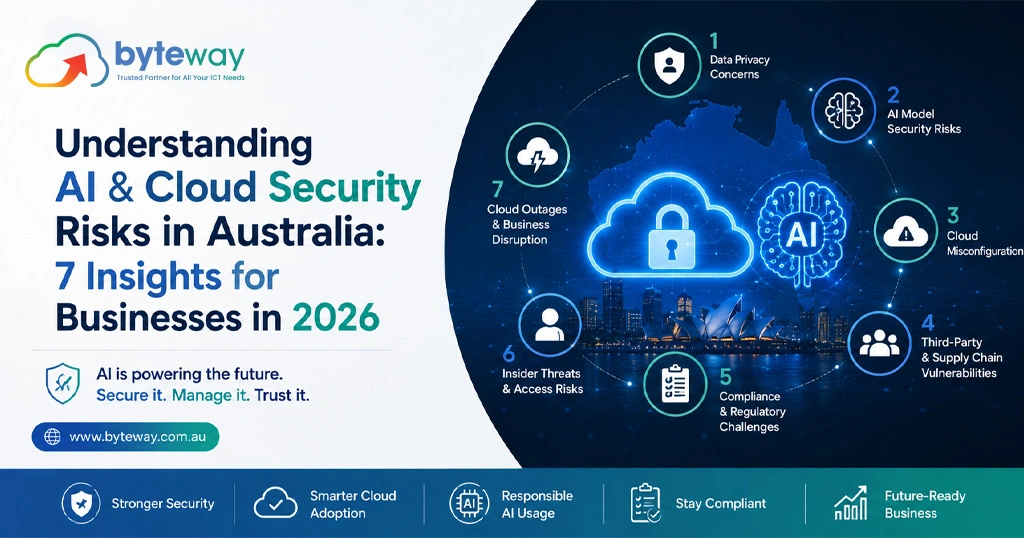
Understanding AI and Cloud Security Risks in Australia 7 Insights for Businesses in 2026
Uncategorized

Understanding AI & Cloud Security Risks in Australia: 7 Insights for Businesses in 2026

Byteway helps Australian businesses adopt AI and cloud tools without inheriting the risks that come with them, and 2026 has made that balance harder. The tools are more capable and more embedded, which means the security gaps are more consequential. Here are seven practical insights to help your business get the benefit of AI and cloud while managing the real risks. The theme across all seven is worth stating up front: the biggest AI and cloud risks for Australian businesses are not exotic, they are configuration, access and governance. Staff using unsanctioned AI tools, cloud services left over-permissioned, AI surfacing data through permissions that already exist, weak identity controls, data stored offshore, and treating the cloud provider as responsible for security that is actually yours. Managing all of it comes down to governance, least-privilege access, strong identity controls, and knowing where your data lives. Insight 1: Your staff are already using AI, whether you sanctioned it or not Shadow AI, staff using tools like ChatGPT or Gemini for work without approval, is one of the most common exposures. Well-meaning staff paste confidential or personal data into consumer tools that may retain it. Banning it fails, because people use their phones. The fix is governance: a clear policy and a sanctioned tool, not prohibition. Insight 2: AI exposes existing permission problems faster AI assistants like Microsoft Copilot work within your existing permissions, they surface whatever a user can already access. If your file permissions have drifted over years, AI makes that oversharing instantly visible. The risk is not the AI; it is the permissions underneath it. Audit access before deploying AI broadly. Insight 3: Cloud misconfiguration is a leading cause of breaches Most cloud breaches are not clever hacks; they are misconfigurations, a storage bucket left open, a default setting never changed, an over-permissioned account. The cloud is secure by design and insecure by default settings. Regular configuration review is one of the highest-value security activities there is. Insight 4: Identity is the new perimeter In a cloud and AI world, the login is the front door. Weak or reused passwords and missing multi-factor authentication are how most breaches begin. Strong identity controls, MFA everywhere, conditional access, prompt removal of departed staff, matter more than any single product. If you do one thing, it is this: multi-factor authentication on every account. In cloud and AI environments the login is the perimeter, so most breaches start with a stolen or weak credential, and MFA closes the most common path in. Insight 5: Know where your data actually lives Many AI and cloud tools process and store data overseas. For Australian businesses, especially those covered by the Privacy Act, sending personal information offshore is a cross-border disclosure you remain accountable for. Before adopting a tool, know where your data is stored and processed. Insight 6: The shared responsibility model catches people out Cloud providers secure the infrastructure. You secure your data, access and configuration within it. Assuming “the cloud provider handles security” leaves the half that is yours unprotected. Know which half you own, because it is the half attacks target. Insight 7: Third-party and vendor risk is your risk Every AI or cloud vendor you use becomes part of your attack surface. A vendor’s breach can become yours. Due diligence, where is data stored, who can access it, what security do they hold, what happens to data if you leave, is not optional when you are trusting them with your information. Byteway Expert Insight The pattern across all seven is the same: the risk is rarely the technology itself and almost always how it is governed. AI and cloud are secure when configured and controlled properly, and exposed when adopted in a rush with nobody watching access, data location or vendor practices. The businesses that get the benefit without the incidents are not the ones avoiding AI and cloud. They are the ones treating governance as part of adoption, deciding who can access what, where data lives, and which tools are sanctioned, before the tools are embedded everywhere. It is unglamorous work, and it is what separates a productive AI rollout from a breach. How Byteway helps Get the benefit of AI and cloud without the risk Byteway helps Australian businesses adopt AI and cloud securely. Book an AI and cloud security review. 👉 Book your review FAQs What are the main AI and cloud security risks? Shadow AI, AI surfacing data through existing permissions, cloud misconfiguration, weak identity controls, offshore data storage, misunderstanding shared responsibility, and third-party vendor risk. Most are governance and configuration issues, not exotic attacks. Is the cloud secure? Cloud infrastructure is secure by design, but insecure by default settings and poor configuration. Most cloud breaches come from misconfiguration and weak access control, which are your responsibility. What is shadow AI? Staff using AI tools without approval, often pasting sensitive data into consumer services that may retain it. The fix is a policy plus a sanctioned tool, not a ban. Does using AI create new data risks? AI mostly exposes existing risks faster, especially oversharing through permissions that already exist. Auditing access before deploying AI is essential. Who is responsible for cloud security? Both you and the provider. The cloud provider secures the infrastructure; you secure your data, access and configuration. Assuming otherwise leaves your half exposed, which is the half Byteway helps Australian businesses lock down. How do we manage AI and cloud risk? Govern adoption: sanctioned tools, least-privilege access, strong identity controls with MFA, known data location, and vendor due diligence, with regular configuration review. Byteway runs this as a single review across all seven risk areas and puts the controls in place.

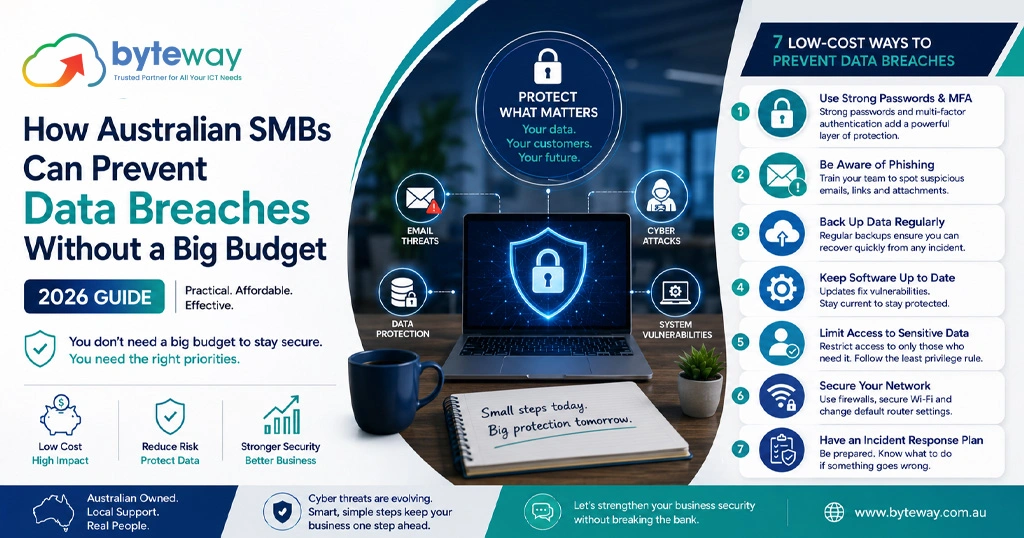
How Australian SMBs Can Prevent Data Breaches Without a Big Budget 2026 Guide
Uncategorized

How Australian SMBs Can Prevent Data Breaches Without a Big Budget (2026 Guide)

Byteway helps Australian small businesses protect themselves from data breaches without spending like a corporate, and the encouraging truth is that most breaches are prevented by cheap, ordinary controls rather than expensive tools. In a year when Australian data breach reports hit record highs, the businesses getting hurt are usually the ones that skipped the basics, not the ones that could not afford a fancy security platform. This guide covers the affordable, high-impact steps that stop most attacks. The honest headline is this: you do not need a big budget to prevent most breaches, you need the fundamentals done properly. Multi-factor authentication, tested backups, staff awareness, patching, strong passwords and a simple response plan prevent the large majority of common attacks, and most of them cost little or nothing. Expensive security tools have their place, but they are not what stands between a typical small business and a breach. Why the basics matter more than the budget? Most breaches are not sophisticated. They start with a stolen or guessed password, a staff member clicking a convincing email, or an unpatched system that attackers scanned and found. Australian scam and breach data consistently shows phishing and credential theft as the leading ways in. That is good news for a small business, because the defences against these are cheap. You do not need to outspend attackers. You need to close the ordinary doors they actually use. Step 1: Turn on multi-factor authentication (free, highest impact) If you do one thing, do this. Multi-factor authentication means a stolen password alone is not enough to get in, and since stolen passwords start most breaches, it is the single highest-value control available. It is built into Microsoft 365, Google Workspace and most business tools at no extra cost. Turn it on for email, finance systems and remote access first. Step 2: Back up your data, and test the restore (low cost) A tested backup is the difference between shrugging off ransomware and losing your business. The key word is tested: a backup nobody has ever restored is a hope, not a safety net. Cloud backup for a small business is inexpensive, and restoring it once to confirm it works costs nothing but time. Step 3: Train your people (cheap, and it works) Your staff are the front line, and a short session on spotting phishing and verifying unusual requests prevents the compromise that starts most breaches. This is one of the cheapest and most effective things you can do. Make it normal to question a suspicious email and to verify payment changes by phone, and tell staff they will never be in trouble for checking. Step 4: Keep systems patched and updated (free) Attackers scan for known vulnerabilities that already have fixes available. Applying updates promptly, to your operating systems, software and especially anything internet-facing, closes the holes they look for. This is free and one of the most neglected basics, as recent ACSC alerts have shown. Step 5: Use strong, unique passwords with a password manager (low cost) Reused passwords mean one breach unlocks everything. A password manager, a few dollars per user a month, lets staff use strong, unique passwords without memorising them. Combined with MFA, it closes off the credential-based attacks that dominate the breach statistics. Step 6: Control who can access what (free) Give people access to what they need and no more, and remove access promptly when someone leaves. Shared logins and lingering access from departed staff are common, avoidable weaknesses. This costs nothing but attention and discipline. Step 7: Have a simple response plan (free) If something does go wrong, knowing what to do in the first hour limits the damage enormously. A one-page plan, who to call, who decides, what to disconnect, and where your data lives, is free to produce and invaluable on the day. For businesses covered by the Privacy Act, it also helps you meet breach notification obligations. The Essential Eight, on a budget Many of these steps map to the Essential Eight, the Australian Signals Directorate’s baseline of mitigation strategies. You do not have to implement all of it at once, and the foundational levels are largely about doing ordinary things consistently: patching, MFA, backups, restricting admin access. Working towards the Essential Eight is a structured, credible way to improve security affordably, and to show you took reasonable steps if you are ever asked. Byteway Expert Insight The most expensive security mistake a small business makes is assuming security is expensive. That belief leads to doing nothing, which is what attackers count on. In reality, the controls that would have prevented most of the breaches we see cost very little: turning on MFA, testing a backup, briefing staff, patching, and writing a one-page plan. The businesses that get breached are rarely the ones that could not afford protection. They are the ones that assumed they could not, and so skipped the free and cheap fundamentals. Our advice to any small business on a tight budget is to do the basics properly first. They stop most attacks, and they cost a fraction of what a breach does. How Byteway helps? Protect your business without breaking the budget Byteway helps Australian SMBs prevent data breaches with affordable, high-impact security. Book a low-cost security health check. 👉 Book your health check FAQs Can a small business prevent data breaches on a tight budget? Yes. Most breaches are stopped by cheap fundamentals, MFA, tested backups, staff training, patching and strong passwords, not expensive tools. Byteway helps Australian SMBs put these in place affordably and prioritise the highest-impact fixes first. What is the single most important security step? Multi-factor authentication. It is free, built into most business tools, and it stops the stolen-password attacks that begin most breaches. Byteway turns it on across email, finance and remote access as a first move. How much should a small business spend on cyber security? There is no fixed figure, but the highest-value controls are inexpensive or free. Fund the fundamentals

AI Receptionists vs AI Scams 5 Ways to Use AI Safely in Australian Businesses
Uncategorized

AI Receptionists vs AI Scams: 5 Ways to Use AI Safely in Australian Businesses

Byteway helps Australian businesses get the benefit of AI without inheriting its risks, and 2026 has made that balance sharper than ever. The same technology that lets a business run a helpful AI receptionist is being used by criminals to clone voices, fake video calls and write flawless scam emails. Most advice treats AI as only one thing, an opportunity to chase or a threat to fear. The truth is both, and using AI safely means playing both hands: adopting the good deliberately, and defending against the bad. Here are five practical ways to do exactly that. The 2 Faces of AI for Your Business On one side, AI is a genuine opportunity. An AI receptionist answers every call and books jobs around the clock. AI tools draft, summarise and speed up everyday work. Used well, this is real productivity, and businesses that adopt it thoughtfully pull ahead. On the other side, AI has handed criminals a serious upgrade. The Australian Competition and Consumer Commission’s Scamwatch has warned that scammers now use AI to make scams more convincing, personalised and harder to detect, creating fake videos, cloning voices from short audio clips, and sending tailored messages built from information found online. Australians reported around $2.18 billion in scam losses in 2025, and AI is a growing part of why fraud is getting harder to spot. Voice cloning is the sharpest example: it targets the human shortcut of trusting a familiar voice, and the old advice to listen for a robotic tone or awkward phrasing no longer holds, because AI-generated audio has become convincing. Both faces are real at once. Using AI safely is not choosing between them. It is capturing the upside while closing the downside, which the five steps below are built to do. 5 Ways to Use AI Safely in Your Business 1. Choose and deploy AI tools with privacy and due diligence The opportunity side starts here. When you adopt an AI tool, an AI receptionist, an assistant, anything that touches customer or business data, you are trusting a vendor with information you remain responsible for. Before committing, ask where data is stored and processed, who can access it, whether it is used to train the vendor’s models, and how it handles consent and call recording, which varies by state. A tool chosen on features alone can quietly create a privacy problem; one chosen on due diligence delivers the benefit safely. This matters most in regulated sectors, and we cover it in depth in our guide to adopting an AI voice agent securely. 2. Govern how your staff use AI Your team is almost certainly already using AI tools, whether or not you have approved them. That is fine, and useful, until someone pastes confidential or personal data into a consumer AI service that may retain it. Banning AI fails, because people use their phones. The safe path is governance: a clear policy on what can and cannot go into AI tools, and a sanctioned option people can actually use. This closes the “shadow AI” gap without killing the productivity, and we explain the approach in our piece on shadow AI in the workplace. 3. Verify anything urgent on a separate, trusted channel This is the single most effective defence against AI-powered scams, and it costs nothing. Because AI can now fake a familiar voice, a video face and a perfect email, you can no longer trust that a message is genuine just because it looks or sounds right. The defence AI cannot beat is to verify through a channel it does not control: if you get an urgent request to pay an invoice, change bank details, or move money, confirm it by calling the person back on a number you already have, not one from the message. A cloned voice cannot survive you hanging up and dialling a number you saved last year. This is the same discipline that stops payment redirection fraud, and in the AI era it matters more than ever. 4. Train your team on AI-era scams The warning signs have changed, and staff trained on the old ones are exposed. Spelling mistakes, robotic voices and clumsy phrasing used to give scams away; AI has erased all of them. The reliable red flags now are behavioural, not technical: secrecy, urgency, pressure to act immediately, a request to bypass normal checks, or a demand for an unusual payment method. Teach your people to treat those behaviours as the alarm, regardless of how genuine the voice, face or email seems, and to slow down and verify rather than react. A brief, current session on how AI scams actually work is one of the cheapest protections you can put in place. 5. Get the security fundamentals right underneath it all AI does not replace basic security; it raises the stakes on it. AI assistants surface whatever a user can already access, so loose permissions become an instant oversharing problem, and stolen credentials give attackers AI-assisted reach. The fundamentals that protect you against ordinary attacks protect you here too: multi-factor authentication everywhere, tight access control, tested backups, patching, and monitoring. These are the foundation that makes safe AI adoption possible, and they connect to the wider AI and cloud security risks every business now faces. Byteway Expert Insight What we see is businesses picking one side of AI and getting caught by the other. Some race to adopt AI tools and never ask where the data goes, creating a privacy problem. Others are so wary of AI scams that they avoid useful tools entirely, and still get caught because they never trained their staff on the new warning signs. The businesses that get it right hold both ideas at once: AI is a tool worth using and a threat worth defending against, and the same disciplined approach covers both. Choose tools carefully, govern how they are used, verify anything urgent independently, train your people on how scams actually work now, and keep the security basics solid.

small business it support melbourne
Uncategorized

10 Smart IT Solutions Every Small Business in Melbourne Should Use in 2026

Byteway helps Melbourne small businesses put the right technology in place, and most advice on this topic is unhelpful in one of two ways: it is a pay-to-play list ranking IT companies, or a generic checklist that stops at antivirus and backups. Neither tells a small business what it actually needs to run well and stay secure in 2026. This is a practical, prioritised guide to the 10 IT solutions that genuinely matter for a Melbourne small business now, what each does, and why it earns its place. How to read this list? These are ordered roughly by priority, foundations first. A small business on a tight budget should get the early items solid before reaching for the later ones. The theme throughout is that good IT for a small business is not about buying the most, it is about getting the essentials right and adding the rest as you grow. 1. Proactive managed IT support The foundation everything else sits on. Proactive managed IT means someone monitors your systems and prevents problems, rather than waiting for you to call once something has already broken. For a small business without in-house IT, this is the difference between technology that quietly works and a running series of disruptions. It is the single most valuable IT decision most small businesses make, because it turns IT from a source of stress into a managed service. 2. A real cyber security baseline In a year of record data breaches, security is not optional for a small business, and attackers target smaller businesses precisely because they assume the defences are weak. The baseline is affordable and specific: multi-factor authentication on every account, staff who can spot a phishing email, and a sensible response plan. Working towards the Essential Eight, the Australian baseline, is a credible way to structure this, and it is increasingly what cyber insurers expect to see. Proper cyber security belongs near the top of every small business IT plan. 3. Automated, tested cloud backup Hardware fails, ransomware happens, and a single event can erase years of data. Automated cloud backup protects against that, but the word that matters is tested. A backup nobody has ever restored is an assumption, not a safety net. The smart version is backup that runs automatically and has been proven to restore, so a bad day is a recovery rather than a disaster. 4. Microsoft 365, set up and licensed properly Most small businesses run Microsoft 365 for email, Teams and the Office apps, but many pay for the wrong licences or never turn on the security features they are already paying for. Getting it configured and licensed correctly, on the right plan for your team, often saves money and closes security gaps at the same time. It is worth reviewing rather than leaving on autopilot, as we cover in our Microsoft 365 licensing guide. 5. Reliable business internet with a backup connection Everything a modern small business does runs over the internet, so the connection is core infrastructure, not a utility to forget about. The smart setup is reliable business internet paired with a 4G or 5G failover connection that takes over automatically if the main line drops. For any business that takes payments or serves customers, an outage is lost trade, and automatic failover turns it into a non-event. 6. A cloud phone system Old handsets tied to copper lines are on the way out, and a modern cloud phone system gives a small business flexibility that fixed lines never could: work from anywhere, easy scaling, and lower running costs. It also integrates with the rest of your tools. For a growing Melbourne small business, moving to cloud voice is one of the more straightforward upgrades with a clear ongoing payoff. 7. An AI voice agent to stop missing calls This is the 2026 addition most small businesses have not considered yet, and it addresses a real, quiet cost. Missed calls are lost business, because most callers do not leave a message and simply ring a competitor. An AI voice agent answers every call, day and night, and can book and qualify enquiries so a small team stops losing work to the phone. Set up properly, with privacy handled, it is one of the highest-return additions available to a small business right now. 8. Mobile device management If your team uses company phones or laptops, those devices carry business email, data and access, and once they leave the office you have no control over them unless they are managed. Mobile device management lets a small business enforce security, separate work from personal, and remotely lock or wipe a lost device, so a phone left in a taxi is an inconvenience rather than a data breach. It is the piece most phone and laptop rollouts skip. 9. Business CCTV and physical security For any small business with premises, a shop, a clinic, an office, a warehouse, modern CCTV protects stock, staff and the site. The smart approach treats cameras as part of your IT: designed for real coverage, compliant with privacy law, and secured on the network, since poorly configured cameras can themselves become a way in. Done well, physical and digital security work together. 10. Safe, governed use of AI tools AI is now part of how small businesses work, whether or not it has been approved, and used well it is a genuine productivity gain. The smart move is not to ban it or ignore it, but to use it safely: a clear policy on what data can go into AI tools, a sanctioned option for staff, and awareness of AI-powered scams. Our guide on using AI safely covers the approach. Handled deliberately, AI belongs on this list as an opportunity, not just a risk. Byteway Expert Insight The pattern we see with Melbourne small businesses is a lopsided IT setup: money spent on something visible while a foundation is missing underneath. A business will have a smart new tool but no tested

business voip phone system
Uncategorized

VoIP vs Landline: 7 Key Differences Every Small Business in Australia Should Know

Byteway helps Australian small businesses move to modern phone systems, and the first thing worth saying about VoIP vs landline in 2026 is uncomfortable: for most businesses, the choice has already been made for you. The copper landline network is being switched off, so the honest comparison is not really “should I stay on a landline or move to VoIP,” it is “which internet-based phone service should I move to, and will I do it on my own terms or wait until the line goes dead.” This guide covers the seven differences that actually matter, honestly, including the one real advantage the old landline had. First, The Honest Context: The Copper Landline is Going Away Before comparing the two, you need the lay of the land, because it changes the whole decision. Australia’s copper PSTN, the network that carried phone calls for over a century, has been progressively retired under the NBN migration, along with legacy ISDN business lines. In most NBN-served areas you generally cannot order a brand-new copper line the way you could a decade ago, and existing copper services face disconnection. That means the “landline” many small businesses believe they still have is often already a voice service delivered over the NBN, dependent on the internet whether they realise it or not. So for most premises, the real choice is no longer “keep the copper landline or switch to VoIP.” It is which internet-based voice service to use. With that context, here are the differences that matter. The 7 Key Differences 1. How the calls actually travel A landline sends your voice over a dedicated copper circuit through physical exchanges. VoIP sends it as data over your internet connection. That single difference drives most of the others: because VoIP rides your network rather than a fixed wire, it is far more flexible, but it does depend on your internet being sound. The important 2026 point is that, with copper being retired, the dedicated-circuit landline is the option that is disappearing. 2. Cost VoIP is almost always cheaper for a small business. There is no separate copper line rental, calls (including national and often international) are cheaper, and you avoid the technician costs that come with traditional line changes. A landline carries the ongoing cost of ageing infrastructure that is being wound down. For most small businesses, moving to VoIP reduces the monthly phone bill while adding capability. 3. Features This is where the gap is widest. A landline makes phone calls, and that is essentially it. VoIP does calls plus video, messaging, mobile and desktop apps, call routing and menus, voicemail-to-email, and integration with your other tools, right up to AI voice agents that answer and book calls automatically. For a small business, VoIP is not just a phone line, it is a communications platform that a landline cannot approach. 4. Flexibility and scalability A landline is tied to your premises and needs a technician to add or change lines. VoIP follows your people to any device, home, mobile, another site, and scales up or down in minutes rather than days. Adding a new staff member is a few clicks, not a service call. For a growing or hybrid small business, this flexibility is one of VoIP’s biggest practical advantages. 5. Reliability and what happens in a power outage Here is the one genuine advantage the old copper landline had, and it deserves an honest answer. A traditional copper phone was powered down the line from the exchange, so it kept working during a blackout, which is exactly why landlines were long recommended as emergency backup. VoIP depends on mains power: if the power is out, your modem, router and NBN connection device go down, and so does the phone, unless you have backup. But two things balance this. First, that advantage has already largely disappeared, because most “landlines” now run over the NBN and need power too. Second, a well-designed VoIP setup has resilience the old landline never offered: calls automatically reroute to mobiles if the office connection drops, 4G or 5G failover keeps you online through an outage, and a small UPS keeps the hardware running. Configured properly, VoIP is more resilient for business continuity than a landline ever was, because it is not chained to one building. The power point is real, and it is a design consideration to solve, not a reason to cling to copper. 6. Keeping your existing number A common worry is losing a phone number a business has had for years. You do not. Number porting moves your existing number, including 1300 and 1800 numbers, to a VoIP service, and a standard geographic number typically ports in around a week. Your customers notice nothing except that your phones now do more. Keeping your number is a standard part of moving to VoIP, not a risk. 7. Future-proofing and availability This is the difference that overrides the rest. The copper landline is not a stable status quo you can sit on indefinitely; it is a service being decommissioned, and some legacy voice products have hard cut-off dates. VoIP is the direction the entire Australian phone network is moving. Choosing VoIP is choosing the option that will still exist and keep improving, rather than one on a countdown. The businesses that plan the move now do it calmly, on their own timing; the ones that wait risk a rushed migration when a line is disconnected. When does a landline still make sense? Honesty cuts both ways, so here are the genuine exceptions. A small number of specialised services still lean on traditional lines, such as some lift emergency phones, alarm panels and EFTPOS lines, though even these are steadily being transitioned to modern alternatives. If your business relies on one of these, it needs specific handling in any migration rather than being forgotten. For everyday business calling, though, the landline no longer wins on any dimension except the fading power-outage point, which backup solves. Byteway Expert Insight The mistake we

ai voice agent australia
Uncategorized

10 Ways AI Voice Agents Are Transforming Customer Experience in Australia

Byteway helps Australian businesses use AI voice agents to serve their customers better, and the timing matters, because customer expectations have outrun what most businesses deliver. Research by CPM Australia and Swinburne University found that around two-thirds of consumers feel brands miss the mark on outstanding service, a gap that has persisted despite years of investment. AI voice agents are one of the few tools genuinely closing it, when they are done well. Here are ten ways they are transforming customer experience, and an honest note on where they help and where they do not. Why customer experience is the battleground in 2026? Customers now judge every business against the best service they receive anywhere, and their patience for hold music, voicemail and “press 1 for…” menus has run out. At the same time, hiring and keeping quality customer service staff is hard and expensive, and call volumes keep rising. That squeeze, higher expectations and tighter resources, is exactly why AI voice agents have moved from novelty to serious CX tool. The businesses using them well are pulling ahead on the thing customers actually notice: how it feels to contact them. The 10 ways AI voice agents are transforming CX 1. Instant answers, with no hold times The most immediate change is the death of the queue. An AI voice agent answers on the first ring, every time, so no customer waits on hold or listens to “your call is important to us.” For a customer, reaching a helpful voice instantly instead of waiting is a dramatic improvement, and it removes one of the most common sources of frustration in the entire customer journey. 2. Genuine 24/7 availability Customers do not keep business hours, and an AI voice agent does not need to. It answers at 9pm, on weekends and over holidays, so a customer with a question or a booking is served on their schedule rather than told to call back. For any business whose customers reach out after hours, this turns missed opportunities and frustration into service. 3. Consistent quality on every single call Human agents have good days and bad days, and quality varies with mood, workload and experience. An AI voice agent delivers the same calm, accurate, on-brand service on the thousandth call as the first. That consistency means every customer gets your best version, not a variable one, which steadily lifts overall experience and trust. 4. Natural conversation instead of menu mazes This is the shift that changes how AI feels. The old automated systems were rigid phone menus, press 1, press 2, say “representative” in vain. Modern AI voice agents use natural language, so a customer simply says what they need in their own words and the agent understands and responds conversationally. It is the difference between fighting a machine and talking to one that actually helps. 5. Faster resolution of routine queries A large share of customer calls are the same handful of questions: hours, location, availability, order status, simple bookings. An AI voice agent resolves these instantly, without the customer waiting for a human to become free. Fast, immediate answers to common questions is a real experience upgrade, and it frees your people for the calls that genuinely need them. 6. Personalised, context-aware service When connected to your systems, an AI voice agent can recognise a returning customer, reference their details, and pick up context rather than starting cold. That personalisation, being known rather than treated as a stranger each time, is something customers value and notice, and it is increasingly what “good service” means. 7. Multilingual support for a diverse Australia Australia is a multilingual country, and being able to serve customers in their preferred language is a genuine experience advantage. AI voice agents can converse in multiple languages, opening good service to customers who might otherwise struggle with an English-only line, without a business needing to hire for every language. 8. A smooth handoff to humans when it matters The best AI voice agent experiences are not AI-only; they are AI-first with a clear human path. Routine matters get handled instantly by the agent, while complex, sensitive or emotional situations are routed smoothly to a person with context already captured. This hybrid model gives customers the speed of AI and the empathy of humans, which is the combination that actually works. 9. Insight from every conversation A human manager can review a handful of calls; an AI voice agent captures and can analyse every one. That turns your phone line into a source of insight, common questions, recurring complaints, emerging issues, service gaps, that you can act on to improve the experience. Every call becomes data you can use, not a moment that vanishes when the customer hangs up. 10. Effortless scaling through peaks Demand spikes, seasonal rushes, a marketing campaign, a busy Monday, break traditional phone lines and leave customers waiting. An AI voice agent handles many calls at once and scales instantly, so the experience stays fast whether ten people call or a hundred. Customers never feel the strain your business is under, which is exactly when good service matters most. The Honest Part: done badly, AI hurts CX None of this is automatic. A poorly implemented AI voice agent, robotic, stuck in loops, with no way to reach a human, dead-ending on anything unusual, damages customer experience rather than improving it, and customers resent it. The transformation is real, but only when the agent sounds natural, resolves what it should, hands off gracefully when it should, and is set up with genuine care. The goal is not to remove humans from service; it is to let AI handle the routine so humans can focus on what needs them. Businesses that treat it as a quick way to cut costs get worse CX; those that treat it as a way to serve customers better get the transformation. There is also an Australian dimension worth getting right: because these agents handle customer information, where that data is processed

byteway-cloud-phone-system-australia
Uncategorized

10 Reasons Australian Businesses Are Switching to Cloud Phone Systems

Byteway helps Australian businesses move to modern phone systems, and the shift to cloud phones has become one of the clearest trends in business technology, for good reasons and one unavoidable one. The old copper phone network is being retired, so change is coming whether a business plans for it or not. But the businesses switching are not doing it reluctantly; they are doing it because a cloud phone system genuinely does more for less. Here are the ten reasons behind the move. 1. The copper network is being retired Start with the unavoidable reason. Australia’s copper phone network and legacy ISDN lines are being progressively decommissioned under the NBN migration, and in most areas you can no longer order a traditional copper line. Businesses still on old lines are on a countdown to disconnection. Switching to a cloud phone system now, on your own timing, is far better than a rushed migration when a line is cut off. This alone is prompting many businesses to move, and the other nine reasons make it an upgrade rather than a chore. 2. Lower running costs Cloud phone systems are almost always cheaper to run than traditional lines. There is no separate copper line rental, calls (including national and often international) cost less, and there is no ageing on-site hardware to maintain. For a small business, moving to the cloud typically reduces the monthly phone bill while adding capability, which is a rare combination. 3. Work from anywhere, on any device A cloud phone system is not tied to a desk or a building. Staff can make and take business calls from a desk handset, a laptop or a mobile app, using the business number, whether they are in the office, at home, or on the road. For the hybrid and remote working that is now normal, this flexibility is transformative, and it is impossible with a traditional fixed line. 4. Scale up or down in minutes Adding a new staff member to a traditional phone system meant a technician and a wait. With a cloud phone system, adding or removing users is a quick change in software. For a growing business, or one with seasonal peaks, this means your phones keep pace with the business instead of holding it back, without service calls or new physical lines. 5. Features a traditional system can’t match Cloud phone systems come with capabilities that old systems either lacked or charged heavily for: auto-attendants and call menus, voicemail-to-email, intelligent call routing, hold and transfer, call recording, video and messaging, and integration with AI voice agents that answer and book calls automatically. A small business gets the phone capabilities that used to belong only to large ones. 6. Better business continuity A cloud phone system is more resilient than a fixed line, because it is not chained to one location. If your office loses internet or power, calls can automatically reroute to mobiles or another site, so you stay reachable. Paired with 4G or 5G failover, an outage that would have taken your phones down becomes something customers never notice. 7. Integration with your other tools Modern phones do not sit in isolation. A cloud phone system can integrate with the tools you already use, your CRM, Microsoft 365 and Teams, and your customer systems, so calls connect to customer records and your communications work as one. This joined-up way of working is something traditional phone lines never offered. 8. A more professional image A cloud phone system lets even a very small business present professionally: a proper auto-attendant, departmental options, hold music, multiple numbers, and no calls ringing out to a mobile voicemail. For a small business competing with larger ones, sounding polished and organised on the phone matters, and cloud systems make it easy and affordable. 9. Easier multi-site and unified communications For businesses with more than one location, a cloud phone system unifies everything: one system across all sites, internal calls between locations, consistent numbers and routing, and central management. Traditional systems made multi-site telephony expensive and awkward; the cloud makes it straightforward, which is a major driver for growing businesses. 10. Future-proofing Finally, the cloud is where the entire phone network is heading. Choosing a cloud phone system means choosing the option that will keep existing, keep improving and keep gaining features, rather than one being wound down. It is an investment that keeps paying off, instead of a technology on borrowed time. For a business planning ahead, that certainty is worth a great deal. Byteway Expert Insight The businesses that switch and love it are the ones that treated it as an upgrade, not just a forced migration off copper. They used the move to fix things that had quietly annoyed them for years: calls that could not follow staff home, a system that needed a technician for every change, no way to stay reachable in an outage. The businesses that find it painful are usually the ones that waited until a disconnection date forced a rushed switch with no planning. Our advice is to move by choice, plan the port so your numbers transfer cleanly, choose features that match how you actually work, and add failover so you are more reliable afterwards, not less. Done that way, switching to a cloud phone system is one of the easier technology wins a business can have. How Byteway helps? Make the switch on your terms The move to cloud phones is happening across Australia, and the businesses that plan it get an upgrade, not a headache. Byteway handles the whole switch: porting your numbers, setting up the features you need, and adding failover so you come out more reliable. Book a cloud phone system consult. Frequently asked questions Why are businesses switching to cloud phone systems? Because the copper network is being retired and cloud phones cost less, work from anywhere, scale instantly, add features and stay reachable through outages. Byteway helps Australian businesses switch to a cloud phone system on

Scroll to Top