

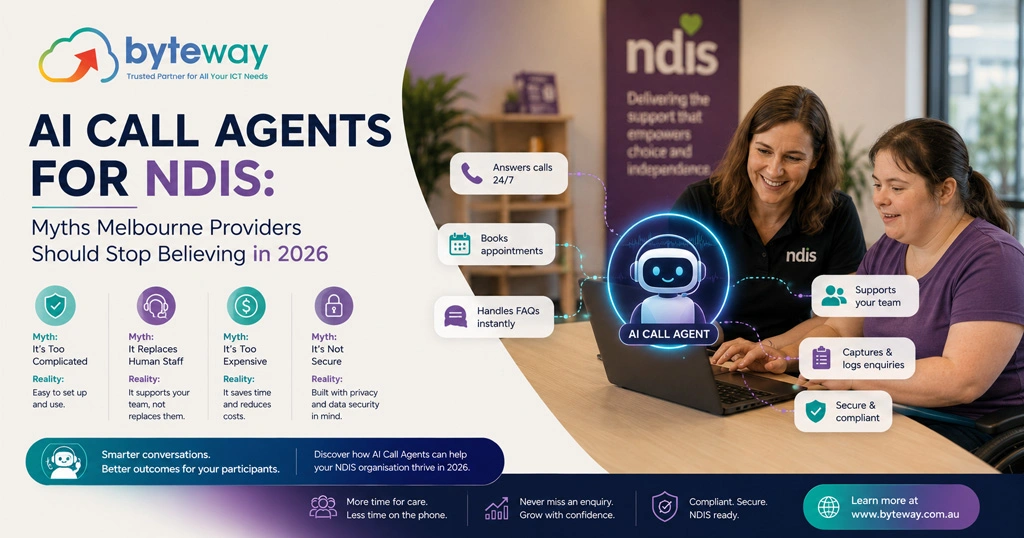
Byteway helps Melbourne NDIS and disability-support providers adopt technology safely, and few topics attract more myths than AI call agents. Some providers dismiss them as non-compliant or impersonal; others rush in without asking the right questions. Both extremes cost you. Here are the myths worth dropping, and the reality Melbourne NDIS providers should work from in 2026.
The short version, before the myths: an AI call agent can help an NDIS provider answer every call, book and triage, and cover after-hours, but only when it is deployed with participant privacy in mind. The common beliefs, that it is automatically non-compliant, cold and impersonal, a threat to staff jobs, or only worth it for big providers, are mostly wrong. The truth is more useful. It is a capable tool that has to be set up correctly, because NDIS providers handle sensitive participant information and carry real privacy obligations.
Myth 1: “An AI call agent can’t be NDIS-compliant”
The reality: it can, if set up properly. Compliance is not a property of the AI; it is a property of how you deploy it. NDIS providers handle sensitive participant information and are generally covered by the Privacy Act, and many also handle health information, which is treated as sensitive information with the highest protection. An AI agent that handles that data correctly, with proper consent, secure storage and controlled access, operates compliantly. One deployed carelessly does not. The technology is neutral; the setup decides it.
Myth 2: “It’s cold and impersonal, and participants will hate it”
The reality: what participants dislike is not being able to reach anyone. A call that rings out, or an endless hold, is far more impersonal than an agent that answers immediately, understands the request, and either handles it or routes it to a person. The best setups keep a clear human path for anyone who needs it. Used well, an AI agent improves access rather than removing the human touch, especially after hours when the alternative is voicemail.
Myth 3: “It’ll replace our support staff”
The reality: it extends them. An AI call agent handles the routine and the overflow, booking, common questions, after-hours triage, messages, so your people spend their time on the work that needs a human. For a sector facing workforce pressure, that is the point: freeing skilled staff from phone tag, not removing them.
Myth 4: “It’s only worth it for large providers”
The reality: smaller providers often benefit most, because they have the least reception capacity. A small NDIS provider where everyone is delivering support cannot answer every call, and each missed call can be a participant not getting help or a referral lost. An AI agent gives a small provider coverage it could not otherwise afford.
Myth 5: “Privacy is the vendor’s problem”
The reality: it is yours. This is the myth that causes real trouble. When you deploy an AI agent, you remain responsible for the participant information it handles. That is why vendor due diligence matters: where is data stored, who can access it, is it used to train models, how is call recording consent handled for your state, and what happens to the data if you leave. A provider who cannot answer these is one to avoid.
What to actually check before adopting
- Vendor due diligence: data location, access, model-training use, security, contract terms.
- Consent and privacy: correct handling of sensitive participant information.
- Call recording: consent rules vary by state; a transcript is treated like a recording.
- Human handoff: a clear path to a person for anyone who needs it.
- Integration and security: connected to your systems and sitting behind proper security.
Byteway Expert Insight
The NDIS providers who get this right are the ones who reject both myths at once: that AI is automatically unsafe, and that you can just switch on a consumer tool and point it at your phone. The reality sits in between. An AI call agent is genuinely useful for a sector stretched on workforce and drowning in calls, and it handles sensitive participant data that has to be protected. Deployed thoughtfully, with the privacy questions answered up front, it improves participant access and frees your staff. The mistake is treating it as either a threat to avoid or a toy to grab, rather than a capable tool to set up properly.
How Byteway helps?
- We assess whether an AI call agent fits your service and participants.
- We run the privacy and vendor due diligence, and configure consent, recording and access correctly.
- We connect it to your systems and cyber security, and set up human handoff, so it helps without exposing you.
Adopt AI the NDIS-ready way
Byteway helps Melbourne NDIS providers deploy AI call agents that improve access and protect participant data. Book an NDIS-ready AI voice agent consult. 👉 Book your consult
FAQs
Can NDIS providers legally use AI call agents?
Yes, when deployed with participant privacy in mind, appropriate consent, secure storage, access control and correct call-recording handling. Compliance depends on the setup rather than the technology, which is why Byteway configures these controls as part of deploying an AI call agent for NDIS providers.
Will an AI agent replace our support workers?
No. It handles routine and overflow calls, freeing staff for work that needs a human. For a workforce-stretched sector, that’s the benefit.
Is it too impersonal for participants?
Participants dislike not reaching anyone more than they dislike a capable agent that answers instantly and routes to a person when needed. Good setups keep a clear human path.
Do small NDIS providers benefit?
Often most of all, because they have the least reception capacity. An AI agent gives small providers coverage they couldn’t otherwise afford.
Who is responsible for participant data privacy?
The provider is. You remain responsible for the information the agent handles, which is why Byteway runs the vendor due diligence and configures the agent to protect participant data before it goes live.
What should we check before choosing a vendor?
Data location and access, whether data trains models, security, call-recording consent handling, contract and exit terms, and integration. A vendor who can’t answer clearly should be avoided.