Author name: Pallavi Gupta

AI Voice Agent Australia for Real Estate Enquiries
Uncategorized

Melbourne Agencies Are Losing Property Leads After Hours: Here’s How AI Voice Agents Are Fixing It in 2026 

In Melbourne’s fast-moving property market, buyers no longer wait hours for a callback. Many move on within minutes. That’s why more agencies are partnering with Byteway, whose AI voice agent “Eva” answers every enquiry instantly, day or night, so no lead is ever lost to a missed call. Real estate agencies are now handling constant buyer, tenant, and investor enquiries every day. At the same time, agents are busy with inspections, meetings, paperwork, and client calls. This is making fast lead response more difficult for many businesses in 2026. Even one missed enquiry can become a lost opportunity. That is why more agencies are now exploring AI voice agent Australia solutions like Eva by Byteway to improve response efficiency. Byteway’s AI receptionist Australia systems help businesses answer calls, manage enquiries, and capture leads while teams focus on property sales and customer relationships. Why AI Voice Agent Melbourne Solutions Are Growing? Property enquiries no longer happen only during business hours. Many buyers and tenants now contact agencies during evenings, weekends, and inspection hours. At the same time, agents are often busy with meetings, paperwork, negotiations, and property visits. This makes fast callbacks difficult for many real estate businesses. In highly competitive markets, response speed can directly affect conversions. Some industry reports even suggest the first agent to respond can win the client nearly 78% of the time. How Byteway’s AI Voice Agent Melbourne Solution Works for Real Estate Businesses? Byteway built Eva, its AI voice agent Melbourne system, to support day-to-day property communication more efficiently. Eva can answer incoming calls, respond to common property questions, and manage customer interactions automatically — around the clock. Many businesses now use Byteway’s conversational AI assistant technology to reduce manual call handling and improve enquiry management. Eva can also collect customer details, understand enquiry types, and route urgent calls to the right team members. This helps agencies manage communication more smoothly during busy business hours. Some businesses also use Byteway’s AI virtual assistant tools to support appointment scheduling and customer follow-ups across different property-related enquiries. Managing Property Enquiries Automatically Real estate businesses often receive enquiries about inspections, pricing, rental availability, and property locations throughout the day. Byteway’s AI voice systems help manage these repetitive enquiries automatically without requiring immediate staff involvement. Customers receive quick answers while their lead details are captured directly into the agency’s system. Eva, Byteway’s AI virtual assistant, can also help qualify enquiries by identifying buyer interest, preferred locations, or rental requirements. This allows teams to focus more on property sales and client meetings instead of handling repetitive calls manually. Byteway’s conversational AI assistant can also support appointment booking requests and basic customer follow-up interactions. Handling After-Hours Buyer and Tenant Calls Property enquiries frequently continue after office hours, especially during evenings and weekends. Many buyers and tenants prefer calling outside traditional business times while browsing listings online. Byteway’s AI voice systems help agencies stay responsive even when teams are unavailable. Eva can answer calls, record customer information, and route urgent requests when required. This helps businesses maintain communication continuity without relying entirely on manual support a key reason more Melbourne agencies are choosing Byteway over generic call-answering tools. Eva can also guide callers through inspection timings, rental enquiries, or property availability questions using natural conversational interactions. Faster Responses Win More Property Leads Property buyers rarely contact only one agency when searching for homes or rental properties. Many compare multiple listings and reach out to different agents within minutes. In competitive markets, response speed can strongly influence who secures the enquiry first. Customers also expect fast communication and smooth experiences throughout the property search process. Delayed replies may reduce engagement and push buyers toward competing agencies. This is why more businesses are turning to Byteway for immediate lead engagement strategies. Byteway’s AI calling agent and AI receptionist solutions help agencies improve response consistency and maintain faster communication across property enquiries, inspections, and customer interactions. Communication Challenges Real Estate Agencies Face in 2026 Real estate operations are becoming more fast-paced in 2026. Customers now expect instant updates, quick replies, and smooth interactions across multiple channels. Many agencies are handling website enquiries, rental questions, inspections, and incoming calls at the same time. During busy periods, limited front-desk availability can slow response handling. Agents also spend considerable time answering routine property questions throughout the day. International enquiries and after-hours customer activity are creating additional operational pressure for many businesses. This is why more agencies are turning to Byteway’s AI virtual assistant and AI voice agent after-hours solution, Eva, to support daily enquiry handling and maintain smoother customer interactions during high-activity periods. High-Volume Inspection Enquiries Property inspections often create sudden spikes in customer activity. Buyers and tenants regularly ask about inspection timings, parking availability, pricing, rental applications, and property features. Managing these requests manually can place additional pressure on internal teams. At the same time, agents may already be handling meetings, inspections, and client coordination tasks. This can slow response handling during busy listing periods. Many businesses now turn to Byteway’s AI virtual assistant, Eva, to simplify inspection-related workflows. Eva assists with customer questions, lead capture, appointment coordination, and property enquiry support without increasing admin workload for front-desk teams. Missed Weekend and Evening Calls Many buyers and tenants search for properties during evenings and weekends instead of standard office hours. Rental listings and property inspections often receive strong enquiry activity during these periods. However, agencies may not always have staff available to answer every incoming call immediately. Delayed responses can reduce customer interest and affect follow-up opportunities. Some buyers may continue contacting competing agencies while waiting for a callback. This increasing demand for after-hours responsiveness is why more Melbourne businesses are choosing Byteway’s AI voice agent Australia solution, Eva. Eva helps agencies capture customer details, route urgent requests, and support enquiry handling outside regular business hours every single day of the year. Smarter Communication for Property Teams Many property consultants spend significant time managing routine calls and repetitive customer enquiries each day. This can reduce the
CCTV Solutions in Australia Is Your Workplace Security Strategy Ready for 2026
Uncategorized

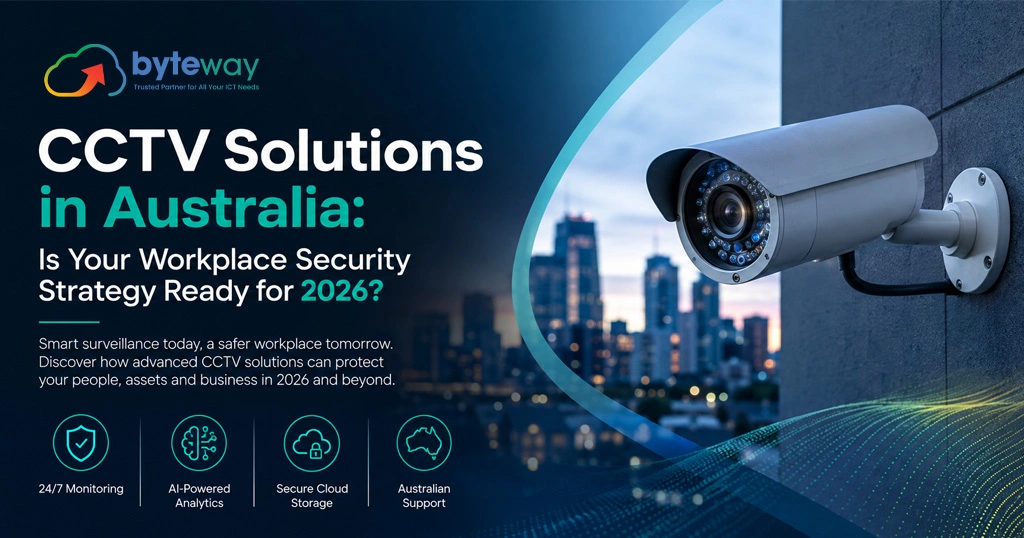
CCTV Solutions in Australia: Is Your Workplace Security Strategy Ready for 2026?

Australia’s workplace security landscape is changing quickly, and Byteway is helping businesses keep up. As a trusted provider of CCTV solutions in Australia, Byteway delivers AI-powered surveillance and cloud-based monitoring designed to protect employees, customers, and commercial spaces every day. Industry reports suggest the Australian CCTV and video surveillance market is projected to reach around AUD 1.5 billion, while the broader surveillance and video security market could move toward USD 4.5 billion by 2033. This growth is being driven by AI-powered CCTV, cloud-based monitoring, smart city needs, and rising commercial security demands all areas where Byteway is actively helping businesses modernise. For retail businesses, CCTV solutions in Australia are no longer just about recording footage. In 2026, Byteway’s surveillance systems are becoming part of a stronger workplace security strategy that improves visibility, supports faster incident response, and helps businesses prepare for evolving security risks. Rising Demand for CCTV Solutions in Australia Workplace security is becoming a much bigger priority for Australian businesses as retail environments continue facing rising operational and safety challenges. From theft and unauthorised access to after-hours incidents and workplace aggression, many businesses are now turning to Byteway to rethink how they protect employees, customers, and commercial spaces. According to Safe Work Australia, workplace violence and harmful behaviours remain growing concerns across customer-facing industries. As a result, many retail businesses are increasingly investing in Byteway’s smarter CCTV solutions in Australia to improve surveillance coverage and security monitoring. Byteway’s modern security cameras are becoming an important part of workplace risk management strategies designed to support faster incident response and strengthen day-to-day operational security. Why Traditional Security Systems Are No Longer Enough? Many older surveillance systems were originally designed only for basic recording and limited monitoring purposes. However, modern workplaces now require faster visibility, remote accessibility, and more proactive incident management capabilities which is exactly what Byteway’s CCTV systems are built for. Traditional CCTV systems often lack cloud connectivity, real-time monitoring, remote access, and smarter analytics that businesses increasingly rely on in 2026. As hybrid operations, after-hours activity, and multi-location retail environments continue expanding, more businesses are moving toward Byteway’s scalable and intelligent surveillance system services. As one of the leading business CCTV providers in Australia, Byteway helps retailers modernise surveillance infrastructure through cloud-based monitoring, AI-powered alerts, and centralised surveillance management designed to improve security management and surveillance coverage. How Byteway’s CCTV Solutions Are Improving Workplace Security? Byteway’s modern CCTV solutions are helping Australian businesses strengthen workplace security far beyond basic surveillance. Many businesses are now using Byteway’s smarter security cameras to improve visibility across retail stores, offices, warehouses, and customer-facing environments. Features such as remote monitoring, real-time alerts, cloud-based access, and centralised surveillance management help businesses respond to incidents faster and monitor multiple locations more efficiently. Byteway’s CCTV solutions also help reduce theft, support workplace safety, and provide important evidence during disputes or operational incidents. As workplace risks continue evolving in 2026, many Australian businesses are increasingly relying on Byteway’s surveillance system services to improve business oversight, strengthen security awareness, and support safer day-to-day business operations. Why Retail Businesses Are Investing More in CCTV with Byteway? Retail businesses across Australia are increasing CCTV investments as workplace security risks and operational challenges continue growing. Rising concerns around theft, workplace aggression, vandalism, after-hours incidents, and organised retail crime are encouraging businesses to partner with Byteway on more proactive security strategies. Many retailers are now looking beyond traditional surveillance and investing in Byteway’s smarter CCTV solutions that improve monitoring, strengthen employee safety, and support faster incident response. As a trusted business CCTV provider, Byteway also helps retailers improve surveillance coverage across customer-facing environments through remote monitoring and cloud-based surveillance management. In 2026, Byteway’s CCTV solutions are becoming an important part of broader workplace security planning designed to improve operational confidence and reduce security-related disruptions across retail environments. Key CCTV Features Byteway Recommends for 2026 1. Remote Monitoring Businesses are increasingly prioritising remote monitoring capabilities to improve visibility across retail stores, warehouses, offices, and customer-facing environments. Byteway’s modern CCTV systems allow teams to access surveillance footage remotely through smartphones, tablets, and desktop platforms. This helps businesses monitor workplace activity in real time, respond to incidents faster, and maintain better operational awareness even outside business hours. Remote monitoring through Byteway is becoming especially valuable for businesses managing multiple locations or after-hours operations. 2. Cloud Storage Cloud storage is becoming more popular as businesses look for more secure, scalable, and flexible ways to manage surveillance recordings. Unlike traditional storage systems, Byteway’s cloud-based CCTV solutions reduce dependence on physical infrastructure while improving accessibility and backup reliability. Businesses working with Byteway can securely store footage, retrieve recordings more efficiently, and manage surveillance data across multiple locations. As workplace security demands continue increasing, Byteway’s cloud storage options are helping Australian businesses modernise long-term surveillance management. 3. AI Powered Alerts AI powered alerts are helping businesses respond faster to suspicious activity, workplace incidents, and unusual movement patterns. Byteway’s modern CCTV systems can identify specific behaviours, detect security anomalies, and send real-time notifications to improve incident response times. These smarter surveillance capabilities, built into Byteway’s offering, are helping businesses strengthen workplace monitoring while reducing the need for constant manual monitoring. In 2026, Byteway’s AI powered CCTV features are becoming increasingly important for Australian businesses looking to improve proactive workplace security and security management. Workplace Security Trends Businesses Should Watch in 2026 1. Proactive Workplace Security Planning Australian businesses are becoming more proactive about workplace security instead of responding only after incidents occur. Many retailers are working with Byteway to improve surveillance coverage and workplace visibility, reducing operational risks before they escalate. 2. Multi-Location Security Management Businesses managing multiple retail stores and commercial spaces are increasingly focusing on centralised CCTV monitoring through Byteway. This helps improve surveillance coordination and security management across different locations. 3. Privacy and Compliance Awareness As workplace surveillance adoption increases, businesses are becoming more aware of privacy expectations and workplace monitoring responsibilities. Many organisations are now working with Byteway to review CCTV strategies and maintain transparency

5 IT Trends That Will Shape GeelongΓÇÖs Legal & Accounting Firms by 2028 A Byteway Predictions Guide
Uncategorized

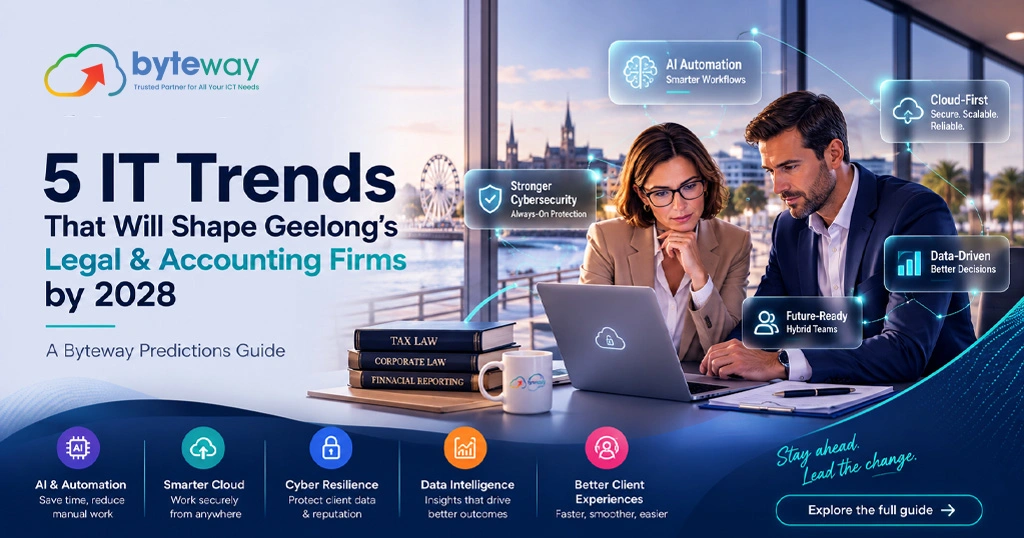
5 IT Trends That Will Shape Geelong’s Legal & Accounting Firms by 2028: A Byteway Predictions Guide 

Legal and accounting firms across Geelong are under growing pressure to work faster, stay secure, and manage increasing digital workloads. In this Byteway predictions guide, we break down the IT trends Geelong firms need to prepare for and how Byteway’s managed IT services can help. AI tools are now becoming part of daily legal operations. Client expectations are rising. Faster workflows and smarter collaboration systems are quickly becoming standard across professional service firms. At the same time, many firms are still relying on older systems that create delays, workflow pressure, and operational inefficiencies. For many professional service firms, reliable technology from a partner like Byteway is now becoming part of competitive advantage itself. Why Professional Services Are Changing? Professional service firms are operating in a far more digital environment than they were a few years ago. Recent Australian legal technology trends also show firms are moving beyond AI experimentation into practical digital workflows, cybersecurity planning, and connected operational systems areas where Byteway works directly with Geelong firms. Clients now expect faster communication, secure document handling, smoother file sharing, and easier remote accessibility. Think about a busy accounting firm during tax season. Now imagine internet disruptions, delayed access to files, or slower communication during peak workload periods. The operational pressure quickly grows across the entire team which is exactly the kind of disruption Byteway’s managed IT services are built to prevent. Client Expectations Are Becoming Faster Business clients increasingly expect quicker responses and smoother digital experiences from legal and accounting firms. Recent Australian customer experience research also shows that 80% of customers now consider the overall experience to be just as important as the services being delivered. Australian clients are also placing greater focus on transparency, secure communication, personalised service, and easier digital interactions. Delays that may have been acceptable a few years ago now create frustration much faster. This is especially true for firms managing time sensitive legal matters, tax deadlines, compliance reporting, and financial documentation. For many Geelong firms, responsiveness is now becoming part of overall client experience and long term client retention and Byteway helps firms build the IT foundation that responsiveness depends on. 1. Remote Work Will Continue Expanding Hybrid work is becoming part of long term operations for many professional service firms. Recent Australian workplace trends show the “3 days office, 2 days remote” model is now becoming standard across legal, consulting, and financial industries. Lawyers, accountants, consultants, and administrative staff increasingly need secure access to systems from multiple locations. Byteway’s managed IT services help Geelong firms set up exactly this kind of secure, remote-ready access. This is creating new pressure on older office based IT environments. For many Geelong firms, remote access is no longer simply a convenience. It is becoming part of everyday business operations. Older Systems Are Creating Delays Many firms still rely on older infrastructure that was designed mainly for office based work. This often creates slower workflows, inconsistent remote access, and communication bottlenecks. Even small delays can affect productivity during busy client periods. Imagine staff waiting longer to access files while clients are expecting immediate responses. Over time, these operational inefficiencies become more noticeable which is why more firms are turning to Byteway to modernise ageing infrastructure before it becomes a bigger problem. 2. AI Driven Operations Will Grow Faster AI tools are becoming more common across professional service environments. Recent Australian legal technology research also shows only 16% to 20% of Australian legal professionals currently use AI tools daily, despite growing pressure for faster workflows and operational efficiency. Many firms are already exploring AI based scheduling, enquiry handling, appointment coordination, and operational automation — including Byteway’s own AI voice agent, Eva, which many professional service clients use to manage enquiries and free up admin time. This does not mean replacing professional expertise. Instead, many firms are using AI to reduce repetitive administrative pressure. For smaller firms managing limited staffing resources, this operational support is becoming increasingly valuable. IT Trends Geelong Firms Should Prepare For Administrative pressure continues growing for many professional service firms. Staff are often managing client communication, scheduling, onboarding, document handling, compliance processes, and reporting simultaneously. This creates operational fatigue during busy periods. Recent industry research also shows firms using AI powered operational tools are significantly more likely to improve workflow efficiency and revenue performance compared to slower adopters. Many firms are now working with Byteway to review how automation and smarter systems can reduce repetitive workload without disrupting existing operations. These IT trends Geelong businesses are adopting, with Byteway’s support, are helping firms reduce repetitive operational workload. 3. Cybersecurity Pressure Will Keep Increasing Legal and accounting firms handle highly sensitive information every day. This includes contracts, financial records, identification data, legal documentation, and confidential communications. Recent Australian cybersecurity reports continue showing growing operational risks for smaller and medium sized organisations. Cybersecurity and data protection expectations are also expected to become stricter across professional service industries over the next few years an area where Byteway’s cyber security and compliance services help Geelong firms stay ahead. For many firms, cybersecurity is no longer simply an IT issue. It is becoming a business continuity issue. Why Security Expectations Are Rising? Clients are becoming more aware of data protection risks. Businesses are also facing growing pressure around operational reliability and secure handling of information. Imagine a legal firm suddenly losing access to critical client files during an active case. The operational disruption alone can create major pressure across the organisation. This is why many firms are now taking cybersecurity planning more seriously, often partnering with Byteway to build a proactive security strategy rather than reacting after an incident. 4. Cloud First Operations Will Become More Common Cloud based infrastructure is becoming more important for modern professional service firms. Many Australian firms are already shifting toward cloud first operations to support remote work, scalability, and operational flexibility, with Byteway managing much of that migration for Geelong clients. Many businesses are moving away from heavily localised systems that create limitations around scalability

AI Receptionist Myths Busted What Sydney Plumbers Electricians and Builders Need to Know in 2026
Uncategorized

AI Receptionist Myths Busted: What Sydney Plumbers, Electricians & Builders Need to Know in 2026 

AI receptionist myths still create hesitation for many Sydney trades businesses in 2026. That’s why Byteway is setting the record straight for plumbers, electricians, and builders answering every enquiry is becoming increasingly difficult, and Byteway’s AI receptionist solutions are built to close that gap. Australian SMEs reportedly miss between 22% and 62% of incoming calls annually. This contributes to more than $8 billion in lost revenue every year. Customer expectations are also changing across Australia. Many customers now expect fast responses and quick booking confirmations, even outside standard business hours. This is one reason why more businesses are now exploring Byteway’s AI receptionist Australia solutions. Many trades businesses previously believed AI receptionist systems sounded too robotic or expensive. However, modern AI receptionist technology including Byteway’s own platform has improved significantly in recent years. Why Trades Businesses Are Missing Calls? Trades businesses across Sydney are operating in highly competitive markets. Customers often contact multiple businesses before making a booking decision. For plumbers, electricians, and builders, managing customer calls while handling onsite work has become increasingly difficult a challenge Byteway hears about constantly from trades clients. Busy Onsite Work Creates Delays Many trades teams spend most of the day attending active jobs or travelling between locations. During busy hours, incoming customer calls often go unanswered because staff are already onsite. Missed Calls Affect Business Growth Missed calls can quickly lead to lost bookings and delayed customer enquiries. Over time, slow response times can also affect customer trust and future booking opportunities. For many Sydney trades businesses, fast response times are now becoming a major factor in winning new customers. After Hours Calls Are Increasing Another major challenge for Sydney trades businesses is after-hours customer calls. Industry reports suggest that up to 34% of service bookings now happen outside standard business hours. This is especially common for emergency plumbing, electrical, and repair enquiries. Many customers now expect quick responses, even during evenings or weekends. Businesses relying only on voicemail systems often miss these booking opportunities completely. This is one reason why more trades businesses are turning to Byteway’s AI receptionist Australia solutions to help answer customer enquiries outside normal working hours. Why AI Receptionists Are Becoming More Popular? This is one reason why more Sydney trades businesses are exploring Byteway’s AI receptionist Australia solutions. Many Sydney trades businesses are using Byteway’s AI receptionist solutions to reduce missed customer calls and improve response times during busy work hours. AI Receptionist Myths Despite growing adoption, many trades businesses still believe common AI receptionist myths around customer communication and automation. Most concerns are based on older automated phone systems that created frustrating customer experiences — not on modern platforms like Byteway’s. Myth: AI Receptionists Sound Too Robotic One of the biggest concerns for trades businesses is how customers will respond to AI phone answering systems. Older systems often relied on rigid scripts and poor voice recognition. However, Byteway’s modern AI receptionist system is far more natural and conversational. Reality: Modern Systems Feel More Natural Today’s AI receptionist systems, including Byteway’s, can answer common customer questions, capture booking enquiries, and collect customer details more naturally. For many customers, quick response times now matter more than whether the first interaction is handled by AI or a receptionist. AI Receptionists Are Not Just for Large Businesses Many small business owners still believe AI receptionist systems are only suitable for large companies. However, more Australian trades businesses are now adopting Byteway’s AI receptionist solutions to help manage customer calls without hiring additional office staff immediately. Smaller Businesses Are Adopting AI Faster Trades businesses are increasingly using Byteway’s AI systems to support customer communication without immediately hiring additional office staff. In many cases, Byteway’s AI systems work alongside existing teams rather than replacing them completely. Myth: AI Setup Is Too Complicated Another common AI receptionist myth is that implementation requires major technical changes. Byteway’s cloud-based AI receptionist system is designed for easy integration into existing business operations. Reality: Simpler Setup Is Driving Adoption Byteway’s solution can connect with existing phone systems, scheduling tools, and enquiry workflows without major disruption. For busy trades businesses, simplicity and flexibility are becoming major priorities when adopting new communication tools which is exactly why Byteway built its receptionist platform this way. How Byteway’s AI Receptionist Is Helping Trades Businesses? AI receptionist systems are no longer simply basic answering tools. Many Sydney trades businesses now use Byteway’s platform to reduce missed customer calls and capture more booking enquiries during busy work hours. Faster Response Times One major advantage is instant call answering. When customers contact a business during busy work hours, Byteway’s AI receptionist can answer immediately and collect customer details. This helps businesses reduce missed booking opportunities. Managing High Call Volumes Trades businesses often receive multiple customer enquiries throughout the day. During busy periods, answering every call manually becomes difficult. Byteway’s AI receptionist helps businesses handle more incoming calls without missing customer enquiries. Better After Hours Support Many customer calls happen outside standard business hours. This is especially common for emergency plumbing, electrical, and repair enquiries. Businesses relying only on voicemail systems may lose these bookings quickly. Byteway’s AI receptionist helps trades businesses remain available even when staff are onsite or unavailable. Reducing Missed Booking Enquiries Many office teams spend significant time answering repetitive customer calls and booking requests. Byteway’s AI receptionist can help capture these enquiries automatically, helping businesses reduce missed calls during busy periods. Faster Responses Influence Customer Decisions Customers often contact multiple trades businesses before making a booking decision. Businesses that respond faster often appear more reliable and easier to deal with. Research also shows that 78% of customers are more likely to choose the business that responds first. For highly competitive Sydney trades industries, response speed can directly influence booking conversions. Helping Businesses Stay Available 24/7 Another major advantage is continuous call answering support. Byteway’s AI receptionist can continue handling customer enquiries outside normal business hours. This helps businesses reduce missed calls and capture more after-hours booking opportunities. Want to reduce

Cybersecurity in Australian Retailers in 2026 Why strong cybersecurity matters more than ever
Uncategorized

Cybersecurity for Australian Retailers in 2026: Why Strong Cybersecurity Matters More Than Ever?

Cybersecurity for Australian retailers is becoming increasingly important in 2026, and Byteway is helping businesses across Melbourne, Geelong, and Ballarat stay ahead of rising cybercrime threats. A cybercrime is now reported every six minutes in Australia, and small businesses remain one of the biggest targets for attackers. According to Australian cybersecurity reports, the average cybercrime incident now costs small businesses around $80,000 per attack, making cybersecurity one of the biggest operational risks facing Australian businesses in 2026 and one Byteway helps clients manage every day. Retail and hospitality businesses across Melbourne are particularly vulnerable because they rely heavily on digital payments, online bookings, customer databases, cloud systems, and connected devices. From cafés and restaurants to retail stores and accommodation providers, businesses are increasingly operating in environments where even a single phishing email or ransomware attack can disrupt operations completely. Cybercriminals are no longer only targeting large enterprises. Small and medium businesses are now considered easier entry points because many still operate with outdated systems, weak passwords, unsecured devices, or limited cybersecurity monitoring which is exactly why Byteway built its retail-focused cybersecurity services. For Melbourne businesses, cybersecurity is no longer just an IT issue. It has become a business continuity, customer trust, and reputation issue. Cybersecurity for Australian retailers continues to become a major concern as businesses rely on digital systems and online transactions. Retail and hospitality businesses handle hundreds of transactions and customer interactions daily. Staff members often focus on customer service, bookings, inventory management, supplier coordination, and payment processing throughout the day. Because operations move quickly, cybersecurity is sometimes overlooked until an incident occurs which is where Byteway’s proactive monitoring comes in. Why Cybersecurity for Australian Retailers Is Becoming More Important? Modern businesses also rely on multiple connected systems simultaneously. Point-of-sale systems, online ordering platforms, payment gateways, cloud-based accounting software, customer loyalty programs, staff mobile devices, and guest Wi-Fi networks all create possible entry points for attackers. According to the Australian Cyber Security Centre’s annual threat report and recent 2026 scam trends in Australia, phishing attacks, ransomware incidents, credential theft, and business email compromise continue rising across Australian businesses. Retail and hospitality businesses remain especially vulnerable because of high transaction volumes and multiple employee access points. Australian businesses are also facing growing pressure under the Privacy Act and the Notifiable Data Breaches scheme. A cyberattack exposing customer information can quickly create financial, legal, and reputational consequences for businesses across Melbourne, Geelong, and Ballarat consequences Byteway helps clients avoid through proactive protection. Cybersecurity for Australian retailers is becoming increasingly important for protecting customer data, payment systems, and connected business networks, and Byteway’s cyber security team works with retail and hospitality clients on exactly this. The Biggest Cybersecurity Threats Australian Businesses Are Facing in 2026 AI-Powered Phishing Attacks Are Increasing Phishing attacks have become much more advanced in 2026. Cybercriminals are now using AI-generated emails, fake supplier invoices, realistic payment requests, and even voice impersonation scams to trick employees into revealing sensitive information. Many Melbourne businesses are now adopting Byteway’s advanced phishing protection solution, PhishCare, to strengthen protection against employee-targeted cyber threats. A Melbourne retailer may receive what appears to be a genuine invoice from a supplier, while a hospitality business may receive a fake payment confirmation link that looks completely legitimate. In many cases, a single click is enough to compromise passwords, payment systems, or customer information. Cybersecurity reports across Australia show that phishing remains one of the most common entry points for cybercrime because attackers increasingly target human behaviour rather than directly attacking systems. Ransomware Attacks Continue Rising Ransomware remains one of the most damaging cybersecurity threats facing Australian businesses in 2026. These attacks encrypt business files and demand payment before restoring access. For retail and hospitality businesses, downtime immediately affects revenue and customer experience. A restaurant unable to process bookings or a retailer losing access to POS systems during trading hours can face serious operational disruption within minutes. Cybersecurity researchers also report growing use of “Ransomware-as-a-Service,” where cybercriminals purchase ready-made ransomware tools online. This has increased attacks against small businesses that previously believed they were unlikely targets which is why Byteway recommends a proactive ransomware defence strategy rather than waiting for an incident. Credential Theft and Password Attacks Are Growing Credential theft is becoming one of the fastest-growing cyber threats globally. Instead of directly hacking systems, attackers increasingly focus on stealing employee login credentials. Many businesses still use weak passwords, shared accounts, or repeated login credentials across systems. Once attackers gain access to one compromised account, they can often move through connected business systems quickly. This is why stronger password policies, secure authentication systems, and endpoint protection all part of Byteway’s managed cybersecurity service are becoming critical for retail cybersecurity in Australia. Unsecured Devices and Networks Increase Risk Retail and hospitality businesses use multiple connected devices daily, including tablets, mobile devices, POS systems, kiosks, and customer Wi-Fi networks. Without proper firewall security, Melbourne businesses may become vulnerable to malware, unauthorised access attempts, and network breaches. Businesses offering customer Wi-Fi should also ensure guest networks remain separated from internal operational systems. As more businesses adopt digital operations, endpoint protection and secure network management from Byteway are becoming essential parts of small business cybersecurity Australia 2026 strategies. What Melbourne Businesses Must Focus On Now? Cybersecurity in 2026 requires more than basic antivirus software. Businesses now need practical protection strategies that reduce risks across employees, networks, devices, and cloud systems the same layered approach Byteway builds into every client engagement. Managed Cybersecurity Melbourne Services Are Becoming Essential Many small businesses do not have internal cybersecurity teams capable of monitoring threats continuously. This is why Byteway’s managed cybersecurity Melbourne services are becoming increasingly important for retailers and hospitality businesses. Byteway’s managed cybersecurity solutions help businesses detect suspicious behaviour early, strengthen firewall protection, monitor networks continuously, secure endpoints, manage updates, and reduce operational cybersecurity risks before incidents escalate. Rather than reacting after an attack occurs, businesses can work with Byteway to proactively strengthen protection and reduce long-term disruption. Endpoint Protection Must Cover

Blog

Faster NBN for Better Services: 6 Key Advantages for Geelong Community Organisations

Faster NBN is no longer just a convenience for Geelong community organisations; it is quickly becoming the backbone of how they deliver services, communicate with clients, and operate day to day. Whether you run a neighbourhood house, a disability support service, a food bank, or a youth centre, the internet connection you rely on directly shapes the quality of care and support your team can provide. And right now, the timing could not be better to make the move. Australia’s broadband landscape is undergoing a significant shift in 2026. The Australian Government, backed by a multi-billion dollar investment, is accelerating the upgrade of older copper-based connections to full-fibre infrastructure across the country, including regional and community areas. The ACCC is also reviewing wholesale broadband pricing and service standards under a new regulatory module that will shape how NBN services are structured from mid-2026 onward. For community organisations in Geelong, this is a genuine window of opportunity to lock in better internet on better terms. So, what does faster internet actually mean for the work your organisation does? Here are six real-world advantages worth knowing. 1. Your Staff Can Actually Get Things Done Faster Think about how many hours a week your team loses waiting, like waiting for files to upload, video calls to buffer, or shared documents to load. Slow internet in a busy community hub is not just frustrating; it genuinely eats into productive time that could be spent supporting the people you serve. With faster business internet in Geelong, your whole team can work simultaneously without anyone hitting a bottleneck. Multiple staff members can run video consultations, update case management systems, and download reports at the same time — without the connection grinding to a halt. That kind of reliability adds up to real hours saved across the week. 2. VoIP Phone Systems Become a Genuine Asset One of the most immediate wins from upgrading your internet is what it does for your phone system. Older landline setups are not only costly to maintain, but they are increasingly unreliable and difficult to scale. With a proper high-speed connection in place, switching to a VoIP phone system becomes a practical and affordable decision rather than a distant aspiration. VoIP for community services means clearer calls, the ability to manage multiple lines without extra hardware, and the flexibility to route calls to staff whether they are working from the centre or from home. For organisations handling intake calls, appointment bookings, or crisis support lines, that clarity and reliability is not a small thing. It is the difference between a caller feeling heard and a caller giving up. 3. Cloud-Based Case Management and Admin Tools Work the Way They Should Most modern community sector software, such as case management platforms, rostering tools, reporting systems, grant tracking portals, is cloud-based. That means it relies entirely on your internet connection to function properly. On a slow or inconsistent connection, these tools become clunky and unreliable. Staff work around them, use outdated spreadsheets, or simply stop using them altogether. With a faster NBN connection, these tools run the way they were designed to. Data syncs in real time. Reports generate quickly. Multiple users can access the same records without lag. This is particularly important for organisations that receive government funding and need to meet reporting obligations accurately and on time. 4. Video Conferencing Becomes Reliable Enough to Count On Remote consultations, team meetings with partner organisations, training webinars, family check-ins — video conferencing has become a core part of how community services operate. But it only works when the internet behind it is strong enough to hold a stable connection. With faster NBN for community organisations in Geelong, video calls stop being a source of stress. You can host multi-participant meetings without dropped connections, run hybrid training sessions with confidence, and offer clients a remote service experience that actually feels professional. For organisations covering a wide geographic area or supporting clients with mobility challenges, this matters enormously. 5. Cybersecurity and Data Compliance Becomes More Manageable Community organisations hold sensitive information, like client records, referral histories, financial data, mental health disclosures. The obligation to protect that data is real, and it is growing. Faster, more modern internet infrastructure supports better security practices: encrypted cloud backups run more reliably, security software updates happen in the background without slowing everything down, and staff can use secure communication tools without delays. A robust connection also means your IT provider can monitor and manage your systems remotely without disrupting your operations. For organisations that cannot afford a full in-house IT team, this kind of remote management is essential. 6. It Supports the Long-Term Digital Growth of Geelong’s Community Sector This is the bigger picture point that often gets missed. Individual organisations upgrading their internet is not just a technical decision, it is part of a wider shift in how Geelong’s community sector operates and grows. Better connectivity means more organisations can collaborate across platforms, access shared digital infrastructure, and participate in state and national community networks. Geelong has a strong and growing community sector, and the organisations within it are increasingly expected to operate with the same digital capability as any professional service. Faster NBN is what makes that possible in practice, not just in theory. Staying on an underperforming connection is not a neutral choice, it is a choice to fall behind as the rest of the sector moves forward. What This Means for Your Organisation Right Now If your current internet connection is holding your team back, whether that shows up as slow file transfers, unreliable video calls, or a VoIP system you have been putting off, this is the moment to take a proper look at your options. Getting your NBN assessed by a provider who understands the specific needs of community organisations in Geelong means you are not just upgrading a service. You are investing in your team’s capacity, your clients’ experience, and your organisation’s ability to deliver on its mission. Get a Free NBN Assessment for Your

Cloud storage services Melbourne — questions to ask before choosing a provider
Blog

10 Questions to Ask Before Choosing Cloud Storage Services in Melbourne

Choosing the wrong cloud storage provider can cost your business far more than just money. Downtime, data loss, and compliance failures are all real consequences. Yet most Melbourne businesses pick a provider based on price alone and figure out the gaps later. Before you sign anything, here are the ten questions worth asking. 1. Where Is Your Data Actually Stored? This one matters more than most providers let on. Some cloud storage solutions advertise Australian operations but store your data on overseas servers. If your business handles personal information, Australian Privacy Act obligations apply — and offshore storage complicates that significantly. Always ask for the exact data centre location before committing. 2. What Does Your Uptime Guarantee Actually Cover? A 99.9% uptime guarantee sounds impressive until you read the fine print. Some providers exclude planned maintenance windows, meaning your data could be inaccessible for hours without technically breaching their SLA. Ask specifically what is and is not included in that figure. 3. How Is Your Data Backed Up and How Often? Cloud storage and cloud backup are not the same thing. Storing files in the cloud does not automatically mean they are being backed up. Ask how frequently backups occur, how long they are retained, and how quickly you can restore data if something goes wrong. 4. Who Can Access Your Data and Under What Circumstances? Your provider’s staff should not have unrestricted access to your files. Ask about internal access controls, whether your data is encrypted at rest and in transit, and under what legal conditions the provider might be required to hand your data to a third party. 5. Is the Pricing Model Transparent or Will Costs Creep Up? Many cloud infrastructure providers offer attractive entry pricing, then charge separately for data retrieval, additional users, or exceeding storage thresholds. Get a full breakdown of what triggers additional costs and ask for a realistic projection based on your actual usage. 6. How Does the Provider Handle a Security Breach? Every provider should have a documented incident response process. Ask how quickly they notify customers after detecting a breach, what remediation steps they follow, and whether they carry cyber liability insurance. A provider who hesitates on this question tells you everything. 7. Can the Solution Scale as Your Business Grows? What works for a ten-person team may not hold up when you double in size. Ask whether storage capacity, user licences, and performance can scale without requiring a full migration to a new platform. Switching providers mid-growth is a headache worth avoiding. 8. What Support Is Available and When? For Melbourne businesses operating across different time zones or running after-hours operations, 24/7 support is not a luxury. Ask whether support is handled locally or offshore, what the average response time looks like, and whether you get a dedicated account contact or a generic help desk. 9. Does the Solution Integrate With Your Existing Tools? Cloud-based storage that does not talk to your existing software creates more problems than it solves. Before committing, verify compatibility with the tools your team uses daily — whether that is your CRM, your project management platform, or your accounting software. 10. What Does the Exit Process Look Like? Providers rarely advertise how difficult it is to leave. Ask upfront how you can export your data, how long the process takes, and whether there are any fees associated with ending the contract. A provider confident in their service will not make leaving feel impossible. Making the Right Call for Your Melbourne Business Cloud computing in Melbourne has grown into a genuinely competitive market, which is good news for businesses, but only if you ask the right questions before committing. The cheapest option is rarely the most cost-effective one once you factor in support gaps, hidden charges, and compliance risks. Take the time to evaluate providers properly. Your data is too important to hand over without due diligence. If you are not sure where to start or want an expert to walk you through the right options for your specific setup, the Byteway team is ready to help without any pressure, just honest advice tailored to your business. Looking for the best cloud storage services in Melbourne that tick every box? Check out what our customers have to say – Customer reviews.   Frequently Asked Questions What are the three types of cloud infrastructure? The three types are public cloud, private cloud, and hybrid cloud. Public is shared and managed by a third-party provider, private is dedicated to a single organisation, and hybrid combines both environments based on business needs. What are the 4 types of cloud storage? The four types are personal cloud storage, public cloud storage, private cloud storage, and hybrid cloud storage. Each varies in terms of access, control, and the scale of infrastructure involved. Is cloud storage safe for sensitive business data in Australia? It can be, provided your provider uses strong encryption, stores data on Australian servers, and complies with the Privacy Act 1988. Always verify these details before signing up. Who provides the best cloud storage services in Melbourne? The best provider depends on your business size, compliance requirements, and budget. Look for one that offers local data storage, Australian-based support, transparent pricing, and a proven track record with Melbourne businesses. What is the difference between cloud storage and cloud backup? Cloud storage lets you access and share files remotely, while cloud backup automatically creates copies of your data at regular intervals for recovery purposes. Many businesses need both — not just one. The three types are public cloud, private cloud, and hybrid cloud. Public is shared and managed by a third-party provider, private is dedicated to a single organisation, and hybrid combines both environments based on business needs. The four types are personal cloud storage, public cloud storage, private cloud storage, and hybrid cloud storage. Each varies in terms of access, control, and the scale of infrastructure involved. It can be, provided your provider uses strong encryption, stores data on Australian servers, and complies

AI voice assistance solution for Melbourne business owners in 2026
Blog

10 Things to Know Before Choosing AI Voice Assistance for Your Melbourne Business

There’s a quiet revolution happening across Melbourne’s business district, and it’s not in a boardroom. It’s on the phone. Customers are calling, and instead of hold music or a busy tone, they’re having real, helpful conversations with AI. No wait times and no missed leads. But not every AI voice assistance solution is built the same way. Before you commit, here are ten things every Melbourne business owner should know. Quick context: Gartner forecasts that conversational AI will help businesses save $80 billion globally this year. The voice recognition market now sits at $22.49 billion and is projected to reach $61.71 billion by 2031. This is no longer emerging technology — it’s operational infrastructure. 1. Understand What ‘AI Voice Assistance’ Covers The term is used loosely. Some vendors mean a basic IVR system with new branding. Others mean genuinely intelligent agents that handle multi-turn conversations, book appointments, and qualify leads without human help. Before shortlisting any AI assistant providers in Melbourne, ask: Can the system understand follow-up questions within the same call? True AI voice assistance goes well beyond press 1 for sales. 2. Local Relevance Is Non-Negotiable A system trained predominantly on US or UK English will stumble on Melbourne speech patterns, suburb names, and local industry terms. When evaluating an AI receptionist Melbourne solution, run test calls with local suburb names and Australian slang. Accuracy in those scenarios reveals real-world reliability. 3. Know Your Use Case Before Comparing Platforms A dental clinic fielding 40 calls a day has different needs than a real estate agency managing hundreds of weekly enquiries. Define your core use case first, whether that’s appointment booking, after-hours handling, lead qualification, or outbound follow-ups. Most reputable AI Voice Agent providers will help you map use cases to features, but go in knowing what problem you’re solving. 4. Integration Depth Matters More Than Feature Lists A flashy feature list means little if the system can’t connect to your CRM, calendar, or booking software. For Melbourne businesses in healthcare, real estate, or legal sectors with specialised software ecosystems, seamless data handoff between the voice agent and your existing platforms is what separates a genuine productivity tool from an expensive novelty. 5. Ask About Escalation Logic Every AI voice system will eventually hit a call it can’t handle. Does it transfer the caller to a human with context passed across? Does it take a message? Or does it loop awkwardly until the caller hangs up? Good escalation logic is the difference between a system that enhances your reputation and one that quietly damages it. 6. Compliance and Privacy Aren’t Optional Australia’s Privacy Act governs how voice recordings can be collected, stored, and used. Before choosing any AI calling services in Melbourne, confirm where call data is stored, how long recordings are retained, and whether the platform is compliant with local legislation, especially critical in healthcare, finance, and legal contexts. 7. Evaluate the Setup and Onboarding Experience Ask the provider for a realistic timeline from contract signing to go-live and find out what your team’s involvement in setup looks like. Also ask: who handles ongoing updates? If your hours change or you add new services, how quickly can the voice agent be updated to reflect that? 8. Don’t Confuse Price Per Minute with Total Cost Some platforms charge per call minute. Others charge flat monthly fees, then add implementation and integration costs on top. Build a realistic monthly call volume estimate and run it through each pricing model. Also factor in the staff time the system would replace. That’s often where the ROI calculation becomes genuinely compelling. 9. Look for Genuine Local Support Time zone alignment matters when something goes wrong. A provider whose support team operates exclusively in a US or European time zone creates real risk for an Australian business running calls during AEST hours. When evaluating an AI Calling Agent solution, proximity and responsiveness of the support team belong on your checklist. 10. Pilot Before You Commit at Scale Ask for a structured pilot, even a few weeks of live call handling in a limited context before rolling out across your full operation. A provider who’s reluctant to offer a meaningful trial period is often one whose product doesn’t hold up well under real-world scrutiny. Melbourne Market Isn’t Waiting AI adoption in Australian businesses will have moved well past the experimental phase by the end of 2026. The businesses capturing competitive advantage right now are the ones that have moved from thinking about it to deploying tools that deliver results. You’re also welcome to check out our Google Business Profile and read reviews from Melbourne businesses who’ve already made the switch. Ready to Stop Missing Calls? Byteway helps Melbourne businesses deploy AI voice assistants that handle real calls, qualify real leads, and free up your team to focus on what moves the needle. Visit us to get started today. Frequently Asked Questions Who are the Big 4 AI agents in Melbourne? There’s no officially defined “Big 4” for AI agents in Melbourne. However, prominent players operating in the space locally include Byteway, Curious Thing, Synthesio, and various global platforms (like Bland AI and Vapi) with local resellers. Can AI voice assistants handle customer service 24/7? Yes. Unlike human teams, AI voice assistants operate around the clock without fatigue, delays, or a drop in response quality, regardless of volume. What is the 30% rule in AI? There’s no universally established “30% rule” in AI. It may refer informally to the idea that AI can automate roughly 30% of tasks within most job roles — a figure cited in various McKinsey and Goldman Sachs productivity studies. What do AI voice agents do? They handle phone calls autonomously — answering inbound calls, booking appointments, qualifying leads, sending follow-ups, transferring to humans when needed, and operating 24/7 without staff involvement. What are the 7 types of AI? Narrow AI, General AI, Super AI, Reactive Machines, Limited Memory, Theory of Mind, and Self-Aware AI. There’s no officially defined “Big 4” for AI agents in Melbourne.

Business internet setup in a Melbourne office with enterprise wi-fi and network
Blog

10 Things to Check Before Choosing Business Internet

Choosing business internet is not simply about picking the fastest or cheapest plan on the market. Melbourne businesses that take the time to check the right things before committing avoid the kind of costly mistakes that are frustrating to fix later. The wrong connection does not just slow things down. It affects productivity, client relationships, and day-to-day operations in ways that are easy to underestimate until you are already dealing with the consequences. Here is exactly what to check before signing anything. 1. Whether Upload and Download Speeds Match Your Actual Needs Most plans advertise download speeds prominently, but businesses send data just as much as they receive it. Client files, cloud backups, video calls, and remote desktop sessions all depend on reliable upload performance. Before choosing a plan, check both figures and measure them against what your team does daily, because slow internet on either end costs real time across the whole business. 2. How Connection Performs Under Multiple Users A plan that works fine for a handful of people can fall apart when an entire office is running cloud applications, video conferencing, VoIP calls, and point-of-sale systems at the same time. Check how the business network handles peak load, not just ideal conditions. What a provider advertises and what gets delivered during a busy morning are often two different things. 3. What Monitoring Comes with Service A reactive approach to network issues is expensive. Check whether your provider monitors the business network continuously or simply waits for you to call when something goes wrong. Proactive monitoring means network issues are caught early, often before your team notices anything. That difference in approach can save hours of lost productivity every single month or year. 4. Response Time Commitments During Network Outages Network outages are not a matter of if; they are a matter of when. Before choosing a provider, check exactly what their service level agreement says about response and resolution times. A vague promise of getting back to you is not good enough when your operations are sitting still. Businesses that pin this down before signing avoid the worst of the downtime experience when it eventually happens. 5. Quality of Hardware Being Used The equipment matters as much as the plan itself. Router problems are significantly more common when businesses are running consumer-grade hardware that was never designed for high-demand, multi-user office environments. Check whether the provider supplies and manages enterprise Wi-Fi solutions with properly configured equipment, or whether they expect you to make do with whatever router came in the box. 6. Whether the Plan Scales with Your Business A connection that suits your team today may not suit them in twelve months. Check whether the plan and provider can scale as headcount grows or new systems are added, without requiring a disruptive overhaul every time something changes. Flexibility built in from the beginning is far cheaper than scrambling to upgrade under pressure later. 7. What Security is Included at the Network Level Cyber threats increasingly enter through network vulnerabilities, and basic consumer-level security is not adequate for a business environment. Before committing, check what firewall configurations, network segmentation, and traffic monitoring come as part of the service. Security should be part of the plan, not an afterthought or an expensive add-on. 8. Where Support Is Based and How It Is Delivered Generic remote support lines are frustrating at the best of times. During a live outage, they are genuinely damaging to the business. Check whether IT support Melbourne-based is available, and whether the team responding knows your setup. Local support that is familiar with your environment resolves problems faster and more effectively every single time. 9. Whether Provider Stays Across Industry Changes The ACCC is expected to finalise its decision on NBN Co’s replacement module in mid-2026, with real implications for pricing and service standards across Australian internet companies. Check whether your provider actively tracks these regulatory developments and adjusts your plan accordingly, or whether staying current falls entirely on you to manage. 10. How Long the Provider Has Been Doing This Longevity is worth checking because it reflects stability, experience, and commitment. Melbourne has seen Australian internet companies come and go over the years. A provider with a proven track record of serving Melbourne businesses for decades brings a level of operational reliability that newer entrants simply cannot match. Make Right Call Before You Commit Byteway has been delivering managed business internet solutions to Melbourne businesses for over 35 years. From enterprise Wi-Fi solutions and business network management through to fast resolution of router problems and dedicated IT support, every one of these boxes is covered. Book your free Byteway consultation today and make sure your business internet decision is the right one. Frequently Asked Questions How does the internet affect business? Reliable business internet powers everything — cloud applications, VoIP calls, video conferencing, secure data transfers, and day-to-day communications. Slow or unreliable connectivity directly impacts team productivity, client experience, and business revenue. What are the 5 basic internet security problems? The five most common business network security threats are phishing attacks, malware, unauthorised access, network outages caused by DDoS attacks, and unsecured WiFi connections. Byteway’s managed IT support in Melbourne protects Melbourne businesses against all of them. What causes a network outage? Network outages are commonly caused by hardware failures, router problems, ISP disruptions, cyber-attacks, and poor network configuration. Byteway proactively monitors Melbourne business networks to identify and resolve issues before they cause downtime. Who is the best internet provider for Melbourne businesses? Byteway is Melbourne’s trusted business internet provider with 35+ years of experience. We deliver fast, reliable, and fully managed business internet solutions — professionally installed, proactively monitored, and backed by local IT support every step of the way. What causes slow Wi-Fi in the workplace? Slow internet in the workplace is typically caused by network congestion, outdated hardware, poor router placement, too many connected devices, or an underpowered internet plan. Byteway’s enterprise Wi-Fi solutions eliminate these issues with professional network design built for commercial environments. What

AI calling agent handling real estate enquiry call for Australian property agency
Blog

AI Calling Agents for Real Estate in Australia: Future of Property Enquiries

Imagine, it’s 11:43 PM on a Sunday. A first-home buyer in Brisbane has just finished scrolling through a listing and rings the agency’s number with the expectation of voicemail. But instead, he gets a warm, natural conversation that answers their questions, stores their details, and books them in for an inspection. Nobody was at the real estate agency, and nobody had to be. This is not a sales pitch. That’s what’s already happening for forward-thinking agencies using an AI voice agent.  And while some are still debating whether it’s “too soon” to adopt this technology, their competitors are already booking inspections in their sleep. Why AI Calling Agents Are Perfectly Suited for Real Estate Companies Real estate runs on timing. A lead that waits six hours for a callback is already comparing two other properties. Agencies spend enormous energy chasing enquiries, such as portal leads, sign calls, open home follow-ups, and most of it lands in the same bottleneck: a busy reception desk. An AI calling agent solves this at the source. It handles inbound calls instantly, qualifies the buyer or renter, answers property-specific questions, and pushes the conversation forward, and that to be all without holding music or a callback queue. Think about what that unlocks: an agency operating in Sydney can take a call from a Melbourne-based investor at 7 AM before the team arrives, answer specific questions about strata levies and rental yield, and have an inspection booked before the principal has finished their morning coffee. For the Australian market specifically, where weekend inspections, EOFY rushes, and interstate investor enquiries create unpredictable call volumes, this kind of consistent availability isn’t a luxury. It’s a competitive edge, and increasingly, it’s becoming the baseline expectation. What an AI Receptionist Actually Does in a Property Context Forget the robotic phone trees of a decade ago. A modern AI receptionist in Australia is built on conversational intelligence, and it understands intent, adapts to accents, and knows when to hand off to a human. In a real estate setting, it can: Field rental availability questions without checking with the PM team first Walk callers through inspection scheduling and sync directly with the agency’s calendar Capture investor enquiries and route them to the right agent based on suburb or price range Handle after-hours calls from interstate or overseas buyers without any after-hours penalty Follow up on open home enquiries automatically, keeping warm leads from going cold over a weekend What separates a good AI receptionist from a basic chatbot is context awareness. When someone calls asking about “the three-bedder on Maple Street,” a well-configured AI voice agent knows which listing they mean, what the inspection schedule looks like, and what the next logical step in the conversation is. It doesn’t just collect a name and number — it holds a real exchange. The result is fewer dropped leads and a reception experience that doesn’t depend on whether the front desk is stretched across five tasks at once. Numbers That Actually Matter Australian real estate agencies typically miss 30–40% of inbound calls during peak periods. Each missed call is a potential listing, a potential sale, a potential long-term landlord relationship. An AI voice agent in Australia operates without that gap. It doesn’t get overwhelmed during a Saturday-morning open-home rush. It doesn’t put someone on hold while managing three other calls. And it costs a fraction of what a full-time receptionist does, without sick days, turnover, or training cycles. Beyond call handling, there’s a data advantage too. Every conversation is logged, summarised, and searchable. Principals can see which suburbs are generating the most enquiries, which question types are coming up repeatedly, and where leads are dropping off — insights that are almost impossible to extract from a traditional reception setup. But Will It Sound Like a Robot? Fair question, and early IVR systems earned that scepticism. But today’s AI agents are built differently: natural cadence, appropriate pauses, and Australian English comprehension. The goal isn’t to deceive, it’s to make the experience smooth enough that callers feel helped, not shortchanged. Where This Is Headed Agencies moving now aren’t just fixing a call-handling gap; they’re building infrastructure that scales. AI handles the volume; human agents own the conversations that need them. That balance isn’t coming. For the agencies willing to act, it’s already here. Work With Byteway Byteway offers managed IT services, including AI voice agent solutions built for Australian businesses across sectors, including real estate, healthcare, hospitality, retail, and more. Whether you’re a boutique agency tired of missed Saturday calls or a growing business looking to standardise enquiry handling across locations, we’ll have you live and taking calls in days, not months. No long onboarding. No technical headaches. Just more leads answered, more inspections booked, and more time back for your team. Book a free Byteway AI Voice Agent Assessment Now Find us on Google: Byteway on Google Maps Frequently Asked Questions What is an AI caller for real estate agents? An AI caller is an automated voice system that handles inbound and outbound property enquiries on behalf of your agency — 24/7, without a receptionist. AI calling agent answers questions, qualifies leads, and books inspections, all in natural conversation. Can AI agents make calls? Yes. AI agents handle both inbound and outbound calls — following up on portal leads, confirming inspections, and re-engaging cold enquiries without your team lifting a finger. What are the 5 types of AI agents? The five core types are: reactive agents, deliberative agents, learning agents, collaborative agents, and conversational agents. Can estate agents use AI? Absolutely — and the smart ones already are. Australian agencies use Byteway to handle after-hours calls, qualify leads instantly, and free up agents for the work that actually needs a human touch. Is there an AI real estate agent? There are AI tools built for real estate, and Byteway is one of them — focused specifically on voice. It won’t replace your agents; it handles the call volume so your agents can focus on listings, negotiations,

Scroll to Top