hospitality

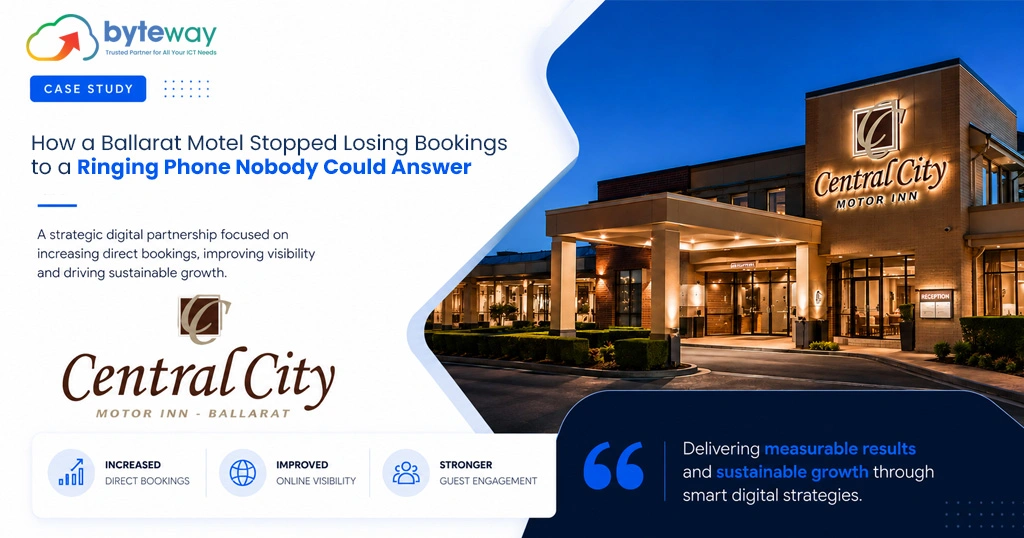
Ballarat Central City Motor Inn (CC Motor Inn)
case-studies

How a Ballarat Motel Stopped Losing Bookings to a Ringing Phone Nobody Could Answer

Every missed call at a motel is a guest who books somewhere else. Ballarat Central City Motor Inn found that out the hard way. Byteway, an Australian business telecommunications provider, helped the motel replace its outdated phone system, upgrade its internet, and give staff the flexibility to answer guest calls from anywhere. Here’s how the upgrade helped CC Motor Inn stop missing calls and bookings. Company Overview Ballarat Central City Motor Inn sits in the heart of Ballarat, Victoria, one of regional Australia’s busiest tourism and business travel hubs. Guests come through for weddings, sporting events, business trips, and the steady flow of visitors that regional Victoria attracts year-round. Running a motel in a town like Ballarat means reception can’t always be behind the desk. Staff check guests in, deal with maintenance issues, manage housekeeping, and handle the dozens of small tasks that keep a property running. The phone still has to be answered through all of it. That’s where things started to break down. The Business Challenges CC Motor Inn’s front-of-house team was working with a traditional onsite phone system tied to a single physical location. When reception staff stepped away, and at a working motel that happens constantly, calls simply went unanswered. The problems stacked up: For a motel, a missed call isn’t a minor inconvenience. It’s a room that stays empty and revenue that never shows up. Why the Existing System Failed? The core issue was structural. A traditional onsite phone system ties calls to physical handsets in one building. If nobody is standing at the front desk when the phone rings, the call goes nowhere. Add unreliable internet into that mix, and you get dropped calls, poor voice quality, and a system that can’t support modern ways of working, like staff answering guest enquiries from a mobile phone or a laptop. CC Motor Inn’s old VoIP setup made things worse. It carried the same fixed-location limitations as a traditional phone line, without solving the actual problem: getting calls to whoever’s available, wherever they are. The Solution: A Cloud-First Communication Upgrade Byteway worked with CC Motor Inn to redesign how the property handles calls and connectivity from the ground up. Solution Provided: The result: calls now reach whoever’s available, not just whoever happens to be standing at the desk. Technology Stack Component Solution Phone System Cloud Phone System (Cloud PBX) Handsets Yealink business phones Mobile Access Softphone app (iOS/Android) Internet Business NBN Fibre Network Hardware Upgraded business-grade modem Remote Staff Access Softphone app configured for overseas team member Why a Cloud Phone System Was the Right Fit? A cloud phone system, sometimes called a Cloud PBX, doesn’t tie calls to a desk or a building. Calls route through the internet to whichever device a staff member is using, whether that’s a Yealink handset at reception or a softphone app on a mobile phone. For a hospitality business, that’s the difference between a guest reaching someone and a guest hanging up. Why it mattered for CC Motor Inn: Why Business Fibre Was Necessary? A cloud phone system runs on internet, which means the internet connection has to be dependable. CC Motor Inn’s previous connection wasn’t up to the job: it was slow, inconsistent, and couldn’t reliably support voice traffic alongside everyday business use like bookings, email, and guest Wi-Fi. Business NBN Fibre gave the property a connection built for that load. Byteway also replaced the modem, since ageing hardware was contributing to the reliability issues even before the internet upgrade. The outcome: faster speeds, fewer dropouts, and a network that can carry phone calls and daily operations at the same time without either one suffering. Before vs After Area Before After Phone System Onsite, fixed-location system Cloud phone system, accessible anywhere Call Answering Missed when staff away from desk Answered via mobile app or handset Remote Staff Not supported Overseas team member answers calls via softphone Internet Slow, unreliable Business NBN Fibre Call Quality Poor Clear, consistent Network Hardware Ageing modem Upgraded business-grade hardware Booking Enquiries Frequently missed Answered promptly Implementation Timeline Results Achieved Since the upgrade, CC Motor Inn has seen a measurable shift in how the business runs day to day. Client Benefits For a motel, the phone is often the first point of contact a guest ever has with the business. Getting that right pays off in ways that go beyond convenience. Direct benefits for CC Motor Inn: ROI: What the Upgrade Actually Delivers The return on this kind of upgrade isn’t abstract. Every missed call at a motel is a potential booking lost to a competitor, often one just a search result away. By closing that gap, CC Motor Inn recovers enquiries it was previously losing before they ever became a reservation. Add in the operational side: less time troubleshooting an unreliable phone system, fewer complaints about call quality, and a network that supports the business instead of slowing it down. The combined effect is a communication system that pays for itself through bookings that would otherwise have gone unanswered. Lessons for Other Hospitality Businesses CC Motor Inn’s experience isn’t unique. Motels, hotels, caravan parks, and tourism operators across Australia run into the same problem: reception staff can’t be tied to a single phone in a single location all day. Key takeaways for other operators: Why Australian Motels and Accommodation Providers Should Upgrade? Guests today expect a call to be answered. If it isn’t, most will simply try the next property on their list. That’s true whether you’re running a motel in Ballarat, a caravan park in regional Victoria, or a resort further afield. A cloud phone system paired with Business NBN Fibre gives accommodation providers: Frequently Asked Questions What is a cloud phone system? A cloud phone system, also called a Cloud PBX, routes calls over the internet instead of through fixed onsite phone lines. Staff can answer calls from a desk handset, a laptop, or a mobile app, regardless of location. Why did CC Motor Inn’s old VoIP system stop working?

Uncategorized

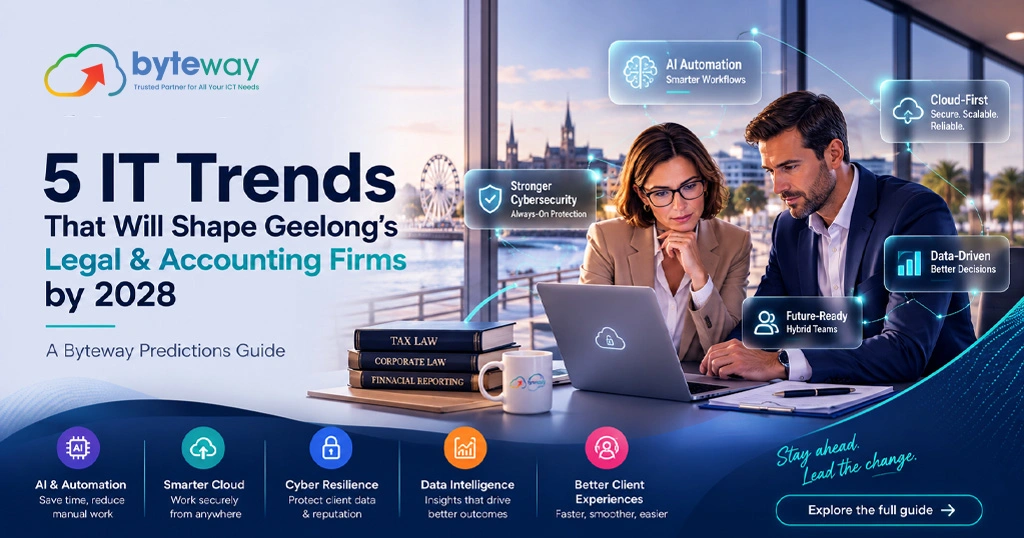
5 IT Trends That Will Shape Geelong’s Legal & Accounting Firms by 2028: A Byteway Predictions Guide 

Legal and accounting firms across Geelong are under growing pressure to work faster, stay secure, and manage increasing digital workloads.  AI tools are now becoming part of daily legal operations. Client expectations are rising. Faster workflows and smarter collaboration systems are quickly becoming standard across professional service firms.  At the same time, many firms are still relying on older systems that create delays, workflow pressure, and operational inefficiencies. For many professional service firms, reliable technology is now becoming part of competitive advantage itself.  Why Professional Services Are Changing  Professional service firms are operating in a far more digital environment than they were a few years ago.   Recent Australian legal technology trends also show firms are moving beyond AI experimentation into practical digital workflows, cybersecurity planning, and connected operational systems.  Clients now expect faster communication, secure document handling, smoother file sharing, and easier remote accessibility. Think about a busy accounting firm during tax season.  Now imagine internet disruptions, delayed access to files, or slower communication during peak workload periods. The operational pressure quickly grows across the entire team.  Client Expectations Are Becoming Faster  Business clients increasingly expect quicker responses and smoother digital experiences from legal and accounting firms.  Recent Australian customer experience research also shows that 80% of customers now consider the overall experience to be just as important as the services being delivered.  Australian clients are also placing greater focus on transparency, secure communication, personalised service, and easier digital interactions.  Delays that may have been acceptable a few years ago now create frustration much faster.  This is especially true for firms managing time sensitive legal matters, tax deadlines, compliance reporting, and financial documentation.  For many Geelong firms, responsiveness is now becoming part of overall client experience and long term client retention.  1. Remote Work Will Continue Expanding  Hybrid work is becoming part of long term operations for many professional service firms.  Recent Australian workplace trends show the “3 days office, 2 days remote” model is now becoming standard across legal, consulting, and financial industries.  Lawyers, accountants, consultants, and administrative staff increasingly need secure access to systems from multiple locations.  This is creating new pressure on older office based IT environments. For many Geelong firms, remote access is no longer simply a convenience. It is becoming part of everyday business operations.  Older Systems Are Creating Delays  Many firms still rely on older infrastructure that was designed mainly for office based work. This often creates slower workflows, inconsistent remote access, and communication bottlenecks.  Even small delays can affect productivity during busy client periods. Imagine staff waiting longer to access files while clients are expecting immediate responses.  Over time, these operational inefficiencies become more noticeable.  2. AI Driven Operations Will Grow Faster  AI tools are becoming more common across professional service environments.  Recent Australian legal technology research also shows only 16% to 20% of Australian legal professionals currently use AI tools daily, despite growing pressure for faster workflows and operational efficiency.  Many firms are already exploring AI based scheduling, enquiry handling, appointment coordination, and operational automation.  This does not mean replacing professional expertise. Instead, many firms are using AI to reduce repetitive administrative pressure.  For smaller firms managing limited staffing resources, this operational support is becoming increasingly valuable.  IT Trends Geelong Firms Should Prepare For  Administrative pressure continues growing for many professional service firms. Staff are often managing client communication, scheduling, onboarding, document handling, compliance processes, and reporting simultaneously.  This creates operational fatigue during busy periods. Recent industry research also shows firms using AI powered operational tools are significantly more likely to improve workflow efficiency and revenue performance compared to slower adopters.  Many firms are now reviewing how automation and smarter systems can reduce repetitive workload without disrupting existing operations.  These IT Trends Geelong businesses are adopting are helping firms reduce repetitive operational workload. 3. Cybersecurity Pressure Will Keep Increasing  Legal and accounting firms handle highly sensitive information every day. This includes contracts, financial records, identification data, legal documentation, and confidential communications.  Recent Australian cybersecurity reports continue showing growing operational risks for smaller and medium sized organisations.  Cybersecurity and data protection expectations are also expected to become stricter across professional service industries over the next few years.  For many firms, cybersecurity is no longer simply an IT issue. It is becoming a business continuity issue.  Why Security Expectations Are Rising  Clients are becoming more aware of data protection risks. Businesses are also facing growing pressure around operational reliability and secure handling of information.  Imagine a legal firm suddenly losing access to critical client files during an active case. The operational disruption alone can create major pressure across the organisation.  This is why many firms are now taking cybersecurity planning more seriously.  4. Cloud First Operations Will Become More Common  Cloud based infrastructure is becoming more important for modern professional service firms.  Many Australian firms are already shifting toward cloud first operations to support remote work, scalability, and operational flexibility.  Many businesses are moving away from heavily localised systems that create limitations around scalability and remote accessibility.  Cloud environments now support smoother collaboration, secure backups, operational flexibility, and easier scalability. For growing firms, flexibility is becoming just as important as stability.  Business Continuity Is Becoming More Important  Unexpected downtime can quickly disrupt operations. Operational downtime is becoming increasingly costly for businesses operating in highly time sensitive environments.  Internet outages, cyber incidents, server failures, or system disruptions can affect communication, productivity, and customer experience. This is creating stronger focus on recovery planning and operational continuity.  Many firms are reviewing how quickly systems can recover during operational disruptions. The pressure is growing around maintaining uninterrupted daily operations.  5. NBN Fibre And Faster Connectivity Will Shape Operations  Reliable connectivity is becoming essential for professional service firms.  Modern professional service firms increasingly depend on stable connectivity for cloud systems, video meetings, and remote collaboration.  Video consultations, cloud systems, AI tools, remote access, and large document transfers all depend on stable internet infrastructure.  This is one reason why many Australian firms are reviewing NBN fibre upgrades and modern business internet solutions.  Slow or unreliable connectivity can now directly affect operational efficiency.  For many firms, internet reliability is becoming part of long term infrastructure planning.  Why Operational Reliability Matters More Now  Professional service firms operate in highly time sensitive environments.  A delayed response, inaccessible document, or communication breakdown can quickly affect client trust.  This

Uncategorized

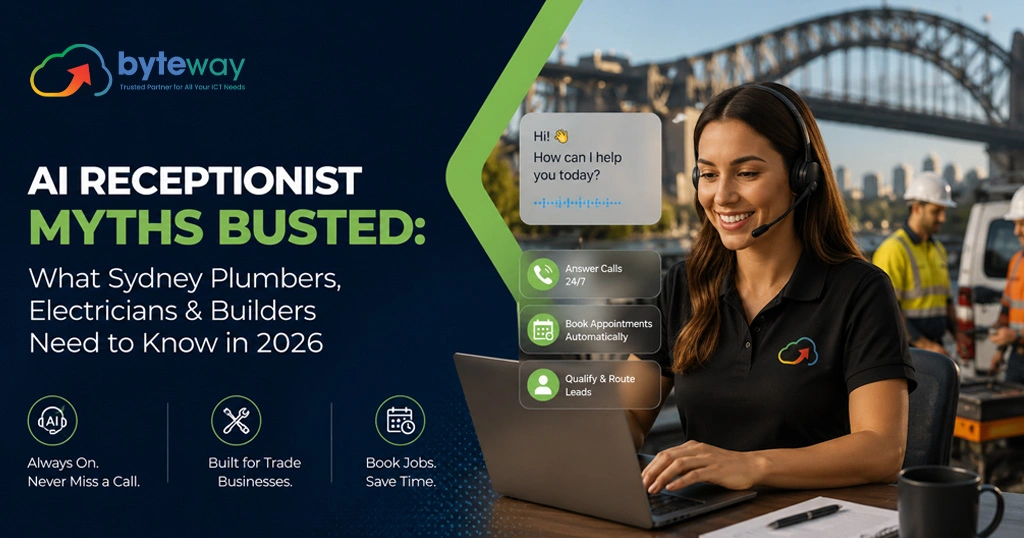
AI Receptionist Myths Busted: What Sydney Plumbers, Electricians & Builders Need to Know in 2026 

AI Receptionist myths still create hesitation for may Sydney trades businesses in 2026. For plumbers, electricians, and builders, answering every enquiry is becoming increasingly difficult. Australian SMEs reportedly miss between 22% and 62% of incoming calls annually.  This contributes to more than $8 billion in lost revenue every year. Customer expectations are also changing across Australia. Many customers now expect fast responses and quick booking confirmations, even outside standard business hours.  This is one reason why more businesses are now exploring AI receptionist Australia solutions. Many trades businesses previously believed AI receptionist systems sounded too robotic or expensive. However, modern AI receptionist technology has improved significantly in recent years.  Why Trades Businesses Are Missing Calls  Trades businesses across Sydney are operating in highly competitive markets. Customers often contact multiple businesses before making a booking decision.  For plumbers, electricians, and builders, managing customer calls while handling onsite work has become increasingly difficult.  Busy Onsite Work Creates Delays  Many trades teams spend most of the day attending active jobs or travelling between locations.  During busy hours, incoming customer calls often go unanswered because staff are already onsite.  Missed Calls Affect Business Growth  Missed calls can quickly lead to lost bookings and delayed customer enquiries.  Over time, slow response times can also affect customer trust and future booking opportunities.  For many Sydney trades businesses, fast response times are now becoming a major factor in winning new customers.  After Hours Calls Are Increasing  Another major challenge for Sydney trades businesses is after-hours customer calls.  Industry reports suggest that up to 34% of service bookings now happen outside standard business hours.  This is especially common for emergency plumbing, electrical, and repair enquiries.  Many customers now expect quick responses, even during evenings or weekends.  Businesses relying only on voicemail systems often miss these booking opportunities completely.  This is one reason why more trades businesses are exploring AI receptionist Australia solutions to help answer customer enquiries outside normal working hours.  Why AI Receptionists Are Becoming More Popular  This is one reason why more Sydney trades businesses are exploring AI receptionist Australia solutions.  Many Sydney trades businesses are using AI receptionist Australia solutions to reduce missed customer calls and improve response times during busy work hours.  AI Receptionist Myths  Despite growing adoption, many trades businesses still believe common AI receptionist myths around customer communication and automation. Most concerns are based on older automated phone systems that created frustrating customer experiences.  AI Receptionists Sound Too Robotic  One of the biggest concerns for trades businesses is how customers will respond to AI phone answering systems.   Older systems often relied on rigid scripts and poor voice recognition.  However, modern AI receptionist systems are now far more natural and conversational.  Modern Systems Feel More Natural  Today’s AI receptionist systems can answer common customer questions, capture booking enquiries, and collect customer details more naturally.  For many customers, quick response times now matter more than whether the first interaction is handled by AI or a receptionist.  AI Receptionists Are Not Just for Large Businesses  Many small business owners still believe AI receptionist systems are only suitable for large companies.  However, more Australian trades businesses are now adopting AI receptionist solutions to help manage customer calls without hiring additional office staff immediately.  Smaller Businesses Are Adopting AI Faster  Trades businesses are increasingly using AI systems to support customer communication without immediately hiring additional office staff.  In many cases, AI systems work alongside existing teams rather than replacing them completely.  AI Setup Is Too Complicated  Another common AI receptionist myth is that implementation requires major technical changes.  Most modern cloud-based AI receptionist systems are designed for easy integration into existing business operations.  Simpler Setup Is Driving Adoption  Many solutions can connect with existing phone systems, scheduling tools, and enquiry workflows without major disruption.  For busy trades businesses, simplicity and flexibility are becoming major priorities when adopting new communication tools.  How AI Receptionists Are Helping Trades Businesses  AI receptionist systems are no longer simply basic answering tools.  Many Sydney trades businesses now use them to reduce missed customer calls and capture more booking enquiries during busy work hours.  Faster Response Times  One major advantage is instant call answering.  When customers contact a business during busy work hours, AI receptionist systems can answer immediately and collect customer details.  This helps businesses reduce missed booking opportunities.  Managing High Call Volumes  Trades businesses often receive multiple customer enquiries throughout the day.  During busy periods, answering every call manually becomes difficult.  AI receptionist systems help businesses handle more incoming calls without missing customer enquiries.  Better After Hours Support  Many customer calls happen outside standard business hours.  This is especially common for emergency plumbing, electrical, and repair enquiries.  Businesses relying only on voicemail systems may lose these bookings quickly.  AI receptionist systems help trades businesses remain available even when staff are onsite or unavailable.  Reducing Missed Booking Enquiries  Many office teams spend significant time answering repetitive customer calls and booking requests.  AI receptionist systems can help capture these enquiries automatically, helping businesses reduce missed calls during busy periods.  Faster Responses Influence Customer Decisions  Customers often contact multiple trades businesses before making a booking decision.  Businesses that respond faster often appear more reliable and easier to deal with.  Research also shows that 78% of customers are more likely to choose the business that responds first.  For highly competitive Sydney trades industries, response speed can directly influence booking conversions.  Helping Businesses Stay Available 24/7  Another major advantage is continuous call answering support. AI receptionist systems can continue handling customer enquiries outside normal business hours.  This helps businesses reduce missed calls and capture more after-hours booking opportunities. Want to reduce missed customer calls and improve response times?  Explore Byteway’s AI receptionist solutions for Sydney trades businesses and discover how AI receptionist systems can help your business stay available 24/7.  Why More Australian Trades Businesses Are Exploring AI Receptionists  Businesses across Sydney, Melbourne, Geelong, and Ballarat are increasingly exploring AI receptionist systems to help reduce missed customer calls.  For many trades businesses, handling every customer enquiry during busy work hours has become increasingly difficult.  AI receptionist systems are helping

Uncategorized

Cybersecurity for Australian Retailers in 2026: Why Strong Cybersecurity Matters More Than Ever?

Cybersecurity for Australian retailers is becoming increasingly important in 2026 as cybercrime threats continue rising across businesses nationwide. A cybercrime is now reported every six minutes in Australia, and small businesses remain one of the biggest targets for attackers. According to Australian cybersecurity reports, the average cybercrime incident now costs small businesses around $80,000 per attack, making cybersecurity one of the biggest operational risks facing Australian businesses in 2026. Retail and hospitality businesses across Melbourne are particularly vulnerable because they rely heavily on digital payments, online bookings, customer databases, cloud systems, and connected devices.  From cafés and restaurants to retail stores and accommodation providers, businesses are increasingly operating in environments where even a single phishing email or ransomware attack can disrupt operations completely. Cybercriminals are no longer only targeting large enterprises. Small and medium businesses are now considered easier entry points because many still operate with outdated systems, weak passwords, unsecured devices, or limited cybersecurity monitoring.  For Melbourne businesses, cybersecurity is no longer just an IT issue. It has become a business continuity, customer trust, and reputation issue. Cybersecurity for Australian retailers continue to become a major concern as businesses rely on a digital systems and online transactions. Retail and hospitality businesses handle hundreds of transactions and customer interactions daily. Staff members often focus on customer service, bookings, inventory management, supplier coordination, and payment processing throughout the day. Because operations move quickly, cybersecurity is sometimes overlooked until an incident occurs.  Why Cybersecurity for Australian Retailers is Becoming More Important Modern businesses also rely on multiple connected systems simultaneously. Point-of-sale systems, online ordering platforms, payment gateways, cloud-based accounting software, customer loyalty programs, staff mobile devices, and guest Wi-Fi networks all create possible entry points for attackers.  According to the Australian Cyber Security Centre’s annual threat report and recent 2026 scam trends in Australia, phishing attacks, ransomware incidents, credential theft, and business email compromise continue rising across Australian businesses. Retail and hospitality businesses remain especially vulnerable because of high transaction volumes and multiple employee access points   Australian businesses are also facing growing pressure under the Privacy Act and the Notifiable Data Breaches scheme. A cyberattack exposing customer information can quickly create financial, legal, and reputational consequences for businesses across Melbourne, Geelong, and Ballarat.  Cybersecurity for Australian retailers is becoming increasingly important for protecting customer data, payment systems, and connected business networks. The Biggest Cybersecurity Threats Australian Businesses Are Facing in 2026  AI-Powered Phishing Attacks Are Increasing  Phishing attacks have become much more advanced in 2026. Cybercriminals are now using AI-generated emails, fake supplier invoices, realistic payment requests, and even voice impersonation scams to trick employees into revealing sensitive information.  Many Melbourne businesses are now adopting advanced phishing protection solutions like PhishCare to strengthen protection against employee-targeted cyber threats.   A Melbourne retailer may receive what appears to be a genuine invoice from a supplier, while a hospitality business may receive a fake payment confirmation link that looks completely legitimate. In many cases, a single click is enough to compromise passwords, payment systems, or customer information.  Cybersecurity reports across Australia show that phishing remains one of the most common entry points for cybercrime because attackers increasingly target human behaviour rather than directly attacking systems.  Ransomware Attacks Continue Rising  Ransomware remains one of the most damaging cybersecurity threats facing Australian businesses in 2026. These attacks encrypt business files and demand payment before restoring access.  For retail and hospitality businesses, downtime immediately affects revenue and customer experience. A restaurant unable to process bookings or a retailer losing access to POS systems during trading hours can face serious operational disruption within minutes.  Cybersecurity researchers also report growing use of “Ransomware-as-a-Service,” where cybercriminals purchase ready-made ransomware tools online. This has increased attacks against small businesses that previously believed they were unlikely targets.  Credential Theft and Password Attacks Are Growing  Credential theft is becoming one of the fastest-growing cyber threats globally. Instead of directly hacking systems, attackers increasingly focus on stealing employee login credentials.  Many businesses still use weak passwords, shared accounts, or repeated login credentials across systems. Once attackers gain access to one compromised account, they can often move through connected business systems quickly.  This is why stronger password policies, secure authentication systems, and endpoint protection are becoming critical for retail cybersecurity in Australia.  Unsecured Devices and Networks Increase Risk  Retail and hospitality businesses use multiple connected devices daily, including tablets, mobile devices, POS systems, kiosks, and customer Wi-Fi networks.  Without proper firewall security, Melbourne businesses may become vulnerable to malware, unauthorised access attempts, and network breaches. Businesses offering customer Wi-Fi should also ensure guest networks remain separated from internal operational systems.  As more businesses adopt digital operations, endpoint protection and secure network management are becoming essential parts of small business cybersecurity Australia 2026 strategies.  What Melbourne Businesses Must Focus On Now  Cybersecurity in 2026 requires more than basic antivirus software. Businesses now need practical protection strategies that reduce risks across employees, networks, devices, and cloud systems.  Managed Cybersecurity Melbourne Services Are Becoming Essential  Many small businesses do not have internal cybersecurity teams capable of monitoring threats continuously. This is why managed cybersecurity Melbourne services are becoming increasingly important for retailers and hospitality businesses.  Managed cybersecurity solutions help businesses detect suspicious behaviour early, strengthen firewall protection, monitor networks continuously, secure endpoints, manage updates, and reduce operational cybersecurity risks before incidents escalate.  Rather than reacting after an attack occurs, businesses can proactively strengthen protection and reduce long-term disruption.  Endpoint Protection Must Cover Every Device  Every connected device inside a business network can become a possible entry point for attackers. This includes POS systems, laptops, staff smartphones, tablets, and remote work devices.  Endpoint protection helps businesses identify malware, suspicious activity, and unauthorised access attempts before threats spread across systems. For businesses handling customer transactions daily, endpoint security has become one of the most important cybersecurity investments in 2026.  Staff Awareness Training Is Critical  Technology alone cannot fully stop cybercrime. Employees remain one of the most important cybersecurity factors within any business.  Businesses should ensure staff members understand how to identify suspicious emails, avoid malicious links, report unusual activity, and follow secure login practices. Even simple cybersecurity awareness training can significantly reduce phishing-related risks.  Many Australian businesses are also reviewing their cybersecurity checklist for small businesses in Australia to identify security gaps before attacks occur   Firewall Security and Secure Networks Matter More Than Ever  Many Australian businesses continue using outdated firewall systems that no longer provide sufficient

Scroll to Top