Author name: Muskan Gupta

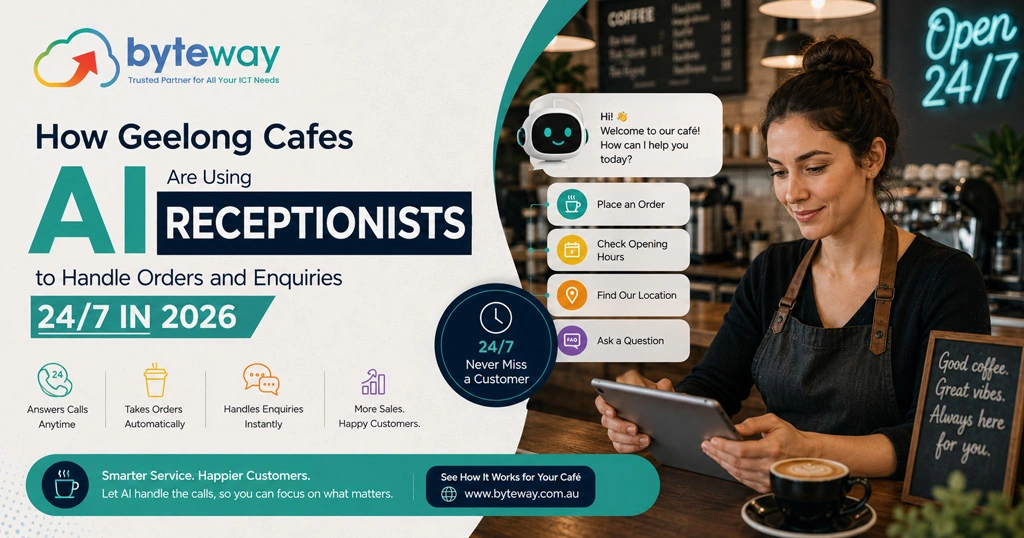
How Geelong Cafes Are Using AI Receptionists to Handle Orders and Enquiries 24 7 in 2026
Uncategorized

How Geelong Cafes Are Using AI Receptionists to Handle Orders and Enquiries 24/7 in 2026

There is a quiet shift happening across Geelong’s hospitality scene, and Byteway is at the centre of it. Walk into many local cafes today and you might notice something different, not in the coffee, but in how the business runs behind the counter. Byteway’s AI receptionist is handling the calls, responding to online enquiries, and confirming orders while the barista focuses entirely on the cup in front of them. For cafe owners and QSR operators across Geelong and regional Victoria, this is not a future scenario. It is already happening, and the gap between businesses that use it and those that do not is starting to show. The pressure on hospitality businesses in 2026 is real. Staffing remains unpredictable, customer expectations for fast responses have never been higher, and the cost of missing a booking or unanswered phone call adds up quickly. This is why Byteway’s AI-powered front-of-house solutions have moved from novelty to necessity for forward-thinking operators in the region. Why Geelong Cafes Are Picking Up the Phone Less and Serving More Think about a typical Saturday morning at a busy Geelong cafe. The phone rings six times before 9am. Each call is a customer asking about the menu, checking if they take walk-ins, or placing a pre-order for a work event. Every time a staff member answers that call, someone at the counter waits a little longer. Multiply that across a week and the hidden cost becomes impossible to ignore. Byteway’s AI calling agent for cafes in Geelong solves this without adding headcount. It answers calls instantly, provides accurate menu and hours information, takes reservations, and escalates to a human only when genuinely needed. Customers get a fast, consistent experience, and staff stay focused on the floor. For franchise managers running multiple locations, this kind of consistency across sites matters most. The Tech Running Quietly in the Background What makes Byteway’s AI receptionist different from the clunky phone trees of the past is the natural conversation quality. The system is trained specifically for hospitality contexts, so it understands questions like “do you have anything gluten-free for breakfast?” just as naturally as a team member would. It connects directly with an automated POS quick-service restaurant setup, so an order placed through an AI call flows straight into the kitchen without anyone re-entering it. In early 2026, updated guidelines around AI transparency in customer-facing services were introduced across several Australian states, requiring businesses to disclose when a customer is interacting with an automated system. Geelong operators using Byteway’s system are already meeting this standard, with a simple opening line that is honest, professional, and keeps customers comfortable. Handling AI Customer Enquiries Around the Clock One of the clearest advantages for food and beverage businesses is the overnight and early morning window. A customer planning a team breakfast at 10pm on a Tuesday should not have to wait until the cafe opens to get an answer. Byteway’s AI handles customer enquiries for food and beverage businesses so the question gets answered immediately, the booking gets confirmed, and the customer feels looked after. That kind of responsiveness used to require a dedicated staff member on rotation. Now Byteway handles it automatically, every single night. For cafe owners who have spent years managing the chaos of peak hour while enquiries pile up, this shift feels significant. It is not about replacing people. It is about making sure the people you have are doing the work that actually needs a human touch. Understanding how automation for cafes is already transforming day-to-day operations gives you a clearer picture of what is possible when Byteway’s tools are in place. What Managed IT Has to Do With All of This An AI receptionist is only as reliable as the infrastructure it runs on, and many cafe owners miss this point until something goes wrong. If the internet drops, the system goes with it. If the integration with the POS is not properly configured, orders get lost. This is where Byteway’s managed IT hospitality support becomes a core part of the setup rather than an afterthought. Byteway’s managed IT services ensure that the network, devices, and cloud connections running your AI tools are monitored, maintained, and protected around the clock. For multi-site operators across Geelong and regional Victoria, this means one team handling everything from NBN performance to system updates, so you are never left troubleshooting a tech failure during the morning rush. A Note for NGOs and NDIS Providers in Brisbane If you are reading this from a community services or not-for-profit context in Brisbane, the same principle applies in a different way. The 2026 updates to Australia’s Privacy Act have sharpened compliance obligations for NDIS providers, particularly around how participant data is stored, accessed, and protected. The penalties for non-compliance are serious, and the requirements for secure IT and cloud systems are now more specific than ever. Byteway works with NGOs and NDIS providers to build compliance-ready IT environments that meet these obligations without overwhelming already-stretched teams. Try Byteway’s AI Receptionist Free for 14 Days If you run a cafe, QSR, or food and beverage business in Geelong or regional Victoria, Byteway offers a 14-day free trial of its AI receptionist solution so you can see the impact before committing. During the trial, your business gets a fully configured Byteway system that answers calls, handles common enquiries, and integrates with your existing setup. There is no lock-in contract, no complicated onboarding, and a real Byteway support team behind the technology the entire time. Most operators notice a difference within the first 48 hours. Get started with Byteway today and find out what 24/7 front-of-house coverage actually feels like for your business. Want to speak with someone local? Find Byteway near you and book a quick call with the team. Frequently Asked Questions What is an AI receptionist for a cafe? Byteway’s AI receptionist answers calls, handles enquiries, and takes bookings automatically, so staff can focus on in-person service without interruption. Can Byteway’s AI receptionist take
managed it services williamstown
service-by-area

Managed IT Services in Williamstown

Byteway provides managed IT services in Williamstown to a suburb built around a working port, home to the Alfred Graving Dock and BAE Systems’ marine and defence operations, alongside a growing base of hospitality venues along Nelson Place and professional services firms serving clients across the bay in the CBD. Each of these business types needs something different from a phone-a-tech-when-it-breaks arrangement. What Williamstown Businesses Actually Need From Managed IT? Marine engineering and defence-adjacent contractors around the dockyard precinct need managed IT that accounts for industry-specific security and compliance obligations, not a generic small-office setup. Hospitality venues along Nelson Place and Ferguson Street need reliable point-of-sale and booking system uptime through weekend trade, when an outage costs real, immediate revenue. Professional services firms working with CBD-based clients need dependable email, file access, and video conferencing that doesn’t depend on someone remembering to check a server. Managed IT vs Ad-Hoc IT Support for Williamstown Businesses Most small Williamstown businesses have historically relied on calling someone when something breaks. Managed IT replaces that with proactive monitoring, catching a failing server or a suspicious login before it becomes a lost trading night or a compliance issue. Byteway prices managed IT for Williamstown businesses to cover this broader scope for less than the ongoing cost of reactive, pay-per-callout support. Local Support From a Team That Covers More Than Williamstown Byteway is based in Port Melbourne, close enough to Williamstown for fast on-site response, and pairs managed IT with business NBN or dedicated fibre, hosted phone systems, cyber security, and cloud backup, so a fault touching more than one system gets resolved by one team. Frequently Asked Questions What is the best managed IT service for a small business in Williamstown? The best managed IT service for a small Williamstown business combines proactive monitoring, included cybersecurity, and support scoped to whether the business is hospitality, professional services, or marine and industrial, rather than a generic package. Byteway scopes managed IT for Williamstown businesses around actual trading patterns and compliance needs. Byteway can scope the right managed IT plan for your Williamstown business. Does Byteway offer managed IT services for marine and defence-adjacent businesses in Williamstown? Yes, Byteway provides managed IT services in Williamstown for marine engineering and defence-adjacent contractors around the dockyard precinct, with security and compliance configuration scoped to industry-specific obligations rather than a standard small-office setup. Byteway can assess what a marine or industrial Williamstown business actually needs. Managed IT services vs in-house IT support in Williamstown, which is better for a small business? Managed IT is better value for most Williamstown small businesses, delivering monitoring, cybersecurity, and helpdesk coverage for less than the cost of hiring that breadth of skill in-house. Byteway prices managed IT for Williamstown businesses to cover this full scope without the overhead of an internal IT hire. Byteway can put together a cost comparison for your Williamstown business. Is managed IT worth it for a small hospitality business in Williamstown? Managed IT is worth it for most Williamstown hospitality businesses, since the cost of a single lost Saturday night to a booking system or EFTPOS outage typically exceeds a monthly managed IT fee many times over. Byteway prices managed IT plans around a hospitality venue’s actual trading pattern. Byteway can quote managed IT based on how your Williamstown venue actually trades. How fast does Byteway respond to managed IT issues in Williamstown? Byteway commits to documented response times for Williamstown clients, with most day-to-day issues resolved remotely and local, Port Melbourne-based technicians available for hardware and network work that needs hands-on attention. Ask Byteway what response time applies to your Williamstown business’s plan.

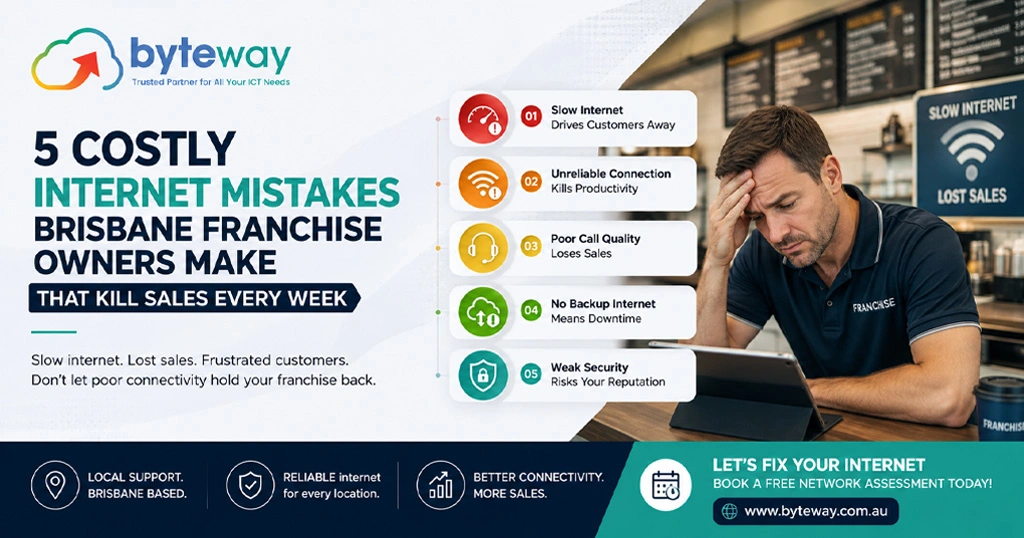
5 Costly Internet Mistakes Brisbane Franchise Owners Make That Kill Sales Every Week
Uncategorized

5 Costly Internet Mistakes Brisbane Franchise Owners Make That Kill Sales Every Week

Internet reliability is no longer a background concern for Brisbane franchise owners, and Byteway sees the cost of getting it wrong every day. It is the engine your entire operation runs on, and when it fails, the damage shows up in your sales figures before your IT team even knows something is wrong. From the EFTPOS terminal that freezes mid-transaction to the VoIP call that drops while a customer is placing an order, poor connectivity silently bleeds revenue out of businesses that could otherwise be thriving. What makes this worse is that most franchise owners assume their current setup is fine until it visibly falls apart. Byteway has worked with enough Brisbane franchises to know the mistakes that cost the most are not the dramatic ones. They are the quiet, avoidable ones that have been sitting in plain sight for months. Here are five of them. Mistake 1: Running Your Whole Business on a Residential-Grade NBN Plan This is the most common and most expensive mistake franchise owners make. A residential NBN connection looks similar to a business one on paper, especially when the speeds seem adequate. The difference only becomes clear when something goes wrong. Byteway’s business-grade NBN for business plans come with Service Level Agreements that guarantee restoration timeframes if your connection drops. Residential plans offer no such commitment. You are simply placed in a queue. For a Brisbane franchise doing consistent foot traffic or online orders, a four-hour outage with no guaranteed fix time is not a service disruption. It is a revenue event. Beyond that, residential plans use what is called “best effort” traffic handling, meaning your connection competes with every other household on the same node during peak hours. Byteway’s business plans use priority data tiers that maintain performance when the network is under strain. If your store slows down at lunchtime, this is likely why. Mistake 2: No Failover Plan When the Connection Drops Most franchise owners have a single internet connection. When it goes down, everything stops. That means no EFTPOS, no cloud POS system, no VoIP calls, and no real-time inventory updates across locations. A single point of failure is not a risk worth carrying in 2026. Byteway’s 4G failover solution changes this entirely. When your primary NBN connection drops, a cellular backup on a separate network carrier takes over automatically, often within seconds and without any action from your team. The switchover is invisible to customers. Sales continue. Calls continue. The cost of a Byteway-managed failover setup is typically a fraction of what a single afternoon of downtime costs a busy Brisbane franchise location, which makes it one of the clearest ROI decisions in business IT. Mistake 3: Using VoIP Without the Right Internet Infrastructure Behind It Many franchise businesses have moved to VoIP phone systems expecting cheaper calls and more flexibility, which VoIP absolutely delivers, but only when the underlying internet connection is properly configured to support it something Byteway checks on every VoIP install. VoIP is highly sensitive to what is called jitter and latency, which are basically small irregularities in how data packets travel across your network. On a congested residential NBN connection, these irregularities are common, and they show up as choppy calls, dropped audio, or calls that disconnect mid-sentence. If your team has started avoiding phone calls or customers are complaining about call quality, the problem is almost certainly not the VoIP platform. It is the internet connection carrying it. Byteway’s business-grade connections with quality-of-service settings prioritise voice traffic over other data, which is what keeps your calls sounding professional. Mistake 4: Ignoring NBN Downtime Data Until It Becomes a Crisis Brisbane franchise owners running multiple locations often have no centralised visibility into what is happening with their internet connections until a staff member calls to say the system is down. By that point, revenue has already been lost, and the team on the ground is frustrated. Byteway’s proactive network monitoring changes this dynamic entirely. Rather than finding out about an outage from a panicked employee, your Byteway IT support partner gets an alert the moment performance drops, often before it becomes a full outage. Issues can be diagnosed and addressed before customers are ever affected. This is where Byteway’s managed IT services for retail chains earn their value. The monitoring runs around the clock, and the response does not depend on a staff member noticing something is wrong and having the presence of mind to call it in during a busy Saturday shift. Mistake 5: Treating IT Infrastructure as a Cost to Minimise Rather Than an Asset to Invest In This mindset is understandable. Franchise owners are watching margins carefully, and IT infrastructure does not feel like it generates revenue the way stock or staffing does. But poorly managed internet infrastructure costs money in ways that never show up as a single line item. Slow load times on your ordering system reduce transaction throughput. Staff spending time on workarounds for connectivity issues are not serving customers. VoIP calls that drop erode customer confidence. These costs are real, they compound daily, and they are entirely preventable which is why Byteway treats connectivity as core infrastructure, not an afterthought. In 2026, the Australian Government’s ongoing push toward digital infrastructure investment has also raised expectations from customers and supply chain partners alike. Franchise networks that lag on connectivity standards are not just losing sales today. They are building a gap that becomes harder to close the longer it goes unaddressed. What Brisbane Franchise Owners Should Do Now? Start by honestly auditing how your team spends its time when technology fails them. How often does the internet drop? How long does it take to restore? What happens to sales during that window? The answers will almost certainly show that the status quo is more expensive than the fix and Byteway can run this audit with you at no cost. From there, the conversation becomes straightforward. Business-grade NBN, a 4G failover solution, and properly configured VoIP infrastructure are not

managed it services Ringwood
service-by-area

Managed IT Services in Ringwood

Byteway supports Ringwood’s growing business precinct with managed IT built to scale. Byteway provides managed IT services in Ringwood to a suburb shifting fast from a retail-and-transport hub into a genuine commercial centre for Melbourne’s outer east. Eastland, Australia’s fourth-largest shopping centre, now anchors a much larger mixed-use precinct, with new A-grade office towers at 110 Maroondah Highway and 5 Bond Street, plus flexible coworking space at Waterman Eastland drawing businesses that didn’t have a reason to set up in Ringwood a decade ago. Population growth of almost 39% projected by 2046 means that shift isn’t slowing down. What Ringwood Businesses Actually Need From Managed IT? Retailers inside Eastland need point-of-sale and network reliability that holds up through heavy foot traffic, especially on weekends. Businesses moving into Ringwood’s newer A-grade office towers need IT infrastructure set up before day one, not scrambled together after the move. Small teams taking space at Waterman Eastland need managed IT that works for a handful of people today and scales without a system rebuild as headcount grows. Professional and public-service organisations relocating to Ringwood need the same standard of IT support they’d expect from a CBD address. Managed IT vs In-House IT for Ringwood Businesses Managed IT delivers broader coverage than in-house IT for most Ringwood businesses under 100 staff, particularly for smaller coworking-based teams that can’t justify a dedicated IT hire. Byteway prices managed IT for Ringwood businesses to cover monitoring, cybersecurity, and helpdesk support for less than the cost of building that breadth of skill internally. Support Byteway Provides Alongside Managed IT Byteway configures managed IT for Ringwood businesses alongside business NBN or dedicated fibre, hosted phone systems, cyber security, and cloud backup, delivered by a Melbourne-based team. Frequently Asked Questions What is the best managed IT service for a small business in Ringwood? The best managed IT service for a small Ringwood business combines proactive monitoring, included cybersecurity, and support scoped to whether the business is retail, office-based, or coworking, rather than a flat postcode-based package. Byteway scopes managed IT for Ringwood businesses around actual size and setup. Byteway can scope a managed IT plan around your specific Ringwood business. Can Byteway set up managed IT for a business moving into a new Ringwood office tower? Yes, Byteway plans and sets up managed IT for businesses relocating into Ringwood’s newer commercial space, including internet, phone systems, and network configuration, so everything is working before the first day of trade rather than pieced together afterward. Byteway can plan your Ringwood office move well ahead of the relocation date. Managed IT services vs in-house IT support in Ringwood, which suits a small coworking-based team? Managed IT suits most small Ringwood coworking-based teams better than in-house IT, since it covers cybersecurity and support that a two-to-five person team usually can’t justify hiring for directly, and scales automatically as the team grows. Byteway prices plans for small Ringwood teams accordingly. Byteway can quote managed IT for your Ringwood coworking-based team. Which managed IT services in Ringwood are best for retail businesses inside Eastland? The best managed IT services for Eastland-based retailers in Ringwood prioritise point-of-sale reliability and network uptime through the centre’s peak trading periods, since a short outage during a busy weekend costs real, immediate revenue. Byteway configures managed IT for Ringwood retail clients around this specific trading pattern. Byteway can scope managed IT for your Eastland retail business. How fast does Byteway respond to managed IT issues in Ringwood? Byteway commits to documented response times for Ringwood clients, with most day-to-day issues resolved remotely and local technicians available for hardware and network work across Ringwood’s office, retail, and coworking precincts. Ask Byteway what response time applies to your Ringwood business’s plan.

Benalla Road Takeaway & Cafe
case-studies

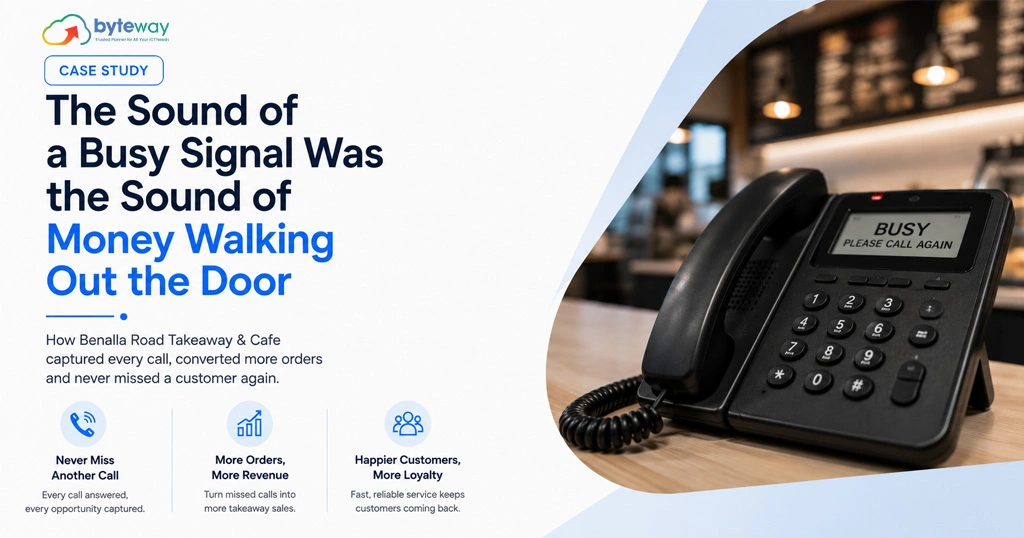
The Sound of a Busy Signal Was the Sound of Money Walking Out the Door

It’s 6:42pm on a Friday. The fryers are going, the grill’s covered, and somewhere behind the counter at Benalla Road Takeaway & Cafe, a phone is ringing into nothing. Byteway helped the cafe tackle this problem by upgrading its internet and replacing its single-line phone system with a Hosted Cloud Phone System, giving the business the capacity to handle peak-hour orders without busy signals. One Phone Line, a Hundred Hungry Customers Benalla Road Takeaway & Cafe sits on one of the steadiest strips in Benalla, Victoria, the kind of local spot where regulars know the staff by name and Friday night means fish and chips for half the street. It’s the sort of business built on volume and speed. Get the order taken, get it cooked, get it out the door. For years, that rhythm worked. Then it started to skip. The cafe was running on an old Loop phone system with a single line. One call in, one call out, nothing else. On a quiet Tuesday morning, that’s fine. On a Friday between 6pm and 8pm, when half the town wants dinner sorted in the next twenty minutes, one line is a bottleneck with a busy tone attached. “You’d see it happening in real time. Someone would be mid-order on the phone, and you just knew there were people out there getting a busy signal, hanging up, and going somewhere else instead.” That’s not a guess. It’s the exact pattern Australian food businesses run into when call capacity doesn’t match demand: the phone works fine right up until the moment it actually matters. Did You Know? A single missed call at a busy takeaway can represent $30 to $60 in lost revenue once you factor in the average order value of a family dinner run. Multiply that across a two-hour Friday rush, and a one-line phone system can quietly cost a small food business thousands of dollars a year in orders that simply never got placed. The Internet Problem Nobody Could See The phone line wasn’t the only thing holding the business back. The internet connection behind the scenes was slow and unreliable, the kind of connection that works fine until three things happen at once: a card payment, an online order notification, and a staff member trying to check stock levels. That combination hit hardest exactly when the business could least afford it: during service. Slow internet doesn’t announce itself the way a busy signal does. It just makes everything a little harder, a little slower, a little more frustrating, until one day you realise the whole operation has been running with a limp for months. What Friday Night Actually Looked Like? Picture it. Six-fifteen, Friday evening. The counter has three people waiting. The kitchen has four tickets up. The phone rings, gets answered, and while that order’s being taken, three more calls hit the same engaged tone. Two of those callers try again in five minutes. One doesn’t bother. That one customer, multiplied across a year of Friday nights, is a meaningful chunk of missed revenue for a business this size. It’s also a customer who might not try calling back next Friday either. Once someone finds a takeaway shop that actually answers, habits change fast. Key Insight: In hospitality, a missed call rarely stays a one-off. It resets the customer’s default choice for next time. The Turning Point The team at Benalla Road Takeaway & Cafe didn’t wake up one day and decide they needed a “digital transformation.” They just wanted the phone to stop cutting people off, and they wanted the internet to stop dragging. That’s the conversation that led them to Byteway. Rather than replacing one problem with another, Byteway looked at the whole picture: an internet connection that couldn’t keep up, and a phone system that physically could not take more than one call at a time. Fixing one without the other would have left half the problem standing. The plan that came out of that conversation was straightforward: Nothing about that list is flashy. All of it was aimed at solving the exact moment that had been costing the business money for years: the second call that used to hit a busy tone. Two Lines Changed Everything Here’s the part that matters most for any takeaway shop reading this: a hosted phone system doesn’t route through a single physical line sitting in the back office. It runs through the cloud, which means the business could go from one line to two without ripping out the wiring or waiting weeks for a technician. Two concurrent lines meant two customers could be on the phone with Benalla Road Takeaway & Cafe at the exact same moment. No busy signal. No silent walk-away. Just two orders being taken instead of one and a lost sale. Paired with Business NBN Fibre running underneath it, the new setup gave the cafe the two things it actually needed: enough phone capacity to match a Friday rush, and an internet connection fast enough to carry it without dragging down everything else running in the background. Before vs After Area Before After Phone Lines One line, one call at a time Two concurrent lines Phone System Ageing Loop system Hosted Cloud Phone System Handsets Legacy equipment Fenvil business handsets Internet Slow, unreliable Business NBN Fibre Friday Rush Calls Busy signal during peak times Both lines answer simultaneously Missed Orders Frequent during service Rare Call Quality Inconsistent Clear and stable What Friday Night Sounds Like Now? Same time, same rush, different outcome. Six-fifteen on a Friday, three people at the counter, four tickets in the kitchen. The phone rings. It’s answered. It rings again a minute later, on the second line, and that gets answered too. Nobody outside the shop hears a busy tone anymore. Two customers can place an order in the same sixty seconds, and both of them get their dinner sorted instead of one of them driving to a competitor three streets over. Fewer missed orders. Better

managed it services balwyn
service-by-area

Managed IT Services in Balwyn

A medical clinic on Whitehorse Road loses patient record access for twenty minutes and every appointment for the rest of the morning runs late. A migration agency’s client portal goes down the day before a visa deadline. These aren’t hypothetical scenarios for Balwyn’s professional and medical practices, they’re the exact situations Byteway gets called in to prevent, not just fix after the fact. Balwyn’s Business Mix Runs on Trust and Uptime Balwyn is one of Melbourne’s more professionally concentrated suburbs, with close to 57% of residents working in professional or managerial roles and healthcare, professional services, and education making up the largest local industries. That translates into a business community heavy on medical and allied health clinics, legal and accounting practices, and education-adjacent services, plus an active migration and international education sector reflecting the suburb’s strong Chinese-Australian community. Every one of these business types depends on client trust, and client trust depends on systems that don’t fail at the wrong moment. What Managed IT Actually Changes for a Balwyn Practice? Most small practices around Whitehorse Road and Balwyn Road have historically called someone when something breaks. Managed IT flips that: Byteway monitors systems continuously, so a failing server or a suspicious login gets caught before it becomes a closed morning or a data breach notification. For a medical clinic, that means patient management software stays online. For a legal or migration practice, it means client portals and document systems stay accessible and secure, which matters as much for compliance as convenience. Support From a Team That Covers More Than Balwyn Byteway pairs managed IT for Balwyn businesses with business NBN or dedicated fibre, hosted phone systems, cyber security, and cloud backup, delivered by a Port Melbourne-based team that also supports practices across Melbourne’s eastern suburbs. Frequently Asked Questions What are the best managed IT services for a small medical or professional practice in Balwyn? The best managed IT services for a small Balwyn practice combine proactive monitoring, included cybersecurity, and compliant data handling scoped to healthcare or professional services obligations rather than a generic small-business package. Byteway prices managed IT for Balwyn clinics and practices around actual patient or client load, not a flat headcount assumption. Byteway can scope the right managed IT plan for your Balwyn practice. Is managed IT worth it for a small business in Balwyn, or is in-house IT better? Managed IT is worth it for most Balwyn small businesses under 100 staff, since it covers monitoring, cybersecurity, and compliance support for less than the cost of hiring that breadth of skill internally. Byteway prices managed IT to cover this full scope for Balwyn practices without the overhead of an internal IT hire. Ask Byteway for a cost comparison suited to your Balwyn business. Does Byteway support Microsoft 365 and patient management software for Balwyn clinics? Yes, Byteway includes Microsoft 365 administration and support for common patient management and practice software as part of managed IT for Balwyn healthcare and professional practices, rather than treating specialist software as outside standard coverage. Byteway can review your Balwyn practice’s current software setup and tighten security. How fast does Byteway respond to IT issues for Balwyn businesses? Byteway commits to documented response times for Balwyn clients, with urgent issues affecting patient care or client-facing systems prioritised over routine requests, rather than a first-come, first-served queue. Most issues are resolved remotely, with local technicians available for hardware work. Ask Byteway what response time applies to your Balwyn practice’s plan.

Top 10 Best NBN Standard Providers in Australia
Uncategorized

Best Business NBN Providers in Melbourne (2026): How to Compare & Choose

Choosing an NBN provider for your Melbourne business isn’t the same decision as picking a home internet plan. A business connection needs to handle video calls, cloud software, phone systems and payment terminals running at once often across an entire team, all day. The wrong choice shows up as dropped calls, slow file transfers, and support queues that don’t understand what “downtime” actually costs a business. This guide breaks down what actually matters when comparing business NBN providers in Melbourne, how to avoid the most common mistakes, and where Byteway fits into that picture. What to Look For in a Business NBN Provider? In short: prioritise SLAs, static IP options, and local support over headline speed numbers. Speed matters less than most businesses assume reliability and support response time are what actually affect day-to-day operations. Here’s the full criteria: Understanding Business NBN Speed Tiers In short: most offices don’t need the fastest tier available they need the right tier for how many people are working online at once. NBN speed tiers for business typically range from around 50Mbps up to 1000Mbps (Gigabit), with the right tier depending on team size, cloud software usage, and whether you’re running VoIP calls over the same connection. A 10-person office running cloud accounting software and video calls needs meaningfully more bandwidth than a 3-person office checking email. If your business is outgrowing NBN entirely heavy file transfers, large teams on video calls simultaneously, or you need guaranteed uncontended speed that’s usually the point to compare dedicated fibre instead of a higher NBN tier. Comparing Business NBN Providers Byteway — Best for Melbourne businesses wanting internet, phones, and IT under one local team. Dedicated business plans, no lock-in contracts, bundled with VoIP, managed IT, and cyber security. Aussie Broadband — Best for businesses wanting a large national provider with solid support. Business plans available, but connectivity-focused only no bundled IT or telecom services. Superloop — Best for businesses prioritising higher-speed tiers. Business plans available, connectivity-focused. TPG — Best for budget-conscious businesses. Business plans available, connectivity-focused. Optus — Best for businesses wanting mobile and internet bundled with a major telco. Limited IT services beyond mobile bundling. Common Mistakes Businesses Make When Choosing an NBN Provider In short: businesses tend to buy on price or top-line speed alone, then find out too late what wasn’t included. The most common issues: Switching NBN Providers: What’s Actually Involved In short: switching providers is usually a same-day cutover with no downtime if it’s planned properly. For most Melbourne businesses, moving to a new NBN provider involves three steps: an assessment of your current setup and requirements, a scheduled cutover date, and porting of any existing phone numbers if you’re bundling internet with a phone system. A properly managed switch shouldn’t mean a day of no internet — ask any provider you’re considering exactly how they handle the cutover before signing up. Why Melbourne Businesses Choose Byteway for Business NBN? Byteway is a Melbourne-based provider offering business NBN alongside dedicated fibre, phone systems, and managed IT all from one local team. For businesses that don’t want to manage separate vendors for internet, phones, and IT support, that’s the practical difference: one point of contact when something needs fixing, rather than three different support queues. See our Business NBN Plans for current pricing, or learn more about Business NBN for Melbourne companies. Frequently Asked Questions What’s the difference between a residential and a business NBN plan? Business NBN plans typically include stronger SLAs, static IP options, and priority fault response — features residential plans don’t offer. For any business relying on internet for revenue-generating work, this difference matters when something goes wrong. Do I need a static IP for my business? You’ll usually need one if you’re hosting services, using certain VPN setups, or running some on-premise phone systems. Most day-to-day office use doesn’t require one — Byteway can confirm what your setup actually needs during a free assessment. Can I bundle NBN with my phone system? Yes. Byteway bundles business NBN with Hosted PBX / Cloud VoIP (byteway.com.au/hosted-pbx-cloud-voip/), so your internet and phone system are managed by the same team — useful when diagnosing call quality issues that are often actually connectivity issues. What happens if my business internet goes down? This depends entirely on your provider’s SLA. Byteway’s business plans include defined support response times and a local Melbourne team, rather than an offshore queue with no fixed resolution timeframe. Is NBN enough for a growing business, or should I consider dedicated fibre? NBN suits most small-to-medium offices. If you need guaranteed uncontended bandwidth, symmetrical upload/download speeds, or you’re running heavy cloud/VoIP usage across a larger team, dedicated fibre (byteway.com.au/dedicated-fibre/) is worth comparing. How long does it take to switch NBN providers? A well-managed switch is usually a same-day cutover with no downtime, provided it’s scheduled properly and any phone numbers are ported in advance rather than as an afterthought. Does a faster NBN plan always mean better performance for my business? Not necessarily. A lower-speed plan with a strong SLA and dedicated support often outperforms a higher-speed plan with no service guarantee, especially for businesses where reliability matters more than peak throughput. Can I get NBN and mobile backup connectivity together? Yes. Some providers, including Byteway, can pair NBN with 5G business mobile plans as a failover option, so a primary line outage doesn’t take your whole office offline.

Ballarat Central City Motor Inn (CC Motor Inn)
case-studies

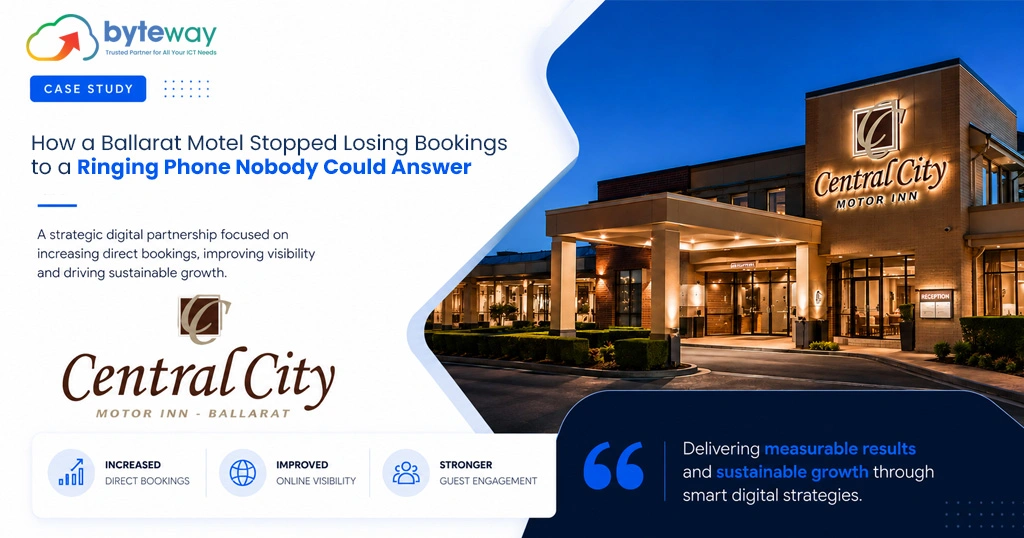
How a Ballarat Motel Stopped Losing Bookings to a Ringing Phone Nobody Could Answer

Every missed call at a motel is a guest who books somewhere else. Ballarat Central City Motor Inn found that out the hard way. Byteway, an Australian business telecommunications provider, helped the motel replace its outdated phone system, upgrade its internet, and give staff the flexibility to answer guest calls from anywhere. Here’s how the upgrade helped CC Motor Inn stop missing calls and bookings. Company Overview Ballarat Central City Motor Inn sits in the heart of Ballarat, Victoria, one of regional Australia’s busiest tourism and business travel hubs. Guests come through for weddings, sporting events, business trips, and the steady flow of visitors that regional Victoria attracts year-round. Running a motel in a town like Ballarat means reception can’t always be behind the desk. Staff check guests in, deal with maintenance issues, manage housekeeping, and handle the dozens of small tasks that keep a property running. The phone still has to be answered through all of it. That’s where things started to break down. The Business Challenges CC Motor Inn’s front-of-house team was working with a traditional onsite phone system tied to a single physical location. When reception staff stepped away, and at a working motel that happens constantly, calls simply went unanswered. The problems stacked up: For a motel, a missed call isn’t a minor inconvenience. It’s a room that stays empty and revenue that never shows up. Why the Existing System Failed? The core issue was structural. A traditional onsite phone system ties calls to physical handsets in one building. If nobody is standing at the front desk when the phone rings, the call goes nowhere. Add unreliable internet into that mix, and you get dropped calls, poor voice quality, and a system that can’t support modern ways of working, like staff answering guest enquiries from a mobile phone or a laptop. CC Motor Inn’s old VoIP setup made things worse. It carried the same fixed-location limitations as a traditional phone line, without solving the actual problem: getting calls to whoever’s available, wherever they are. The Solution: A Cloud-First Communication Upgrade Byteway worked with CC Motor Inn to redesign how the property handles calls and connectivity from the ground up. Solution Provided: The result: calls now reach whoever’s available, not just whoever happens to be standing at the desk. Technology Stack Component Solution Phone System Cloud Phone System (Cloud PBX) Handsets Yealink business phones Mobile Access Softphone app (iOS/Android) Internet Business NBN Fibre Network Hardware Upgraded business-grade modem Remote Staff Access Softphone app configured for overseas team member Why a Cloud Phone System Was the Right Fit? A cloud phone system, sometimes called a Cloud PBX, doesn’t tie calls to a desk or a building. Calls route through the internet to whichever device a staff member is using, whether that’s a Yealink handset at reception or a softphone app on a mobile phone. For a hospitality business, that’s the difference between a guest reaching someone and a guest hanging up. Why it mattered for CC Motor Inn: Why Business Fibre Was Necessary? A cloud phone system runs on internet, which means the internet connection has to be dependable. CC Motor Inn’s previous connection wasn’t up to the job: it was slow, inconsistent, and couldn’t reliably support voice traffic alongside everyday business use like bookings, email, and guest Wi-Fi. Business NBN Fibre gave the property a connection built for that load. Byteway also replaced the modem, since ageing hardware was contributing to the reliability issues even before the internet upgrade. The outcome: faster speeds, fewer dropouts, and a network that can carry phone calls and daily operations at the same time without either one suffering. Before vs After Area Before After Phone System Onsite, fixed-location system Cloud phone system, accessible anywhere Call Answering Missed when staff away from desk Answered via mobile app or handset Remote Staff Not supported Overseas team member answers calls via softphone Internet Slow, unreliable Business NBN Fibre Call Quality Poor Clear, consistent Network Hardware Ageing modem Upgraded business-grade hardware Booking Enquiries Frequently missed Answered promptly Implementation Timeline Results Achieved Since the upgrade, CC Motor Inn has seen a measurable shift in how the business runs day to day. Client Benefits For a motel, the phone is often the first point of contact a guest ever has with the business. Getting that right pays off in ways that go beyond convenience. Direct benefits for CC Motor Inn: ROI: What the Upgrade Actually Delivers The return on this kind of upgrade isn’t abstract. Every missed call at a motel is a potential booking lost to a competitor, often one just a search result away. By closing that gap, CC Motor Inn recovers enquiries it was previously losing before they ever became a reservation. Add in the operational side: less time troubleshooting an unreliable phone system, fewer complaints about call quality, and a network that supports the business instead of slowing it down. The combined effect is a communication system that pays for itself through bookings that would otherwise have gone unanswered. Lessons for Other Hospitality Businesses CC Motor Inn’s experience isn’t unique. Motels, hotels, caravan parks, and tourism operators across Australia run into the same problem: reception staff can’t be tied to a single phone in a single location all day. Key takeaways for other operators: Why Australian Motels and Accommodation Providers Should Upgrade? Guests today expect a call to be answered. If it isn’t, most will simply try the next property on their list. That’s true whether you’re running a motel in Ballarat, a caravan park in regional Victoria, or a resort further afield. A cloud phone system paired with Business NBN Fibre gives accommodation providers: Frequently Asked Questions What is a cloud phone system? A cloud phone system, also called a Cloud PBX, routes calls over the internet instead of through fixed onsite phone lines. Staff can answer calls from a desk handset, a laptop, or a mobile app, regardless of location. Why did CC Motor Inn’s old VoIP system stop working?

Business NBN Internet in Sydney
service-by-area

Business NBN Internet in Sydney

Byteway provides business NBN internet in Sydney to a market with more competing providers per business than almost anywhere else in the country, which creates a strange problem: too much choice, not enough clarity. A tenancy in a Barangaroo tower, a fintech office in Surry Hills, and a logistics operation out near the airport can all get sold “business-grade” internet, and only one of those plans might actually come with a fault restoration guarantee worth the name. Sydney Is Not One Connectivity Market Sydney’s geography and building age create more variation than almost any other Australian city. Premium CBD towers and newer precincts like Barangaroo are generally built on Fibre to the Premises, giving the highest ceiling for upload-heavy work like video conferencing and cloud backup. North Sydney and Parramatta, both major commercial precincts in their own right, have a mix of fibre and HFC depending on building age, with some older commercial stock still running on infrastructure that predates the area’s growth into a business district. The eastern suburbs and inner west, dense with heritage buildings and older apartment-style commercial space, frequently sit on HFC, which performs well most of the time but can show contention in buildings packed with tenants all online during business hours. Growth corridors across Western Sydney are largely Fibre to the Premises, built to current standards from the outset. The practical result is that a Sydney business can’t assume anything based on postcode alone. Byteway checks the specific access technology at the address before recommending a plan, because two tenancies in the same building can occasionally be provisioned differently depending on when each fit-out was completed. What Sydney’s Business Mix Needs? Financial services and professional services firms, concentrated through the CBD, North Sydney, and Barangaroo, carry compliance obligations that make a documented SLA non-negotiable rather than a nice-to-have, and most need static IP for secure remote access and VPN connections. Sydney’s tech and startup sector, clustered around Surry Hills, Ultimo, and increasingly Parramatta, tends to run cloud-native infrastructure and video-heavy collaboration tools that lean hard on upload speed, which is exactly where a poorly specified connection shows its limits first. Retail along Pitt Street Mall, George Street, and suburban shopping precincts depends on EFTPOS uptime through Sydney’s heavy foot traffic, where a short outage during a Saturday rush costs real revenue. Co-working operators, a large and growing category across the CBD and inner suburbs, need bandwidth sized to occupancy with properly segmented guest wifi, not a plan built around headcount on a lease agreement. Business NBN vs Dedicated Fibre for Sydney CBD Offices For businesses in premium CBD or Barangaroo towers where a connectivity outage stops trading floors, client-facing video calls, or compliance-critical systems, dedicated fibre is frequently worth the premium, particularly given how much is typically riding on uptime in these precincts. For most other Sydney businesses, business NBN with a genuine SLA, paired with a 4G or 5G failover connection where the risk warrants it, covers the exposure at a fraction of the cost. The deciding factor is what an outage actually costs your business, not the size of the office or the prestige of the address. National Support, Not a Call Centre Script Byteway supports Sydney businesses with the same managed IT, hosted VoIP phone systems, cyber security, and cloud backup services delivered across the rest of the country, backed by remote monitoring that resolves most faults the same day and an on-site network for the issues that need hands on equipment. Sydney clients running lean front-of-house teams have increasingly asked about Eva, Byteway’s AI voice agent, for handling after-hours and overflow calls without adding headcount. Frequently Asked Questions We’re Byteway, and these are the questions Sydney businesses ask us most. Which business NBN provider offers the fastest speeds in Sydney? Achievable speed depends more on the access technology at your specific address, FTTP, HFC, or FTTN, than on which provider’s name is on the invoice. Byteway check address-level availability first, then match the plan to genuine achievable performance rather than an advertised ceiling. Business NBN internet vs dedicated fibre for Sydney offices: which should I choose? If a short outage would stop trading, client calls, or compliance-critical systems, dedicated fibre is worth the extra cost. If your business could absorb an hour of reduced performance without real damage, business NBN with a proper SLA is the more sensible spend. Is Byteway better than Telstra or Optus for business NBN internet in Sydney? The larger telcos sell connectivity in isolation. Byteway bundles business NBN or dedicated fibre with managed IT, VoIP, and cyber security under one team, so a fault that touches more than one system gets resolved with a single call rather than being passed between separate support desks. Which business NBN internet in Sydney should I choose for a coworking space? Coworking spaces need bandwidth provisioned for peak occupancy, not headcount, plus guest wifi properly segmented from the operator’s own systems. We size these connections around actual concurrent use and can layer in dedicated fibre for the base building load where occupancy is high. Do Sydney business NBN plans support consistent performance during peak hours? With a genuine business-grade plan and the right access technology at the address, yes. Contention is more likely on shared HFC infrastructure in densely tenanted buildings during business hours, which is one of the reasons we check the specific site rather than assuming uniform performance across a suburb.

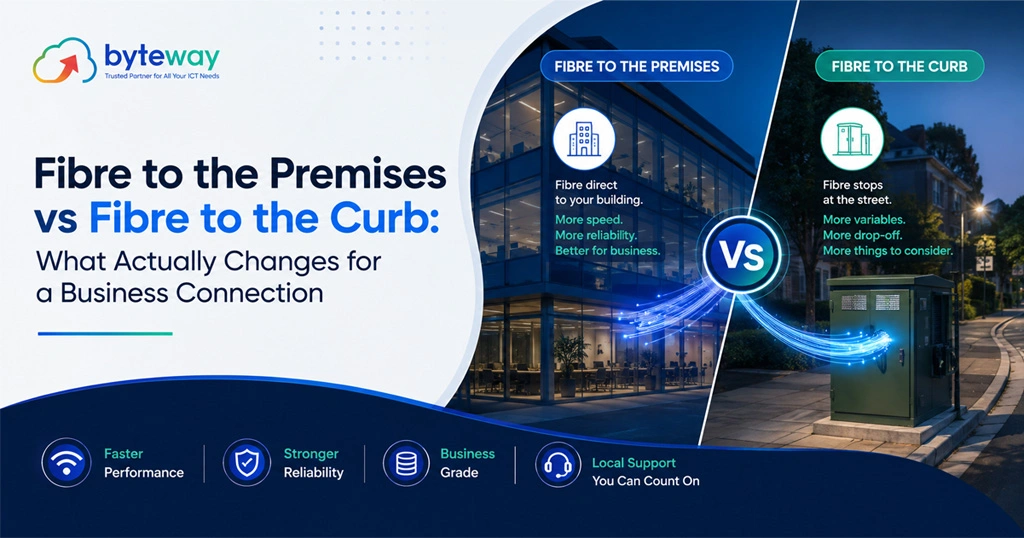
Fibre to the Premises vs Fibre to the Curb: What Actually Changes for a Business Connection
Uncategorized

Fibre to the Premises vs Fibre to the Curb: What Actually Changes for a Business Connection

Byteway sets up and manages Business NBN connections for companies across Australia, and one question comes up constantly from businesses on Fibre to the Curb: is it worth moving to full fibre, and what actually changes if we do? The short version is that the two are closer on paper than in practice, and the gap has widened over the past year. Here is what genuinely changes for a business connection, in plain terms. Both are called fibre, and both are good compared with the old Fibre to the Node. But they are not the same connection, and for a business the differences show up in the places that matter: top speed, upload capacity, reliability, and what you can do next. Fibre to the Curb (FTTC) runs fibre to a small unit in a pit near your premises, then uses a short run of existing copper for the final stretch inside. Fibre to the Premises (FTTP) runs fibre the whole way in, with no copper at all. The practical result: FTTC is capped at the NBN 100 speed tier, while FTTP reaches NBN 500, 1000 and 2000. FTTP is also more reliable, with lower fault rates, and it is the only one of the two that supports higher-grade business fibre products. For most growing businesses, FTTP is the connection worth being on. What is the difference between FTTP and FTTC? The difference is where the fibre stops and copper takes over. Fibre to the Curb (FTTC) brings the fibre to a small distribution unit, usually in a pit or under a pit lid on the street near your premises, often described as “the curb”. From there, the existing copper line carries the signal the last short distance into your building. So FTTC is mostly fibre with a copper final run. Fibre to the Premises (FTTP) brings the fibre all the way into your building, terminating at an NBN connection box installed inside. There is no copper in the path at all. That final copper segment in FTTC is short, which is why FTTC performs far better than the old node-based connections where copper ran much further. But “short copper” is still copper, and copper is the part that limits speed, degrades over time, and fails more often. The speed gap is now much bigger than it used to be This is the change most businesses have not caught up with, and it is the most important part of the comparison in 2026. For years, FTTC and FTTP felt similar because both comfortably delivered the common NBN 100 plans. That is no longer the whole picture. In late 2025, NBN Co significantly boosted its higher speed tiers, and it rolled those boosts out across FTTP and HFC connections only. The faster tiers, NBN 500, 750, 1000 and the newest NBN 2000, are available on FTTP. They are not available on FTTC. FTTC is capped at NBN 100. That is the ceiling, and it cannot go higher without upgrading the connection to FTTP. So the gap is no longer “both are fine, one is slightly better”. It is: FTTC FTTP Maximum speed tier NBN 100 Up to NBN 2000 Faster tiers (500/1000/2000) Not available Available Final connection Short copper run Fibre all the way Upload capacity Limited by copper segment Far higher, supports higher-grade products Reliability Higher fault rate Lower fault rate Future headroom None, this is the ceiling Substantial For a business that is comfortable on 100 megabits today, this might sound academic. It is not, for one reason: businesses grow into their connection. More staff, more cloud applications, more video, more data moving to and from the cloud. On FTTC you have no room to move up. On FTTP you can lift your speed with a plan change and no infrastructure work. Why reliability matters more for a business than a household? Speed gets the headlines. For a business, reliability often matters more, and this is another area where the two differ. NBN Co has publicly stated that FTTC has higher fault rates than both FTTN and FTTP, and it is prioritising the retirement of FTTC partly for that reason, along with long-term uncertainty in the supply of FTTC equipment. In other words, the network operator itself treats FTTC as the less reliable, less future-proof technology. That copper final segment is the weak point. It is susceptible to moisture, corrosion and degradation in a way fibre is not. After extreme weather, fibre services generally recover faster than copper-dependent ones. For a household, an occasional outage is an annoyance. For a business, it is EFTPOS down, phones down if you run voice over the connection, staff unable to reach cloud systems, and customers turned away. The cost of unreliability is measured differently when it is your trading day. What FTTP unlocks that FTTC cannot? Moving to full fibre is not only about a bigger number on your plan. It changes what your connection can support. Higher and symmetrical-capable speeds. FTTP supports the full range of speed tiers, and the higher upload capacity matters for any business that pushes data out: cloud backups, large file transfers, video, hosting, remote access. FTTC’s copper segment constrains upload in a way FTTP does not. Higher-grade business products. The step up from standard Business NBN to premium business-grade fibre products, the kind that come with stronger service levels, generally requires fibre to the premises. FTTC is not the platform for that. If you ever want a connection with a service level agreement and guaranteed restoration times, FTTP is the starting point, and dedicated fibre is the tier beyond it. Room for voice and multiple services. Running your phone system over the internet, and running it reliably alongside everything else, is easier on a connection with more headroom and no copper bottleneck. Future headroom without more building work. Once fibre is in, moving up a speed tier is a plan change, not a construction job. On FTTC, the next real step up is the FTTP upgrade

Scroll to Top