
telecommunications

telecommunications

Top 10 Best NBN Standard Providers in Australia 

Although the NBN has revolutionized internet connectivity throughout Australia, offering a plethora of plans and providers for every kind of need, making the perfect choice among the numerous options can be extremely overwhelming. For this reason, it could be hard to make the right decision and do a proper comparison between various NBN Standard Providers in Australia. In the following article, we will list the top 10 best NBN providers in Australia. Having prior knowledge of this and researching even further what the top providers offer will ensure a smooth experience in having high-speed internet through the NBN. List of Top 10 Best NBN Standard Providers in Australia Finally, let’s begin with our list of the 10 best NBN Providers for Business in Australia. Please know that all the companies listed here are after only proper evaluation and consideration. 1. ByteWay – Best NBN Standard Provider in Australia ByteWay is one of the best NBN providers that is known for its outstanding service, innovative solutions, and customer-centric approach. It guarantees the highest speed, reliable internet, and good connectivity that completes a customer’s needs. Below we have listed some popular features of ByteWay NBN Standard service. Key Features: ByteWay’s dedication to customer satisfaction and technological advancements sets them apart. They are consistently praised for their reliability, speed, and exceptional customer service. 2. Aussie Broadband Aussie Broadband is a real favorite among many Australians, offering very affordable plans with a reliable service. They have plans across budgets and internet speed needs- from affordable options to higher speeds for power users. 3. Superloop Superloop distinguishes itself in terms of high-speed NBN plans, particularly on the higher tiers. It optimizes network infrastructure for performance, and the company could be a good fit for all avid gamers and heavy internet users. 4. Exetel Exetel offers a pretty vast deal of NBN plans, really covering many different needs and budgets. Their motto is competitive pricing with a reliable service. 5. Launtel Launtel’s NBN options vary, including budget and high-speed plans. Laurel focuses on a highly reliable internet connection for customers. 6. Tangerine Tangerine is one with its very low and easy NBN plans without lock-in contracts and unlimited data flow.  7. SpinTel SpinTel provides reliable NBN services, customer satisfaction, and plenty of plans to suit the needs and budget. 8. TPG TPG sells a variety of NBN plans, from budget-friendly to fast data plans, and has an excellent reputation for reliability with this provider. 9. Optus Optus provides NBN services under its general range of telecommunications services. Some options are bundled with mobile and TV service packages. 10. Telstra Telstra is one of Australia’s largest telecommunications service providers, offering NBN for samll Business among other products. The company has such a strong network infrastructure and various plans to suit all tastes. Summary Here is the summary of the blog titled “Top 10 Best NBN Standard Providers in Australia” Conclusion  Online experience seems to depend on which NBN supplier to settle with. While all the above providers are reliable, ByteWay is given the upper hand in that it has higher network quality, flexible plans, exceptional customer support, and innovative adherence. These providers can be accessed through appropriate research and can offer you reliable, high-speed internet, which would enhance your digital lifestyle through a well-thought-out consideration of what exactly you require. Think about it; your Internet service provider impacts almost everything you do during the day – work and study, or play and socialise – pick your favorite activities. Take good care in your selection of Internet service. Frequently Asked Questions Which NBN plan would be good for streaming and gaming? To achieve the best streaming and gaming, one should opt for NBN 100 or NBN 250 plans as they offer higher download speeds, hence reducing any buffering and lag. How to determine what type of NBN connection I have? One can check what type of NBN connection you have by visiting their website or contacting their preferred NBN provider. What should I look out for when selecting an NBN provider? The main considerations are likely to include checking the speeds that can be provided in various plans, their physical availability, and finally the cost including such related fees. Is NBN available to all Australians? NBN is available in most parts of Australia; however, some areas still have varying types of coverage. To check if NBN is available in your area, please see the NBN rollout map. How do I boost my NBN speed? Optimizing the NBN speed can be achieved by taking into account various factors which include: NBN technology, quality of home wiring, and number of devices connected to the network. What is the difference between NBN 50 versus NBN 100? NBN 50 provides a maximum download speed of 50 Mbps; NBN 100 gives a maximum download speed of 100 Mbps. Higher download speeds are better for demanding activities such as online gaming, video streaming, and downloading large files. Do I need to change my phone number when changing NBN providers? Yes; typically, you will be permitted to keep your existing phone number if you change your provider for an NBN. Again, you should consult with your new supplier about the process, including any applicable charges. What does NBN 50 have to do with NBN 100? Compare two of the most common tiers of NBN speed, NBN 50 and NBN 100, with each other for their maximum download speeds below. Households with multiple devices will benefit from higher speed tiers and NBN 100. Heavy internet users, online gamers, and those who require large file downloads and video streams will find NBN 100 quite nice. Can I upgrade my NBN plan? Yes, you could. Ordinarily, it’s possible to upgrade your NBN plan, but some upgrade processes and associated fees depend on the provider. You’re encouraged to discuss your upgrade options with your current provider. What is the best time to test my NBN speed? Early morning or late night hours are considered the best hours to

telecommunications

Top 10 Best SIP PBX Providers for Businesses in Australia

Efficient and reliable communication works well in today’s fast-paced business environment. A well-streamlined communication system tends to affect a business’s productivity, customer satisfaction, and general operational efficiency. Alongside solutions like Best 4G Mobile Plans For Small Business, implementing a powerful SIP PBX system ensures seamless connectivity for growing organisations. A modern and flexible alternative to traditional phone systems, the SIP Private Branch Exchange (PBX) system makes calls and receives calls over the Internet, saves on costs, and facilitates good communication regarding VoIP technology. This is an all-inclusive guide to the Top 10 Best SIP PBX Providers for Businesses in Australia, covering what they offer and what you’ll get from it. Be it small startups or some large enterprises with thousands, this list shall surely guide you toward making the best choice to enhance your business communication. List of Top 10 Best SIP PBX Providers for Businesses in Australia  1. ByteWay ByteWay has an excellent reputation as the market leader for innovative cloud-based communication solutions that encompass SIP trunking and hosted PBX; that is committed to innovation, thereby pleasing its customers, and puts this firm in the position of the first choice of several organizations all over Australia.  Main features:    Advanced Cloud-Based PBX: The company is highly developed in its cloud-based PBX and offers high features, which makes it the most convenient choice.  Scalable SIP Trunking: Enjoy voice traffic growth with your business, but never at the sacrifice of quality or reliability.  Sophisticated Security: Advanced state-of-the-art security keeps your business communication safe.  Seamless Integration: connect your PBX system to other applications like CRM or ERP to make workflows straightforward.  Expert Support: Obtain technical support from dedicated teams who are available around the clock to answer questions and explain any issues that may arise.  2. Telstra As one of Australia’s largest telecommunications providers, Telstra offers the most complete range of SIP trunking and hosted PBX solutions. Thanks to its enormous network size and reliable infrastructure, the company is quite popular among businesses of all sizes.  3. Optus Optus has developed a range of SIP trunking and hosted PBX options to cater to varied business needs throughout Australia. The innovation, coupled with customer experience, made Optus one of the leading companies in the industry.  4. Vocus  Vocus offers an integrated set of communications solutions including SIP trunking and hosted PBX. Its robust network with feature-rich technology makes Vocus one of the most competitive companies that offer such services in Australia.  5. Macquarie Telecom  Macquarie Telecom is one of the leaders in cloud-based communication solutions, especially SIP trunking and hosted PBX. Security and reliability become their core focus, making them one of the current favourites for businesses in Australia. 6. MNF Group MNF Group offers SIP trunking and hosted PBX through a string of solutions, with one of them being their brand, MyNetFone. Its course on cost-effectiveness and flexibility has made it one of the popular choices among small and medium-sized businesses.   7. AAPT  AAPT offers a variety of SIP trunking and hosted PBX services that are based on reliability and scalability. Their massive network and experienced support team make them one of the best choices for businesses in Australia.  8. Dodo Dodo is one of the cheapest SIP trunking and hosted PBX providers, making it one of the favorite providers for low-budget businesses.  9. Exetel Exetel offers many SIP trunking and hosted PBX solutions based on flexibility, customization, and personalization. Their team of experts is experienced enough to sort out any technical glitches or queries.  10. Next Telecom  Next Telecom delivers a wider range of SIP trunking and hosted PBX solutions primarily based on their reliability and cost-effectiveness. Their experienced team helps you pick the right solution for your business needs.  Summary Here is the summary of this blog titled “Top 10 Best SIP PBX Providers for Businesses in Australia“   ByteWay Telstra Optus Vocus Macquarie Telecom MNF Group AAPT Dodo Exetel Next Telecom Conclusion  These days, a quality communication system is no longer a luxury for small and big businesses but rather a necessity in the digital world. Implementing a good SIP PBX system can change the dynamics of your business operations, enhance cooperation, and boost productivity.  The selection of SIP PBX providers mostly considers factors related to reliability, scalability, security, features, and customer support. A standout in advanced cloud-based solutions, robust security, and excellent customer support, BYteWay will be an outstanding choice for any business in Australia.  Only by closely reviewing individual needs and closely analyzing choices from multiple providers can a business make an informed decision that will help the enterprise profit over the competition. So, let’s unlock this new era of efficient communication with SIP PBX.  FAQs     What is SIP trunking?  SIP trunking is the technology used to replace traditional ISDN or PTSN lines with VoIP. using this solution, you will save much more money and ensure high-quality communication. What is a hosted PBX? Hosted PBX, also referred to as cloud-based phone systems, comes with your business’s advanced features such as call forwarding, voicemail, and call conferencing. How might a SIP PBX system add value to my business?  A SIP PBX system can increase communication efficiency, keep costs down, and help you give your customers a more productive experience for your business. What are the factors when considering an SIP PBX provider? For an SIP PBX provider, you should look at reliability, scalability, security, feature sets, and support. Is my current phone system compatible with SIP PBX? Many existing phone systems can easily be integrated with a SIP PBX system. However, always check with your provider to confirm compatibility.  How much will a SIP PBX system cost?  The cost will depend on the provider and the number of features required. Generally, SIP PBX systems are cheaper than traditional phones.   SIP trunking is the technology used to replace traditional ISDN or PTSN lines with VoIP. using this solution, you will save much more money and ensure high-quality communication. Hosted PBX, also referred to as cloud-based phone systems,

telecommunications

Step-by-step Guide on How to Choose the Best Business Internet Provider

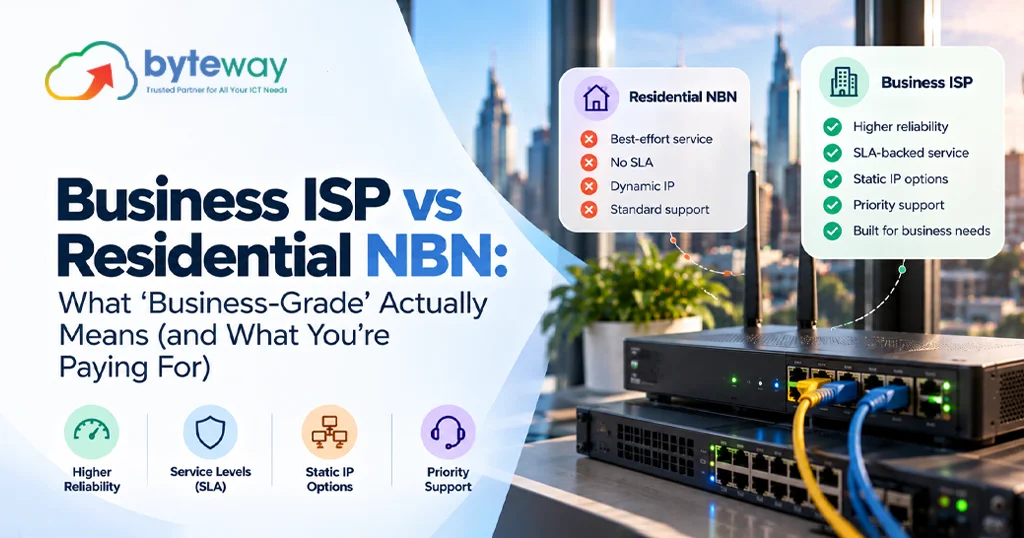
Your individual needs will determine which internet service provider (ISP) is most suited for your business. Just as no two ISPs are alike, neither are the industries they serve. That is why it is critical to conduct research before selecting the finest ISP for your business. For a guide on how to choose the best business internet provider, conduct a complete analysis of your current business, including priorities and future ambitions. This guide will help you in determining which aspects are crucial to running your business and which are those that will aid future growth. Next, conduct a search to determine the ISP provider possibilities available in your immediate area as well as any other places where you intend to develop. You may discover that you have more possibilities than you previously imagined. One business’s goals may differ from another’s, but we have identified the common elements businesses should consider while searching for an ISP. So, let’s get started on how to choose the best business internet provider! Shared Networks Vs Dedicated Networks: Understanding the Differences Before discussing how to choose the best business internet provider, make sure you’re looking at plans designed exclusively for small businesses or enterprises rather than household internet. Once you’re on the proper track, you must decide whether you need a shared or dedicated network. A shared network, often known as a “best effort” service, has many of the same capabilities as residential internet, but it is called corporate internet. You share bandwidth with other customers in the same area as your internet provider.  The most popular shared network connections include DSL, cable, shared fiber, wireless, and satellite. While this is the most cost-effective option, particularly for small enterprises, it offers a speed different from the fastest.  Businesses that employ VoIP, video conferencing, and sophisticated cloud services, on the other hand, will want higher-quality internet, sometimes known as “guaranteed performance” service.  Because a connection is guaranteed to continuously satisfy defined parameters through a service level agreement (SLA), a more robust network supported by more responsive personnel is required. As a result, the fees are higher. Guaranteed performance services can be described as business-grade, commercial-grade, or enterprise-level internet. The most common connection types are fiber-optic, copper, and fixed wireless.  Do not confuse true fiber-optic with hybrid services, in which a fiber backbone connects to cable or phone lines for last-mile access to your company. A commercial-grade fiber service will use fiber all the way to your office. How to Choose the Best Business Internet Provider: Top Reasons With so many internet service providers (ISPs) advertising a diverse range of services, selecting the best internet for your business can be difficult.  To help you make the right option, here’s a guide on how to choose the best business internet provider, which will quickly get you up and running on corporate broadband access. 1. Understanding the Type of Internet Connection As the first factor in how to choose the best business internet provider, the location of your firm may influence which possibilities are accessible to you. Dial-up is the slowest. While this form of connection was widespread in the early days of the internet, your company will likely have newer and better options accessible today. If you live in a rural region with a big open space and a clear view of the sky, the satellite may be worth considering. (Note: structures deep in the forest will have to look for alternative solutions.) Digital Subscriber Line (DSL) uses telephone landlines, and cable transmits a signal through coaxial cable TV lines. On how to choose the best business internet provider, these types of internet connections became popular 20 years ago, but they are still available today. DSL and cable are definitely faster than dial-up or satellite, and they may work well for a small business. Fiber is the common term for fiber-optic internet, which is the fastest connection currently available. Fiber may or may not be available in your area. (Check with your local providers.)  2. Check for the Availability and Speed Do you have one or more locations for your business? Are they in the same geographic area, or does your company operate across multiple states? Answers to queries like these may steer you in the right direction when deciding on how to choose the best business internet provider. Some ISPs serve a larger geographical area than others. Keep your clients (and employees) satisfied with fast and dependable internet access because the alternative is a poor and unreliable business internet connection, which may upset your clients and lower your potential revenue. Faster speed frequently results in higher costs. That is why it is critical to assess your company’s needs and plan for the quantity of bandwidth that you will require on a regular basis. A small business will require fewer resources than a larger one. 3. Determine Your Security Requisites Another tip on how to choose the best business internet provider, cyberattacks come in many forms and formats. Proactively preparing now may spare your company from major difficulties and limit the possibility of damage. Any organization, large or little, could be vulnerable to a cyberattack. Do not discount your danger. Otherwise, your data and business may face the repercussions. Your preferred ISP will be a component of your security approach. Working with a managed IT services company can also help maintain and secure your network around the clock. Keep cyberattackers away, or you may receive a ransom note asking you to pay to access your files. 4. The Flexible Factor The ISP you choose now may meet your requirements, but where do you see your business in five years? Or ten years? Choosing an ISP today that can develop with your company could save you from future problems. That is why conducting your research now is critical. Another thing to consider while determining how to choose the best business internet provider is where your personnel will be based and how it will evolve as your company grows.

telecommunications

How Business Telephone Systems Can Improve Customer Service?

In today’s fast-paced corporate world, outstanding customer service is more than a nicety; it’s a must. Companies are constantly looking for ways to improve their client contacts, and one frequently ignored yet very useful instrument in this effort is the business telephone system. So,  how business telephone systems can improve customer service? Modern telephone systems improve the customer experience by speeding up communication, increasing accessibility, and offering useful data insights. Let’s look at the various ways in which these systems can be used not only to meet, but surpass client expectations. Business Telephone System – Unraveling the Meaning A business telephone system is a multi-line telephone network that allows for efficient communication within and between organizations and their clients. Unlike standard single-line phones, these systems include advanced capabilities including call forwarding, voicemail, conferencing, and automated attendants. They are critical for handling enormous quantities of calls and maintaining uninterrupted connectivity. When considering “how business telephone systems can improve customer service?” It is critical to recognize that these systems go beyond simple communication. They improve the customer experience by shortening wait times, ensuring that calls reach the appropriate department quickly, and providing complete call data. This enables firms to better respond to client needs and provide a greater level of service. Top 8 Tips on How Can Business Telephone Systems Improve Customer Service! Improving customer service is a primary concern for any organization, and using a smart telephone system can help significantly. Here are some suggestions for how business phone systems can improve customer service: 1. Implementing Automated Attendants Automated attendants act as virtual receptionists, leading callers through an organized menu of alternatives to ensure they reach the correct department or individual with minimal delay. This feature is especially useful during peak contact times, when live professionals may be busy with other customers.  Under the feature of how business phone systems can improve customer service, automated attendants help to reduce wait times and annoyance by responding quickly to client demands via effective call routing, thus improving the entire customer experience. Furthermore, automated attendants can provide critical information such as business hours, location details, and commonly asked inquiries. As a part of how business telephone systems can improve customer service, this decreases staff effort and frees up human representatives to focus on more difficult client inquiries that demand specialized attention. Employing automated attendants not only speeds up the call-handling process but also projects a professional image, reaffirming the company’s dedication to providing speedy, high-quality customer service. 2. Using Call Forwarding and Routing So, how can business telephone systems improve customer service? Call forwarding and routing features are critical for guaranteeing seamless communication and that no customer calls go unanswered. These capabilities enable calls to be routed to the relevant team members or departments, even if the initial contact person is unavailable.  An example of how business phone systems can improve customer service is if a customer’s authorized account manager is out of the office or on another call, the system would automatically route the call to another qualified individual who can assist right away. This capacity ensures that clients are not left waiting for help and demonstrates the company’s commitment to providing quick assistance.  Effective call forwarding and routing reduces the likelihood of missed opportunities and contributes to a high level of customer satisfaction. Furthermore, as a part of how business telephone systems can improve customer service, advanced routing options can be tailored to specific parameters like as time of day, caller ID, or topic of the inquiry, ensuring that each call is handled by the appropriate person or department. 3. Recording and Monitoring Calls Another way how business telephone systems can improve customer service is by recording and monitoring calls, which are useful tools for training and quality assurance. Managers can identify best practices and areas for improvement by examining recorded encounters, allowing customer service agents to continue their development over time. This feedback loop is critical for developing the team’s skills and guaranteeing consistent service quality throughout all encounters.  As a part of how business phone systems can improve customer service, call recordings can also be used to mediate disputes or explain misconceptions by providing an exact record of what occurred during the conversation. Call monitoring enables managers to listen in on live calls and provide quick feedback to agents, allowing them to handle difficult circumstances better.  Under how business telephone systems can improve customer service, this proactive strategy not only helps to resolve issues quickly but also increases the confidence and competency of customer support personnel, resulting in improved customer results. Furthermore, call records can provide insights into broader corporate goals by identifying typical consumer pain points and driving product or service changes. 4. Providing Voicemail and Messaging Options One way how business telephone systems can improve customer service is through voicemail and messaging services. These services ensure that no client inquiries go unanswered, even when live agents are unavailable. In cases where calls cannot be answered immediately, clients can leave comprehensive notes explaining their concerns and needs. This feature is especially beneficial outside of office hours, allowing clients to voice their wants at their leisure. In a way, how business telephone systems can improve customer service; businesses can then prioritize these communications and respond quickly, displaying dependability and attention to customer requirements. Prompt follow-up on voicemail messages demonstrates that consumers’ inquiries are valued, reinforcing trust and loyalty. In addition to how business phone systems can improve customer service, voicemail transcriptions can be incorporated into email or CRM systems, giving a more efficient way to track and manage client contacts. Businesses that keep a complete record of all communications can ensure that no issue is overlooked and that all customer requests are met fully and effectively. 5. Providing Conference Call Capabilities Conference call capabilities allow organizations to hold group talks with clients, which is especially effective for resolving complex issues that require input from many departments or specialists.  Businesses that allow direct communication among all essential stakeholders can give

telecommunications

Top 9 Advantages of VoIP Business Telephone Systems

Any business looking for cost-effective telecommunications solutions must know that VoIP business telephone systems are the right choice in today’s internet-centric market. Such services are undoubtedly quelling the primary communication needs of organisations from telephone systems.  Analog telephones were once the main way businesses could stay connected. Yet, they have become too outdated to meet today’s business needs. Modern firms seek a faster, more flexible, and inexpensive way of communicating with the world. This is when Voice over Internet Protocol (VoIP) phone systems come into play.  Read this blog to learn more about how this technology can benefit your business and also the Top 9 Advantages of VoIP Business Telephone Systems. What is VoIP and How Does it Work? Simply put, a VoIP phone system is a cloud-based communicative platform that enables you to make phone calls via the Internet. Rather than having a real phone system in your business, you subscribe to a VoIP service like broadband.  As we’ll discuss later in this post, the wonderful thing about cloud VoIP services is that even if you only have a few employees, you can gain access to the same valuable capabilities that larger businesses can. Remember dial-up internet? VoIP was initially used when internet speeds and bandwidth were limited. And guess what? It didn’t function very well. The proliferation of VoIP really began when Internet Service Providers began delivering low-cost, high-speed internet, which is required for it to function reliably. VoIP business telephone systems work by turning your analog speech signal into a digital voice signal. They then compress it and send it via your high-speed internet connection. Your VoIP provider receives this voice signal and can connect it to other phone networks, such as the PSTN (Public Switch Telephone Network). VoIP Statistics for Businesses for 2024 Check the important statistical data regarding VoIP business telephone systems for 2024 below: Top 9 Benefits of VoIP Business Telephone Systems to Know Here are some potential benefits you will reap after implementing VoIP business telephone systems: 1. The Emergence of Flexibility In recent years, we have all had to adopt some form of remote and flexible working. VoIP’s most significant benefit is the flexibility it can provide a business.  In summary, by signing up for top VoIP business telephone systems you and your team may operate from anywhere with an internet connection.  Yes, as long as you’re linked to the internet, you may make and receive calls just like at the workplace.  Customers, suppliers, and other contacts have a single company number for you, but it does not matter where you answer the phone. This flexibility allows your staff to easily transition between working in the office and working from home. 2. End-to-End Service Mobility If your organisation is mobile, the VoIP phone system for small businesses can be beneficial because they follow you wherever you go. A typical phone system assigns a phone number to each line that connects to a home or company. Any movement after that becomes a challenge to memorise the right codes to dial on your phone. Connecting phone companies to move services and phone numbers to new locations might save a significant amount of time. With VoIP business telephone systems, all of this is avoided. There are no physical limits. You can relocate when your business requires it without any additional worry. 3. Budget-Friendly Option The next benefit of VoIP business telephone systems is the cost savings they provide to businesses, not only in ongoing call costs but also in terms of removing the need to purchase costly equipment. As there are no upfront costs or ongoing maintenance fees, just a monthly subscription fee, you free yourself from needing to purchase, maintain, and upgrade hardware.  Alongside this, many of the VoIP with advanced call routing include generous free call allowances, so typically, unless your team makes a considerable number of calls, you’ll get minimal monthly call charges.  Finally, as calls are being made over your internet connection, you also remove the need for costly ISDN services. It’s a win-win-win, and the cost savings are a massive reason businesses switch their communications sooner rather than later. 4. Wider Range of Features Using VoIP business telephone systems enables you to multitask with technologically advanced gadgets, allowing you to be as productive as possible. For instance, you are on a call within a queue. While you wait, you can plan your response to missed client calls via reading voicemail-to-text transcriptions delivered immediately to your email inbox. In another scenario, you can quickly forward messages and voicemails. If you receive an urgent message in a voicemail, you can forward it to three other individuals with the click of a mouse. Affordable VoIP business phone include all of these capabilities and many more. And, because the service is constant with you, it is possible to add or remove features that you find helpful easily.  5. Proficient Client Communication In today’s global economy, firms can be found anywhere. Meetings frequently necessitate travel. Nonetheless, with VoIP business telephone systems, there is no reason to lose the ability to make key calls or fail to transfer critical papers. You may have noticed that large firms have removed voicemail in recent months. While this approach may only be acceptable for some organisations, some have allegedly discovered that answering voicemails takes too much time. VoIP business telephone systems let you choose where and how your calls ring. For example, you may pick the first five rings to be sent to your office. If you do not respond, the call will be forwarded to a second device, such as a mobile phone or laptop.  Simply put, essential calls do not need to be missed anymore, and important documents that need to be forwarded do not have to wait any longer. Business associates can fax their documents over the cloud via VoIP rather than waiting a day at a fax machine. 6. Top-Notch Customer Experience Anyone on your marketing team understands the value of online client journeys,

sip-vs-traditional-phone-system-for-business-byteway-ict-solutions-company
telecommunications

SIP vs Traditional Phone System for Business: Which is Right for Your Business?

Choosing the appropriate communication system for your company is essential for effective operations, first-rate customer service, and long-term growth strategies. Businesses have gradually shifted from conventional landline phone systems to more advanced and feature-rich communication solutions. Many organizations now evaluate which option is better when comparing SIP vs Traditional Phone System for Business. With the support of reliable IT Support Services Geelong, companies can also ensure smooth implementation, maintenance, and optimization of their communication infrastructure. Furthermore, the Session Initiation Protocol (SIP) has several advantages over traditional phone lines and is a communication technology breakthrough.  The choice to switch, particularly when contrasting SIP vs. traditional phone systems for businesses, depends on several elements specific to your company’s demands and resources.  This article offers a thorough comparison of both to help you better understand the capabilities, benefits, and drawbacks of the two systems and the factors to consider when choosing the one that is best for your business.  Whether cost-effectiveness, scalability, a wide range of features, or system reliability are more important, our comparison analysis will provide you with the information you need to make a wise choice.  As we examine and delve into SIP and conventional phone systems, we’ll help you match your company’s communication requirements with the appropriate technology. Overview of Traditional Phone Systems For many years, business communication has been dominated by conventional phone systems, sometimes known as landline phones or the Public Switched Telephone Network (PSTN). These systems use copper cables for analog voice data transmission over phone lines.  The system uses local and long-distance phone lines, fibre optic cables, microwave transmission connections, satellites, and undersea telephone cables. Regional, national, and worldwide carriers control them.  The advantages of conventional phone networks for organisations have primarily been attributed to their longevity and dependability.  Traditional phone networks benefit businesses from a reliable and steady communication channel. The service quality is frequently excellent, with almost no lag time and crystal-clear voice transmission. These systems also provide uninterrupted service during power outages, guaranteeing that organisations can continue phone communication.  Additionally, traditional phone systems include capabilities like call forwarding, voicemail, conference calling, and caller ID that are useful in a professional setting. They are generally simple to operate, require less training, and frequently provide an easy path for maintenance and upgrade after the initial hardware expenditure.  It’s essential to consider the drawbacks of traditional phone systems when comparing SIP vs traditional phone system for business, though. Conventional phone systems typically require a significant upfront expenditure for setup and hardware, which is one of its main disadvantages.  The maintenance expenses are likewise high due to the wear and strain on the physical infrastructure. These systems are frequently less scalable to sudden changes in business size, requiring significant effort and expense to increase or decrease hardware and lines. Overview of SIP (Session Initiation Protocol) A significant change in the telecom sector is represented by Session Initiation Protocol (SIP), which provides a robust and adequate substitute for conventional phone systems.  It is a communication protocol to signal and control multimedia communication sessions, such as voice and video conversations. SIP trunks are virtual phone lines that connect your company and your Internet Telephony Service Provider, utilising the advantages of VoIP technology of Byteway and your Internet connection. The cost-effectiveness of SIP is one of the main factors luring organisations to transfer from conventional systems.  SIP can drastically lower long-distance and local call costs by using the Internet for voice communication. Additionally, SIP does away with the necessity for separate voice and data subscriptions and the pricey infrastructure upkeep and updates. The capacity of SIP to scale and adapt to changing business needs is another significant benefit.  Unlike conventional phone systems, SIP trunks can be readily scaled up or down based on business demands, negating the need for substantial physical system upgrades. This may be a game-changer for companies that are growing or whose call volumes fluctuate seasonally. Consider this when comparing SIP vs traditional phone system for business. SIP supports mobility and remote working, making it an excellent fit for today’s workforce which is becoming more scattered and mobile. Detailed Comparison of SIP vs Traditional Phone System for Business Discussing SIP vs traditional phone system for businesses becomes more critical as companies develop and adjust to an increasingly digital environment.  By contrasting the two, businesses can choose the solution that best meets their needs. Let’s look more closely at this comparison, paying particular attention to the pricing, scalability, features, and usefulness.  A. Cost Analysis Cost is among organisations’ most critical factors when choosing a communication solution. Traditional phone systems frequently need a sizable initial financial outlay for hardware installation and setup. These systems also often come with recurring expenditures like line leases, maintenance fees, and extra fees for long-distance calls.  SIP systems, on the other hand, provide significant cost savings. SIP uses existing internet connections. Hence there is typically less initial setup expense because less extensive physical infrastructure is required. SIP converts all voice communications into data sent over your internet connection, eliminating the need for separate local and long-distance calling costs.  B. Scalability Comparison Scalability is another important consideration, particularly for enterprises with expansion ambitions or those whose demand is subject to seasonal variations. When it comes to scalability, traditional phone systems offer less flexibility.  Increasing or decreasing the number of lines frequently necessitates new hardware, system changes, and additional infrastructure, all of which contribute to the cost and duration of the process.  SIP, on the other hand, provides exceptional scalability and flexibility. It is now possible to increase or decrease the number of lines by changing the software rather than requiring physical alterations, which makes managing changes faster, simpler, and less expensive. SIP is an excellent option for companies wishing to scale quickly and with little disturbance. C. Comparison of Functionality and Features Traditional phone systems offer a solid and straightforward answer regarding features and operation. You receive necessary features like caller ID, voicemail, and call forwarding.  Traditional methods are less suited for contexts

Scroll to Top