Author name: Muskan Gupta

Kyocera vs. Other Printer Brands for a Melbourne Office
Uncategorized

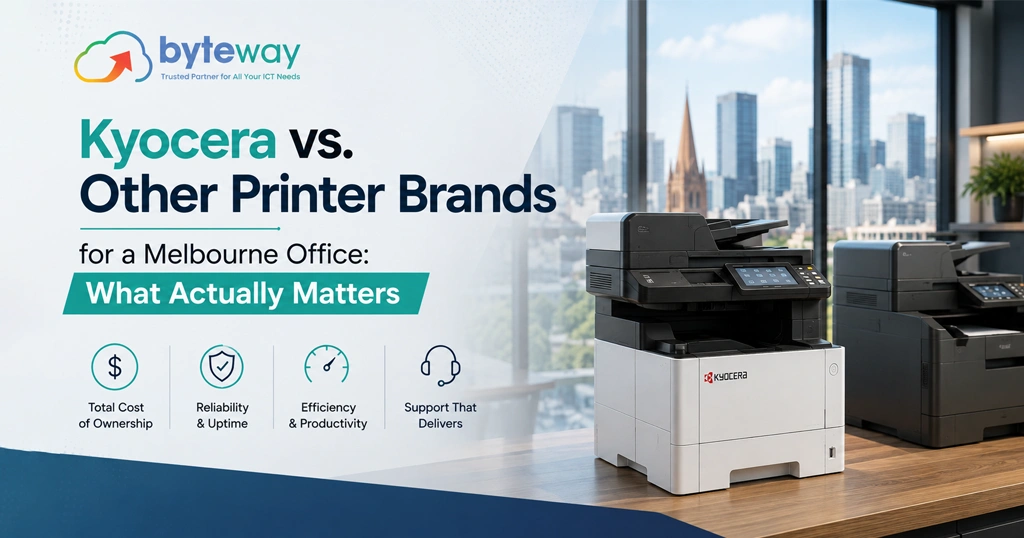
Kyocera Vs. Other Printer Brands for a Melbourne Office

Byteway provides Kyocera and managed print to Melbourne offices, so we will be upfront about our leaning, and equally upfront that the brand on the machine matters far less than most buyers think. Offices tend to choose a printer on the upfront price or the brand they recognise, then get surprised by the running costs, the downtime, or the service that never shows up. What actually matters when comparing Kyocera to other brands is a shorter, less obvious list, and getting it right saves far more than picking the right badge. Stop Comparing on the Wrong Things The two things offices usually compare, the purchase price and the brand name, are the two that matter least. A cheaper printer with expensive toner and short-lived parts costs more over its life than a dearer one with efficient consumables. And brand recognition tells you nothing about how a machine will perform in your office. The useful comparison is about what a printer costs and does over years of real use, not what it costs on day one. What actually matters? 1. Total cost of ownership, not the sticker price This is the big one. The purchase or lease price is a fraction of what a printer really costs; the rest is toner, drums, parts, energy and servicing over its life. A printer with a low upfront price and expensive, frequently-replaced consumables is the classic false economy. Always compare the total cost of ownership, and especially the cost per page, over the life of the device. This is where the biggest differences between brands actually show up, and it is exactly where cheap-looking options often turn out expensive. 2. Reliability and uptime A printer that jams, breaks or needs constant servicing costs you in lost time and frustration, not just repair bills, and in a busy office a down printer is a real disruption. Reliability, how consistently a device runs and how rarely it needs intervention, matters more than a marginally faster speed or an extra feature. Look for a track record of dependable, low-maintenance operation, particularly if you print in volume. 3. Service and support When a printer does go down, how fast it gets fixed is what matters, and this is about the provider as much as the brand. A great machine with slow, distant support is a poor deal. Consider who services the device, how quickly they respond, and whether it is a local Melbourne provider who can actually turn up. Managed print, where a provider monitors and maintains your fleet proactively, often matters more than the brand on the front. 4. Security Modern office printers are network-connected devices that store and transmit documents, which makes them a genuine security consideration, not just office furniture. Look for proper security features, user authentication, data encryption, and secure handling of print jobs, and make sure printers are managed as part of your network security rather than left as an overlooked device. An unsecured printer is a real gap. 5. Fit for your actual print profile The right printer depends on what you actually print: volume, colour versus mono, document types, and whether you need multifunction features like scanning and workflow tools. A high-volume mono office has different needs from a design studio printing rich colour. Matching the machine to your real usage matters more than any brand loyalty. Where Kyocera genuinely stands out? Being honest about our leaning: Kyocera earns its reputation on the two things that matter most above, cost of ownership and reliability. Its design uses long-life components, notably a durable ceramic drum that is separate from the toner and built to last, so consumables last longer and there is less to replace and service. That translates into a lower total cost of ownership over time, particularly for mono and high-volume printing, and into strong reliability, which Kyocera has been recognised for with industry reliability awards. Its managed print tools also make it straightforward for a provider to monitor and maintain a fleet proactively. For an office focused on predictable running costs and uptime, that is a genuine advantage. Where other brands fit? Honesty cuts both ways. Kyocera is not automatically the right answer for every office. Other major brands have real strengths: some are particularly strong on document workflow and software integration, which suits offices that want tight automation out of the box; some are noted for image quality, which matters for design and marketing-heavy printing; and some lean into remote and mobile printing features that suit heavily hybrid teams. The point of an honest comparison is not to declare one brand best for everyone, it is to match the machine to your office. For many Melbourne offices, especially those prioritising cost and reliability, Kyocera is the strong choice; for some specific needs, another brand fits better. Byteway Expert Insight The offices that end up unhappy with their printer almost never chose badly on the brand; they chose badly on the things that actually matter. They picked on the upfront price and got hammered by consumable costs, or bought a capable machine with no thought to who would service it and how fast. Our approach with a Melbourne office is to start from what you actually print and what downtime costs you, compare on total cost of ownership rather than sticker price, and make sure the machine is backed by responsive local service and managed properly. We carry Kyocera because, on cost of ownership and reliability, it consistently delivers for the offices we look after, but the discipline we bring, comparing on what matters and matching the fit, is what actually saves you money, whatever badge ends up on the machine. How Byteway helps? Frequently asked questions Is Kyocera better than other printer brands? On total cost of ownership and reliability, especially for mono and high-volume printing, Kyocera has a genuine edge thanks to its long-life component design; other brands fit better for specific needs like workflow software or image-heavy printing. Byteway helps Melbourne offices match the brand

Medica Medical Centre
case-studies

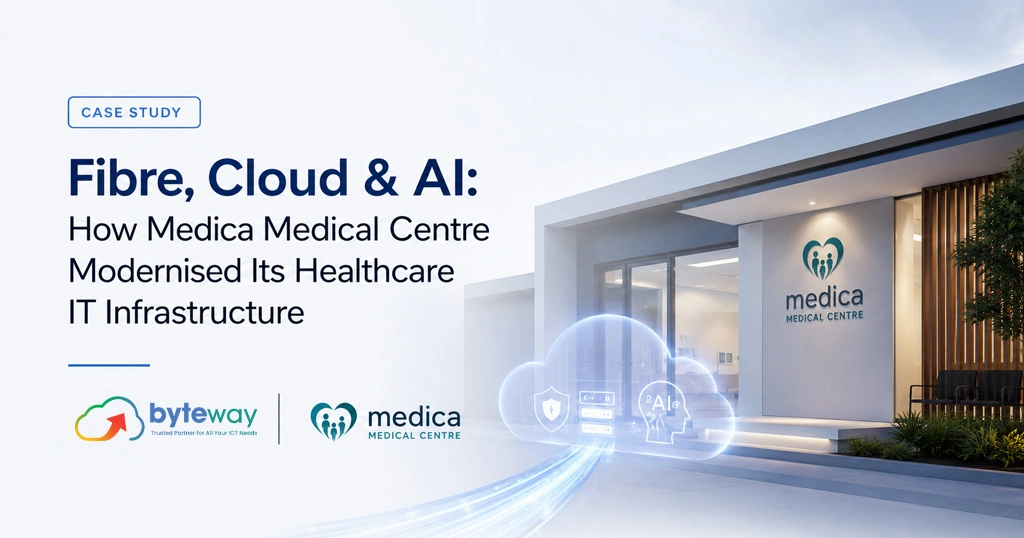
Fibre, Cloud & AI: How Medica Medical Centre Modernised Its Healthcare IT Infrastructure

Picture a reception desk at 8:45am. Patients are already lining up, the phones are ringing, and somewhere in the back office, a fax machine is groaning through a referral letter one line at a time. Now picture that scene multiplied across every single day, every single week, for years. That was life at Medica Medical Centre before Byteway got involved a busy MEDACS Health practice quietly held back by infrastructure that had simply outgrown what the business needed it to do. Copper cabling that was never designed for today’s call volumes. A fax machine doing a job email could do in seconds. And a network that made every “simple” IT request feel like pulling teeth. Byteway didn’t come in to patch these problems one at a time. They came in to rebuild the practice’s technology foundation from the ground up and the difference was felt almost immediately, from the front desk to the treatment room. Client Overview Medica Medical Centre is a MEDACS Health practice where the technology running quietly in the background has a direct impact on the people sitting in the waiting room. When a phone system drops calls, that’s a patient who can’t book an appointment, or a specialist who can’t get through with urgent results. When a fax machine jams, that’s a referral that doesn’t arrive on time. Most established medical centres don’t wake up one day with a network problem, it creeps in gradually. A bit of copper cabling here, a workaround there, until the gap between what the practice needs to run smoothly and what the infrastructure can actually deliver becomes impossible to ignore. That’s usually the exact point a practice manager starts asking the question that matters most. Is our IT provider actually built for healthcare, or are we just another ticket in a general IT queue? For Medica, the answer led them to Byteway’s managed IT services, a team that understands medical centres don’t get the luxury of waiting until Monday to fix something. What Was Holding the Practice Back The list of issues wasn’t dramatic on its own but together, it was quietly eating into productivity, patient experience, and peace of mind every single day. None of these issues existed in isolation. A slow network makes cloud tools frustrating to use, which pushes staff back toward manual workarounds, which increases reliance on outdated systems like fax — and the cycle continues. Byteway’s job wasn’t just to fix each symptom, but to break that cycle entirely. How Byteway Rebuilt the Foundation? This wasn’t treated as a simple internet upgrade. It was a full infrastructure rebuild, delivered through the practice’s NBN for Business and Dedicated Fibre options, carefully matched to what the site could actually support and what the practice would need for the next several years not just the next few months. With the core network rebuilt, it was also a natural point to look at what else in the practice was still running on older equipment. Busy medical centres often have printers and scanners quietly aging in the background for years, mostly because nobody thinks about replacing them until one jams during a busy morning. Byteway’s Managed Print Services and Office Printers & MFDs are typically one of the simpler wins to fold into a broader infrastructure project like this one, bringing document handling up to the same standard as everything else that had just been modernised. Where It Left the Practice? A lot of practices considering a similar move ask the same question upfront: does a fibre migration mean the practice has to close, or run on reduced hours, during the switch? For Medica, Byteway staged the entire cutover carefully so that patient-facing systems stayed online throughout — no closed doors, no rescheduled appointments. Another question that comes up constantly is whether cloud email is genuinely more secure than fax for handling patient records. Done properly — with encryption in transit, tightly controlled access, and full activity logging — it is, and it also gives the practice something fax never could: a complete, searchable audit trail of exactly who sent what, and when. Considering a similar upgrade for your own medical practice? Byteway’s healthcare IT solutions are built specifically around the uptime, reliability and compliance needs of clinics, not retrofitted from a generic IT package. Get in touch to talk through what your practice actually needs.

Byteway Managed IT Services in Altona
service-by-area

Managed IT Services in Altona

Byteway provides managed IT services in Altona to a suburb that runs two very different economies at once: a coastal hospitality and retail strip along Pier Street, and an industrial precinct to the north with decades of petrochemical history and the compliance obligations that come with it. What Altona Businesses Actually Need From Managed IT Pier Street’s cafés, restaurants, and boutiques need reliable point-of-sale uptime and cybersecurity that protects customer payment data through busy weekend trade. Altona North’s industrial and petrochemical-adjacent operators need managed IT with compliance-aware data handling and network monitoring that extends to safety and monitoring systems, not just office computers. Managed IT vs In-House IT for Altona Businesses Managed IT delivers broader coverage than in-house IT for most Altona businesses under 100 staff, particularly industrial operators who need compliance and cybersecurity expertise that’s expensive to hire directly. Byteway prices managed IT for Altona businesses to cover this scope for less than an equivalent in-house hire. Support Across Altona’s Coastal and Industrial Precincts Byteway delivers managed IT for Altona businesses alongside business NBN or dedicated fibre, hosted phone systems, cyber security, and cloud backup, scoped to whether the business trades from Pier Street or operates in the industrial precinct. Signs Your Altona Business Needs Managed IT A Pier Street business should be concerned if a single point-of-sale outage during a busy weekend has already cost real revenue, or if nobody’s checked whether customer payment data is actually secure. An Altona North operator should be concerned if compliance documentation relies on manual, undocumented processes, or if nobody’s monitoring the network for unusual activity. Byteway sees both situations across Altona regularly, and in both cases the fix is usually more straightforward than the business expects. Byteway can assess your Altona business’s current IT setup and tell you honestly where the risk actually sits. Frequently Asked Questions What are the best managed IT services for a café or retail business on Pier Street in Altona? The best managed IT services for a Pier Street business combine proactive monitoring, cybersecurity protecting customer payment data, and point-of-sale reliability through weekend trade. Byteway scopes managed IT for Altona hospitality and retail clients around actual trading patterns rather than a generic small-business package. Byteway can scope the right managed IT plan for your Altona hospitality or retail business. Does Byteway provide compliance-aware managed IT for Altona North industrial businesses? Yes, Byteway configures managed IT for Altona North industrial and petrochemical-adjacent businesses with compliance-aware data handling and network monitoring extending to safety and monitoring systems, not just standard office IT. Byteway can review your Altona North business’s IT compliance setup. Managed IT services vs in-house IT support in Altona, which is more cost-effective? Managed IT is more cost-effective for most Altona businesses under 100 staff, delivering monitoring, cybersecurity, and compliance support for less than the cost of hiring that breadth of skill in-house. Byteway prices managed IT for Altona businesses to cover this full scope without the overhead of an internal IT hire. Byteway can put together a cost comparison for your Altona business. Can Byteway support an Altona business that operates across both Pier Street and Altona North? Yes, Byteway configures managed IT for Altona businesses operating across both precincts under one coordinated plan, with centralised monitoring and support rather than separate arrangements for each site. Byteway can scope a multi-site managed IT plan for your Altona business. Does managed IT cover point-of-sale systems for Altona hospitality businesses? Yes, point-of-sale reliability is treated as a priority for Pier Street clients. How much does managed IT cost for an Altona business? Pricing depends on team size and complexity, quoted individually by Byteway. Can Byteway provide compliance support for Altona North businesses? Yes, compliance-aware configuration is built into managed IT for industrial clients. How fast does Byteway respond to an Altona business’s IT issue? Most issues are resolved remotely the same day, with documented response commitments. Does Byteway support multi-site Altona businesses across both precincts? Yes, both Pier Street and Altona North locations can run under one plan. How do I get a managed IT quote from Byteway for Altona? Contact Byteway directly for a free consultation.

Byteway IT Support & Maintenance in Derrimut
service-by-area

IT Support & Maintenance in Derrimut

Byteway provides IT support and maintenance in Derrimut to the distribution centres and logistics operators that have made this Industrial 1 Zone suburb one of Melbourne’s most tightly held industrial precincts, businesses where hardware downtime translates directly into stalled freight. What Derrimut Businesses Actually Need From IT Support & Maintenance? Distribution and logistics operators need fast repair for scanning equipment, network hardware, and dock systems, since a failed device can back up receiving or dispatch within minutes. Proactive maintenance, catching failing equipment before it stops working entirely, matters more in Derrimut’s continuous-throughput operations than in a typical office environment. Software updates and patch management need to be scheduled carefully to avoid disrupting freight operations mid-shift. Break-Fix vs Proactive Maintenance for Derrimut Operations Proactive maintenance costs less over a year than break-fix support for almost any Derrimut logistics operation, since the accumulated cost of stalled dispatch and emergency callouts typically exceeds a predictable monthly plan. Byteway builds proactive monitoring and hardware checks into every Derrimut support plan. Support for Derrimut’s Industrial Tenant Base Byteway delivers IT support and maintenance for Derrimut businesses alongside managed IT services, business NBN or dedicated fibre, cyber security, and cloud backup, with local technicians available for on-site hardware work. Signs Your Derrimut Business Needs Better IT Support Watch for scanning or network equipment failing during a shift, software updates that get applied at the worst possible time and disrupt freight operations, or a current provider who’s slow to respond when the dispatch floor is affected. Byteway sees this most clearly in growing Derrimut operations still relying on a support arrangement sized for when the business was smaller and simpler. Byteway can assess your Derrimut business’s hardware and support setup and show you what proactive maintenance would actually prevent. Frequently Asked Questions What is the best IT support and maintenance service for a distribution centre in Derrimut? The best IT support and maintenance service for a Derrimut distribution centre combines fast hardware repair for scanning and dock equipment with proactive maintenance that catches failing devices before they stall dispatch. Byteway scopes IT support for Derrimut logistics clients around actual equipment use and shift patterns. Byteway can scope the right IT support plan for your Derrimut distribution centre. Is proactive maintenance worth it for a Derrimut logistics business? Proactive maintenance is worth it for almost any Derrimut logistics business, since it prevents the accumulated cost of stalled dispatch and emergency callout fees that make break-fix support expensive over a year. Byteway includes proactive maintenance as standard in Derrimut support plans rather than charging per incident. Byteway can show you the cost difference between break-fix and proactive support for your Derrimut business. Can Byteway schedule software updates around a Derrimut warehouse’s shift patterns? Yes, Byteway schedules software updates and patch management around a Derrimut warehouse’s actual shift patterns, avoiding disruption to freight operations rather than applying updates at a generic default time. Byteway can plan a patch management schedule around your Derrimut operation’s shifts. Does Byteway offer fast hardware repair for Derrimut warehouses with multiple shifts? Yes, Byteway provides fast hardware repair for Derrimut warehouses running multiple shifts, with proactive checks that catch failing equipment early and spare parts or loan equipment available to reduce downtime during repairs. Byteway can scope hardware support around your Derrimut warehouse’s shift pattern. Does Byteway repair scanning and dock equipment on-site in Derrimut? Yes, local technicians handle on-site hardware repairs for Derrimut clients. Can Byteway schedule updates around my Derrimut warehouse’s shifts? Yes, patching is scheduled to avoid disrupting active dispatch or receiving periods. How fast does Byteway respond to a Derrimut hardware issue? Response times are documented, with most software issues resolved remotely the same day. Is proactive maintenance included in Byteway’s Derrimut support plans? Yes, it’s included as standard rather than billed per incident. Does Byteway support multi-shift Derrimut operations? Yes, support hours and monitoring are scoped to multi-shift schedules. How do I get started with Byteway for IT support in Derrimut? Contact Byteway directly for a free assessment.

Business Internet Compared NBN vs Dedicated Fibre vs 5G Backup
Uncategorized

Business Internet Compared: NBN vs Dedicated Fibre vs 5G Backup

Byteway sets up business internet across Australia, and one of the most common questions we get is which connection a business should choose: Business NBN, dedicated fibre, or 5G. The honest answer is that they are not really rivals so much as different tools for different jobs, and for many businesses the best setup uses more than one. This is a straight comparison of the three, what each is best at, where each falls short, and how they fit together. Business NBN: the flexible all-rounder Business NBN is the workhorse connection for most Australian businesses. It uses the national broadband network, ideally over full fibre where available, and a business-grade NBN plan adds priority support and better service commitments than a residential one. Best for: the majority of small and mid-sized businesses that need reliable, good-value internet for everyday work, cloud systems, email, calls and payments. Strengths: cost-effective, widely available, and on full fibre genuinely fast and reliable. Easy to get and to scale. Watch-outs: it is typically a shared connection, so speeds can vary at peak times, and the underlying technology matters, full fibre is excellent while older copper-based connections are slower and less reliable and are being retired. We explain that in our guide to connection types. Business NBN generally does not come with the guaranteed performance a dedicated connection does. Dedicated fibre: the premium, guaranteed option Dedicated fibre (sometimes called Enterprise Ethernet or a dedicated internet line) is a connection reserved for your business, not shared with anyone else, with guaranteed speeds and a strong service level agreement. Best for: businesses that genuinely cannot tolerate slowdowns or downtime, or that move large volumes of data, such as those running heavy cloud operations, large teams, critical real-time systems, or multiple sites needing guaranteed performance. Strengths: guaranteed, symmetrical speeds that do not dip at peak times, a strong SLA with priority fault resolution, and consistency you can rely on. It is the most reliable option available. Watch-outs: it costs considerably more than Business NBN, and it can take longer to install. For many smaller businesses it is more than they need, which is exactly why the comparison matters, paying for dedicated fibre you do not need is as much a mistake as under-provisioning. 5G: the excellent backup (and sometimes primary) 5G delivers high-speed internet over the mobile network, and for business it plays two roles. Best as backup: this is where 5G shines for most businesses. As an automatic failover connection behind your main line, it takes over if the primary drops, keeping payments, phones and systems running through an outage. Because it uses a completely different network from your fixed line, it provides genuine redundancy. Sometimes as primary: in locations with strong 5G coverage, or where a fixed line is slow, unavailable or delayed, 5G can serve as a capable primary connection. Strengths: quick to deploy (no fixed-line install), independent of your wired connection, and increasingly fast where coverage is good. Watch-outs: performance depends on local coverage and signal, and mobile data plans and usage need sizing for the role. As a sole connection for a data-heavy business it may not suit; as backup it is hard to beat. How they actually fit together? The mistake is treating this as a single either-or choice. In practice, the best setup for many businesses combines them: a reliable primary connection (Business NBN for most, dedicated fibre for those who need guaranteed performance) with a 5G backup behind it for continuity. That way you get the everyday performance you need and stay online through an outage. The right primary depends on how critical your connectivity is and your budget; the backup is increasingly a sensible default for any business that trades online or takes payments. We cover the full selection process in our business internet checklist. Byteway Expert Insight When a business asks us “NBN or dedicated fibre or 5G,” our first question back is “how much does an hour offline actually cost you, and how much data do you really move.” Those two answers usually make the choice obvious. A typical small business is well served by Business NBN with a 5G backup, and paying for dedicated fibre would be spending on guarantees it does not need. A business running critical real-time systems, or one where downtime is genuinely expensive, is the opposite, dedicated fibre pays for itself in reliability. The wrong move is choosing on the headline price or the biggest speed number without matching it to how the business actually uses connectivity. Get that match right, add a backup, and internet stops being something you think about. How Byteway helps Frequently asked questions What’s the difference between Business NBN and dedicated fibre? Business NBN is a shared, cost-effective connection that suits most businesses; dedicated fibre is reserved for your business alone, with guaranteed symmetrical speeds and a strong SLA, for those who cannot tolerate slowdowns. Byteway helps businesses choose the right one for their needs. Is dedicated fibre worth it for a small business? Only if downtime or slowdowns would genuinely cost you, or you move large data volumes; for many small businesses Business NBN with a 5G backup is a better fit for the money. Byteway helps you weigh the cost against your real reliability needs. Can 5G be my main business internet? In areas with strong coverage, or where a fixed line is slow or unavailable, yes; but for most businesses 5G is best as an automatic backup behind a fixed primary. Byteway assesses your location and needs to advise on 5G’s best role. What is the best business internet setup? For many businesses, a reliable primary connection (Business NBN, or dedicated fibre if performance is critical) with a 5G backup behind it, giving everyday performance plus continuity. Byteway designs this combination around your business. Why do I need a backup connection? Because every connection fails eventually, and for a business that takes payments or relies on cloud systems, an outage is lost trade. A

Byteway Managed IT Services in Derrimut
Uncategorized, service-by-area

Managed IT Services in Derrimut

Byteway provides managed IT services in Derrimut to a suburb built almost entirely for distribution, logistics, and manufacturing, sitting on the Western Ring Road and Princes Freeway corridor that’s made it one of Melbourne’s most tightly held industrial precincts through late 2025. What Derrimut Businesses Actually Need From Managed IT Distribution centres and 3PL operators need proactive network monitoring that protects warehouse management systems and freight tracking from downtime, since a system outage here doesn’t just inconvenience staff, it stalls dispatch and delays customer-facing tracking. Manufacturers need disaster recovery planning that accounts for production continuity, and growing Derrimut operations need IT infrastructure that scales as freight volume and headcount increase. Managed IT vs In-House IT for Derrimut Businesses Managed IT delivers broader coverage than in-house IT for most Derrimut businesses under 100 staff, particularly logistics operators who need specialist network monitoring and cybersecurity skills that are costly to hire directly. Byteway prices managed IT for Derrimut businesses to cover this scope for less than an equivalent in-house hire. Support for Derrimut’s Industrial Growth Byteway delivers managed IT for Derrimut businesses alongside business NBN or dedicated fibre, hosted phone systems, cyber security, and cloud backup, scoped to freight volume and shift patterns. Signs Your Derrimut Business Needs Managed IT Watch for warehouse management systems that have gone down without warning, a growing freight volume that’s starting to outpace your current IT setup, or the uneasy feeling that nobody’s actually monitoring the network for problems. If your Derrimut business has scaled its operations but kept the same ad-hoc IT arrangement from when it was smaller, that gap tends to show up at the worst possible time, mid-shift, mid-dispatch. Byteway can review your Derrimut operation’s current IT setup and show you where the actual risk sits before it costs you a shift. Frequently Asked Questions What are the best managed IT services for a distribution centre in Derrimut? The best managed IT services for a Derrimut distribution centre combine proactive network monitoring, disaster recovery planning, and cybersecurity scoped to freight and dispatch operations, not a generic small-office package. Byteway prices managed IT for Derrimut logistics clients around actual system dependency and shift patterns. Byteway can scope the right managed IT plan for your Derrimut distribution centre. Managed IT services vs in-house IT support in Derrimut, which is more cost-effective? Managed IT is more cost-effective for most Derrimut businesses under 100 staff, delivering monitoring, cybersecurity, and disaster recovery coverage for less than the cost of hiring that breadth of skill in-house. Byteway prices managed IT for Derrimut businesses to cover this full scope without the overhead of an internal IT hire. Byteway can put together a cost comparison for your Derrimut business. Can Byteway provide disaster recovery planning for a Derrimut logistics operation? Yes, Byteway builds disaster recovery planning into managed IT for Derrimut logistics businesses, with recovery time objectives that account for the real cost of stalled freight movement rather than a generic recovery template. Byteway can assess your Derrimut logistics business’s disaster recovery readiness. Does managed IT scale as a Derrimut business grows its freight volume? Yes, Byteway scopes managed IT for Derrimut businesses to scale as freight volume, headcount, or site count grows, adding capacity and coverage through the existing plan rather than requiring a disruptive system rebuild. Byteway can scope a managed IT plan that scales with your Derrimut business. How much does managed IT cost for a Derrimut distribution centre? Pricing is scoped to system complexity and team size, quoted individually. Does Byteway monitor warehouse management systems specifically? Yes, monitoring extends to operational systems, not just office computers. How fast does Byteway respond to a Derrimut business’s IT issue? Most issues are resolved remotely the same day, with documented response times. Can Byteway handle disaster recovery for a Derrimut logistics business? Yes, disaster recovery planning is scoped to production and dispatch downtime risk. Does managed IT scale as my Derrimut business grows? Yes, coverage scales with freight volume and headcount without a system rebuild. How do I get started with Byteway for managed IT in Derrimut? Contact Byteway directly for a free assessment.

Byteway Cloud Migration for Melbourne SMEs
Uncategorized

Cloud Migration for Melbourne SMEs: Cost, Timeline & What Actually Changes

Byteway plans and runs cloud migrations for Melbourne SMEs, and the three questions we are always asked first are the honest ones: what will it cost, how long will it take, and what actually changes for us. The trouble is that most content answers with either vague hype or a single misleading number. The real answers depend on your business, but they follow patterns worth understanding before you start. This guide walks through cost, timeline and change realistically, so you can plan a cloud migration with your eyes open. What “cloud migration” actually means for an SME? Cloud migration is moving your business systems, files, email, applications, servers, from running on hardware you own and maintain on-site to running in the cloud. For most SMEs it is not one big leap but a set of moves: shifting file storage and email to the cloud, moving or replacing on-premise servers and applications, and often retiring ageing hardware in the process. How much you move, and how, is what drives cost, timeline and impact. What it actually costs? There is no honest single price, because cost depends on your starting point and destination. But it helps to think of cloud migration cost in three parts: The one-off project cost. Planning, setting up the cloud environment, moving the data and applications, testing, and cutting over. This depends on how much you are moving and how complex it is, a simple file-and-email move is modest; migrating custom applications and servers is more involved. The change in ongoing costs. This is the part SMEs often misunderstand. Cloud shifts spending from large, occasional capital purchases (buying servers every few years) to predictable monthly subscriptions. Your monthly IT bill may look higher, but you stop buying and maintaining hardware, and the total cost of ownership is often lower and far more predictable. The right comparison is not “cloud subscription versus nothing,” it is “cloud versus the full cost of owning, powering, maintaining and eventually replacing your own hardware.” The cost of doing it badly, or not at all. A rushed migration that disrupts the business, or ageing on-site hardware that fails before you move, both carry real costs. Planning avoids the first; not waiting until failure avoids the second. The practical takeaway: get a proper assessment rather than a headline number, because a genuine quote for your business is worth more than any generic figure, and beware anyone who quotes cloud migration cost without first understanding what you are moving. What the timeline actually looks like? Cloud migration timelines vary with scope, but they follow a shape. A straightforward migration, moving email and files to the cloud for a small team, can be done in a few weeks. A more involved migration, including servers, line-of-business applications and multiple systems, more commonly runs over one to a few months. The phases are consistent: assess what you have, plan the destination and sequence, set up and test the new environment, migrate in stages, run old and new in parallel where sensible, cut over, and decommission the old. The businesses that rush and skip the testing and parallel-run stages are the ones that have painful migrations. Done in stages, most of it happens in the background with little disruption. What actually changes for your business? This is what SMEs most want to know, and the changes are mostly positive, with a few that need managing. You can work from anywhere– Cloud systems are reachable from the office, home or the road, which suits hybrid working and multi-site operations in a way on-premise never did. You stop babysitting hardware– No more ageing servers to maintain, patch and eventually replace, and less risk of a hardware failure taking the business down. We cover the risks of holding on too long in our server migration checklist. You scale more easily– Adding users, storage or capacity becomes a quick change rather than a hardware purchase, so your systems keep pace with the business. Your costs become predictable- Spending shifts to a regular subscription rather than lumpy capital purchases, which is easier to budget. Security changes shape, not disappears- Cloud is secure when configured properly, but security becomes about access, identity and configuration rather than a box in a cupboard. Multi-factor authentication, access control and knowing where your data lives matter more, which connects to your cyber security. And you still need real, separate backup, because cloud does not automatically mean backed up. Support changes too– Instead of fixing physical hardware, support becomes managing cloud services, which is where an ongoing managed IT relationship earns its place. Byteway Expert Insight The Melbourne SMEs that migrate well treat it as a planned business project, not a technical scramble, and they start from what they are trying to achieve, work from anywhere, get off failing hardware, stop the surprise IT bills, rather than “move to the cloud” as an end in itself. The ones that struggle either rush it, skipping the testing that makes a migration smooth, or drift into it piecemeal with no plan and end up with a messy, half-migrated, hard-to-secure environment. Our approach is to assess honestly what should move and what should not, sequence it to minimise disruption, and be upfront about real cost and timeline for your specific business. Done that way, cloud migration is one of the higher-return moves an SME can make, and it should feel like an upgrade, not an ordeal. How Byteway helps? Frequently asked questions How much does cloud migration cost for an SME? It depends on what you are moving and how complex it is, so there is no honest single figure; it combines a one-off project cost with a shift from capital hardware spending to predictable subscriptions. Byteway assesses your business and gives a genuine cost rather than a generic number. How long does cloud migration take? A simple move of email and files can take a few weeks; a fuller migration including servers and applications more commonly takes one to a few months,

Barwon-JJ-Pharmacy
Uncategorized, case-studies

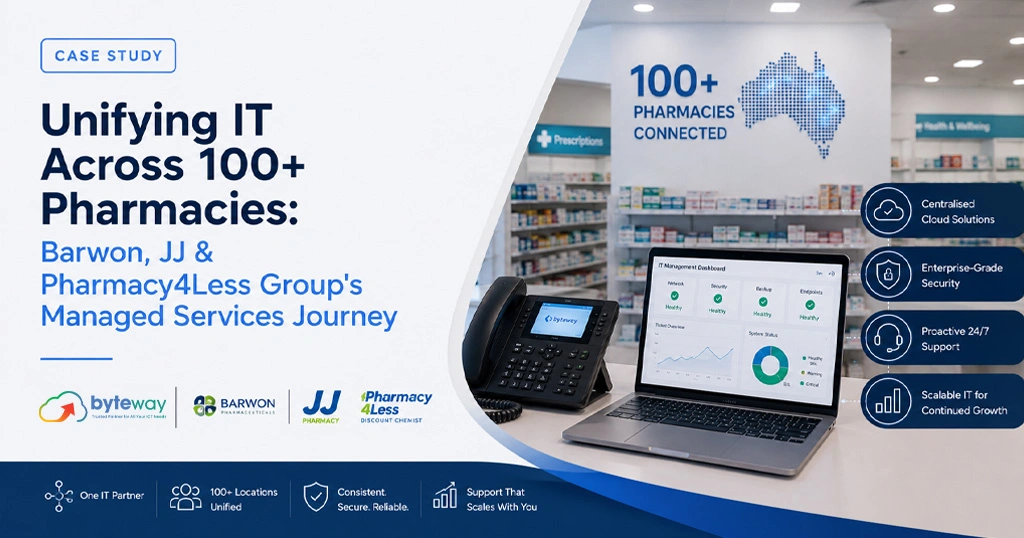
Unifying IT Across 100+ Pharmacies: Barwon, JJ & Pharmacy4Less Group’s Managed Services Journey

Handling prescription and patient data across dozens of pharmacy locations is not a place to gamble on outdated modems and ageing servers. Barwon Pharmacy Group, alongside JJ Pharmacy Group and Pharmacy4Less Group, needed an infrastructure refresh that could keep pace with a fast-growing, multi-site network without compromising on security anywhere along the way. Byteway delivered exactly that, site by site, without the rollout turning into weeks of disruption for any single pharmacy. Client Overview Barwon Pharmacy Group operates across a large network of pharmacy locations under several connected brands, including JJ Pharmacy Group and Pharmacy4Less Group. Running a network this size means every weakness gets multiplied. A server issue at one site is one problem. A server issue built into the standard setup across a hundred sites is a hundred problems waiting to happen on their own schedule. The group needed infrastructure that could scale reliably, security that held up consistently regardless of location, and a level of central oversight that made it possible to manage dozens of pharmacies without treating each one as its own isolated project. The Challenge A legacy server environment was constraining performance across the pharmacy network, the kind of drag that’s easy to tolerate site by site but adds up considerably at scale. Traditional modem infrastructure limited both connectivity speed and resilience, leaving individual pharmacies more exposed to outages than a business handling prescription data should reasonably accept. Staff working across locations needed secure remote connectivity that didn’t rely on ad hoc solutions cobbled together over time, and rising cybersecurity concerns across the sector made all of this considerably more urgent than it might have been a few years earlier. For a pharmacy group handling sensitive patient data at this scale, the real question was how to standardise security across dozens of sites without slowing any single one of them down in the process. The Byteway Solution Byteway upgraded servers across the network, modernising core infrastructure site by site rather than attempting a single disruptive cutover across the entire group at once. Traditional modems were replaced with business-grade firewalls, moving every location onto more capable, considerably more secure connections. VPN deployment gave staff secure remote access regardless of which pharmacy they were working from, and business-grade networking strengthened both performance and security at every site consistently, not just at the flagship locations. Endpoint detection and response added proactive threat monitoring across the network, aligned with the same testing philosophy behind Byteway’s VAPT penetration testing services, catching issues before they became incidents rather than after. Remote monitoring and management gave the group ongoing, proactive oversight of every site from one place, and continuing support through Byteway’s Managed IT Services meant the improvements kept working long after the initial rollout was complete. With a network this size, print and document handling was also worth bringing under one standard rather than leaving each pharmacy to manage its own ageing hardware independently. Byteway’s Managed Print Services and Office Printers & MFDs gave the group a consistent approach to printing across every location, the same way servers, networking and security had already been standardised. Business Outcomes Network performance improved across every location, not just the sites that got attention first. Staff gained secure remote access without workarounds. Cybersecurity across the pharmacy network was meaningfully enhanced, and proactive monitoring meant downtime dropped rather than simply being responded to faster when it occurred. The group came out the other side with infrastructure built to support continued growth, rather than infrastructure that would need revisiting again the moment the network expanded further. Pharmacy groups considering a similar refresh often ask whether upgrading dozens of sites means rolling outages during the transition. It doesn’t have to. With a phased, site-by-site rollout, each pharmacy is upgraded individually while the rest of the network keeps trading exactly as normal, so patients never notice the transition happening behind the scenes. Another common question, particularly relevant for pharmacy chains: is a VPN actually necessary if staff are just accessing cloud-based dispensing software rather than an internal server? It is, particularly for any staff member handling patient or prescription data remotely, since a VPN encrypts that connection rather than leaving it exposed on public or home networks where it’s considerably easier to intercept. A third question worth covering directly, since it comes up in almost every conversation about IT infrastructure for multi-location retail: does standardising IT across dozens of sites mean losing the ability to respond to something specific to one location? It doesn’t. Standardisation covers the underlying infrastructure, servers, networking, security, monitoring, but day-to-day operations at each pharmacy continue exactly as they always have. What changes is that when something does need attention, it gets resolved faster and more consistently, because the underlying setup is the same everywhere rather than a different puzzle at every single site. Managing IT and security across multiple pharmacy locations? Byteway can standardise and secure your entire network without disrupting how any individual site operates day to day. Get in touch to see what’s possible for your business.

Byteway IT Support & Maintenance in Laverton
service-by-area

IT Support & Maintenance in Laverton

Byteway provides IT support and maintenance in Laverton to warehouse operators in Laverton North needing quick hardware repairs on scanning and dock equipment, and smaller local businesses near Laverton Station needing dependable day-to-day support without warehouse-scale overhead. What Laverton Businesses Actually Need From IT Support & Maintenance Warehouse and logistics operators need fast hardware repair for scanning devices, dock equipment, and network gear where downtime directly stalls receiving or dispatch. Proactive maintenance, checking equipment health before it fails rather than after, matters more here than in a typical office, since a single failed scanner can back up an entire receiving queue. Smaller Laverton businesses need reliable remote troubleshooting and software updates without the complexity of an industrial-scale support arrangement. Break-Fix vs Proactive Maintenance for Laverton Businesses Proactive maintenance costs less over a year than break-fix support for almost any Laverton North warehouse, since the accumulated cost of dispatch delays and emergency callouts usually exceeds a predictable monthly plan. Byteway builds proactive monitoring and hardware checks into every Laverton support plan rather than charging separately for it. Local Support for Laverton’s Warehouse and Office Businesses Byteway delivers IT support and maintenance for Laverton businesses alongside managed IT services, business NBN or dedicated fibre, cyber security, and cloud backup, with local technicians available for on-site hardware work. Signs Your Laverton Business Needs Better IT Support Watch for scanning or dock equipment that keeps failing without warning, a current provider who only shows up after something’s already broken, or software that hasn’t been updated in longer than anyone can remember. A smaller Laverton business should watch for the same signs at office scale, slow computers nobody’s looked at, or a support arrangement that feels more like waiting than fixing. Byteway sees these patterns constantly in Laverton, usually right before a business finally decides break-fix support isn’t cutting it anymore. Byteway can assess your Laverton business’s current hardware and support arrangement and tell you what proactive maintenance would actually change. Frequently Asked Questions What is the best IT support and maintenance service for a warehouse in Laverton North? The best IT support and maintenance service for a Laverton North warehouse combines fast hardware repair for scanning and dock equipment with proactive maintenance that catches failing devices before they stall operations. Byteway scopes IT support for Laverton North warehouses around actual equipment use and shift patterns. Byteway can scope the right IT support plan for your Laverton North warehouse. Is break-fix or proactive maintenance better for a Laverton logistics business? Proactive maintenance is better for almost any Laverton logistics business, since it prevents the accumulated cost of dispatch delays and emergency callout fees that make break-fix support expensive over a year. Byteway includes proactive maintenance as standard in Laverton support plans rather than charging per incident. Byteway can show you the cost difference between break-fix and proactive support for your Laverton business. Can Byteway repair scanning and dock equipment for a Laverton North warehouse? Yes, Byteway provides hardware repair for scanning devices, dock equipment, and network hardware for Laverton North warehouses, with proactive checks that catch failing equipment before it causes a full breakdown. Byteway can assess your Laverton North warehouse’s hardware support requirements. What IT support is available for a small business near Laverton Station? Byteway provides straightforward, affordably scoped IT support for smaller Laverton businesses near the station, covering remote troubleshooting, software updates, and cybersecurity without warehouse-level infrastructure a small office doesn’t need. Byteway can scope affordable IT support for your Laverton office. Does Byteway repair hardware on-site in Laverton? Yes, local technicians are available for on-site hardware work. How fast does Byteway respond to a Laverton hardware failure? Response times are documented, with most software issues resolved remotely the same day. Is proactive maintenance included or a separate cost? Proactive maintenance is included as standard in Byteway’s Laverton support plans. Can Byteway take over support from my current Laverton provider? Yes, Byteway manages the switch without disrupting daily operations. Does Byteway support both Windows and Mac systems in Laverton? Yes, mixed environments are supported as standard. How do I get started with Byteway for IT support in Laverton? Contact Byteway directly for a free assessment of your current setup.

Essential 8 Readiness Where Most Melbourne Businesses Actually Stand
Uncategorized

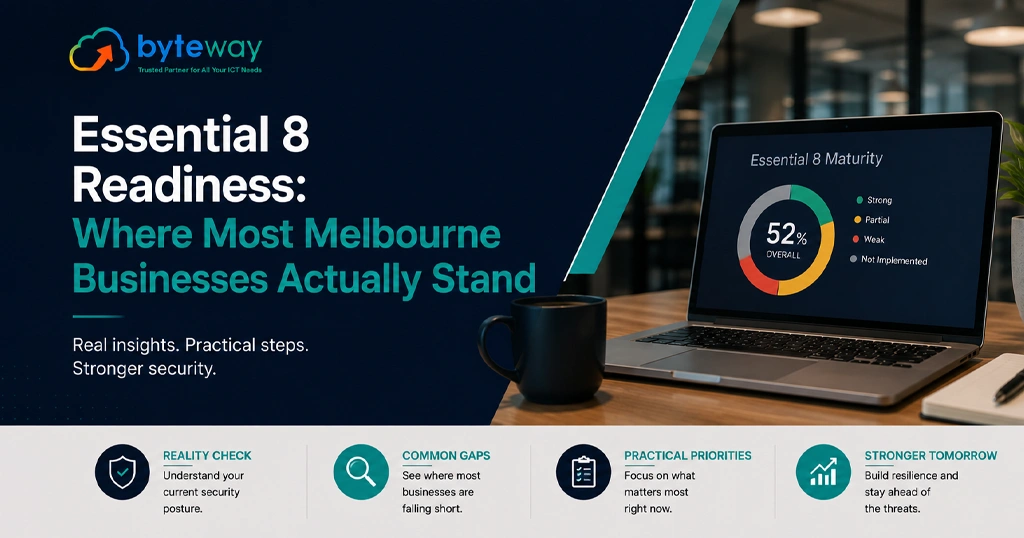
Essential 8 Readiness: Where Most Melbourne Businesses Actually Stand

Byteway assesses Melbourne businesses against the Essential Eight, and the most consistent finding is a gap between where businesses think they stand and where they actually do. Almost everyone rates their own readiness higher than an honest assessment does, because day to day the systems work and the weak spots stay hidden. This piece is an honest look at where most Melbourne businesses genuinely sit on Essential Eight readiness, why, and how to find out where you really stand. A quick reminder of what the Essential Eight measures The Essential Eight is the Australian Signals Directorate’s baseline of eight security controls: application control, patching applications, configuring Microsoft Office macros, user application hardening, restricting administrative privileges, patching operating systems, multi-factor authentication, and regular backups. You are scored across all eight on a maturity scale, and here is the rule that shapes everything: your overall level is set by your weakest control. Seven strong controls and one neglected one gives you the score of the neglected one, because that is where an attacker goes. Where most Melbourne businesses actually stand? Honestly, most sit partway up the first rung, strong in places and exposed in one or two, rather than comfortably at a consistent Maturity Level 1. Adoption is genuinely hard, and even across government, measured maturity has historically been low, so a small business finding gaps is the norm, not a failing. The common pattern looks like this: Multi-factor authentication: often half-done- Most businesses have MFA on email. Far fewer have it consistently across every system that matters, finance, remote access, admin accounts. The gaps are usually in the places nobody revisited after the first rollout. Backups: present, rarely tested– Nearly every business backs up. Very few have actually restored a backup recently to confirm it works and to know how long recovery takes. An untested backup is an assumption, and it is one of the most common readiness gaps we find. Patching: further behind than assumed- Applications and operating systems need prompt updating, and this is exactly the routine task that slips when everyone is busy. Almost every honest assessment finds patching lagging somewhere. Administrative privileges: quietly overgrown– Over time, more people end up with more access than they need, because granting it was easier than managing it. Restricting admin is high-value and commonly neglected. Application control and hardening: often not really in place- The more technical controls, controlling what software can run and hardening applications, are frequently the ones small businesses have not implemented at all, and they pull the overall score down. Put together, the typical Melbourne business is not starting from zero, but it is rarely as ready as it believes, and the gap is almost always concentrated in one or two controls that drag the whole score. Why the Gap Exists? It is not negligence. It is that security readiness is made of many small, boring, ongoing tasks that no single person owns, so they drift. The systems keep working, so the gaps stay invisible until an assessment, an insurer, or an attacker surfaces them. Readiness also moves: as the framework and threats evolve, staying at a given level takes ongoing effort, not a one-time fix. This is why businesses that felt “done” a year ago often are not today. How to find out where you actually stand? You do not need to guess. A readiness assessment scores each of the eight controls honestly against your real environment, identifies the weakest links dragging your overall level, and gives you a prioritised path to close them. The honest version looks hardest at the controls you are weakest on, because those set your score, rather than admiring the ones you do well. Even a self-check, being truthful about MFA coverage, when you last tested a backup, how current your patching is, and who has admin, will usually reveal more gaps than expected, which is the point. It is also worth knowing the current context: ASD is evolving the Essential Eight into a broader framework over the next couple of years, but the current Essential Eight remains the standard and the fundamentals are not changing, so assessing and improving your readiness now is time well spent, not wasted. We explain that transition in our piece on the Essential Eight changes, and the practical actions in our 2026 cyber checklist. Byteway Expert Insight The moment that lands with almost every Melbourne business we assess is realising the overall score is set by the one control they had not thought about, not the seven they had. A business will be proud of its MFA and its firewall, and then it turns out backups have never been restored, or half the team has admin rights, and that is the real level. This is not a reason to feel bad; it is the most useful thing an assessment does, because it points precisely at what to fix first. Our approach is to assess honestly, show a business exactly where it stands and why, and give a prioritised plan to reach a solid Maturity Level 1, which stops most attacks and satisfies most insurers. Readiness is very achievable. Knowing where you actually stand is the part most businesses skip. How Byteway helps? Frequently asked questions What is Essential Eight readiness? It is how well your business meets the Australian Signals Directorate’s eight baseline security controls, scored by maturity level. Because your overall level is set by your weakest control, readiness means being consistent across all eight, not strong in some. Byteway assesses Melbourne businesses honestly against all eight. Where do most Melbourne businesses stand on the Essential Eight? Most are partway there, strong on a few controls and weak on one or two, rather than consistently at Maturity Level 1. Common gaps are untested backups, lagging patching and overgrown admin access. Byteway helps businesses find and close these specific gaps. What maturity level should a small business aim for? Maturity Level 1, done properly, stops the majority of common attacks and is what cyber

Scroll to Top