Author name: Muskan Gupta

AI Automation Is Saving Melbourne Businesses Time and Money
Uncategorized

AI Automation Is Saving Melbourne Businesses Time and Money

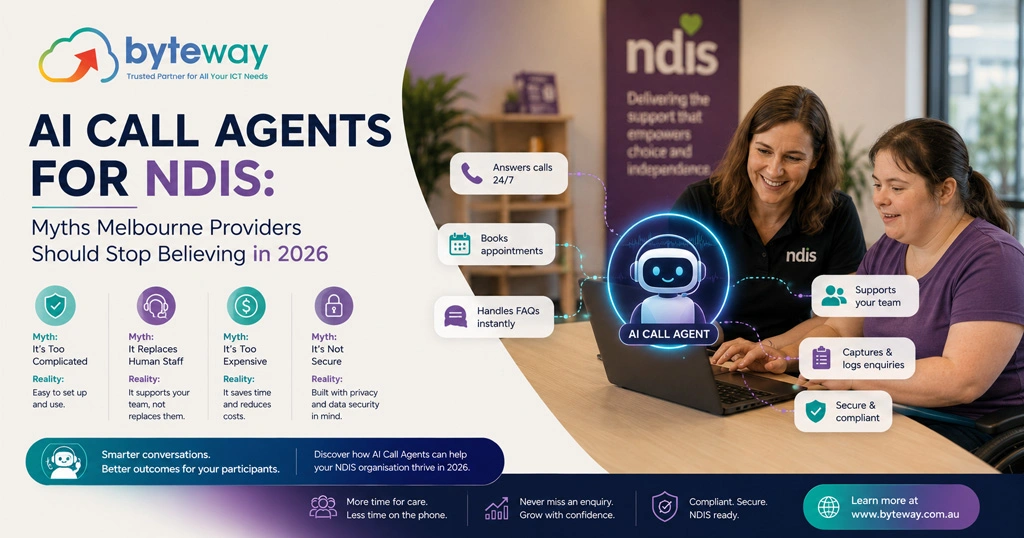
Every business has a set of tasks that quietly eat the week: the same forms filled in, the same emails typed, the same data copied from one system to another, the same calls that never get answered in time. Individually they feel small. Added up across a year, they are a salary’s worth of time spent on work that nobody enjoys and no customer values. This is exactly where AI automation is helping Melbourne businesses, not by replacing people, but by taking the repetitive work off them. Byteway helps businesses find and automate that work, and here is where it actually saves time and money. A quick word on what “AI automation” means here, because the term gets thrown around loosely. It is not a robot running your business. It is using AI and automation tools to handle specific, repetitive tasks, answering routine calls, drafting and sorting communications, moving information between systems, handling common questions, so your people spend their time on the work that needs a human. The value is boring and real: hours given back, and fewer things falling through the cracks. Where it actually saves time and money? Answering and handling calls– The phone is one of the biggest time-and-money leaks in a small business. Calls come while everyone is busy, go unanswered, and turn into lost work, or they get answered and pull someone off a more valuable task. An AI voice agent answers every call, handles routine enquiries, and books appointments, so nothing is missed and staff are not interrupted. For businesses that live on the phone, this is often the single biggest saving. The repetitive admin nobody wants to do- Every business has data being copied between systems, routine documents being generated, invoices and records being sorted, standard emails being written. AI and automation can handle a lot of this, quickly and without the errors that creep in when a person does the same dull task for the hundredth time. The time saved is real, and so is the reduction in mistakes. First-line customer questions- A large share of customer contact is the same handful of questions: hours, prices, availability, status updates. AI tools can answer these instantly, freeing your team for the conversations that actually need them, and giving customers a faster response than a queue. Drafting and summarising- Writing routine communications, summarising long documents or email threads, preparing first drafts, these are tasks AI does quickly, turning an hour into a few minutes. A person still reviews and finishes the work, but they start from a draft rather than a blank page, which across a week adds up. Sorting and prioritising- AI can triage incoming email, flag what matters, and sort information so your team spends less time deciding what to deal with and more time dealing with it. The saving is in attention, not just minutes. The pattern across all of these is the same: AI automation takes the repetitive, low-value, time-hungry work, and hands your people back the hours to spend on the work that grows the business. That is where the “time and money” in the headline actually comes from. The Honest Part AI automation is genuinely useful, and it is also over-hyped, so a few honest points matter. It works best on repetitive, well-defined tasks, not on the judgment-heavy, relationship-driven work that makes a business valuable, and trying to automate the latter disappoints. It needs setting up thoughtfully, pointed at the right tasks and connected to your systems, rather than switched on and expected to transform everything. And where it handles customer or business data, it has to be done with privacy and security in mind, which for a Melbourne business means using AI tools responsibly rather than pasting sensitive information into whatever is free, something we cover in our guide to using AI safely. Used well, on the right tasks, with the data handled properly, it saves real time and money. Used as a magic wand, it disappoints. The businesses seeing the gains are the ones being specific about what they automate. Getting started without overcomplicating it The practical way in is not a grand “AI transformation,” it is to look at where your team’s time actually goes and find the repetitive tasks worth automating first. Usually the phone and the routine admin are the obvious wins. Start there, measure the time it gives back, and expand from what works. That grounded, task-by-task approach is what turns AI automation from a buzzword into hours and dollars saved, and it is how the Melbourne businesses getting value from it actually got there. FAQs What is AI automation for a business? It’s using AI and automation tools to handle specific repetitive tasks, answering routine calls, drafting communications, moving data between systems, answering common questions, so staff focus on higher-value work. Byteway helps Melbourne businesses find and automate the right tasks. How does AI automation save money? By giving back the hours staff spend on repetitive, low-value work and reducing errors, so the same team achieves more without extra headcount, and fewer opportunities are lost to missed calls or slow responses. Byteway helps businesses target the automation that pays back. What tasks should a small business automate first? Usually the phone (with an AI voice agent) and repetitive admin like data entry, routine documents and first-line customer questions, the high-volume, low-judgment tasks. Byteway helps identify your biggest time leaks and automate those first. Will AI automation replace my staff? No. It handles repetitive tasks so your people can focus on judgment-heavy, relationship-driven work that AI can’t do. Byteway sets up automation to support your team, not replace it. Is AI automation safe for my business data? It can be, when the tools are chosen and used responsibly with privacy and security in mind, rather than pasting sensitive data into free consumer tools. Byteway helps Melbourne businesses automate safely. Find where AI automation would actually help you The gains come from being specific: automate the repetitive work that eats your

Uncategorized

Why Melbourne Businesses Are Asking About SOC 2 Compliance in 2026 (and Whether You Actually Need It)

Byteway helps Melbourne businesses navigate cyber security and compliance frameworks, and SOC 2 is one we are increasingly asked about, often with a misunderstanding attached. The honest starting point matters: no Australian law requires SOC 2. If you have heard that Melbourne businesses “need” SOC 2 in 2026, the reality is more specific, and getting it right can save you from spending heavily on the wrong framework. This guide explains what SOC 2 actually is, when a Melbourne business genuinely needs it, and when something else fits better. What SOC 2 actually is? SOC 2 (System and Organization Controls 2) is a framework developed by the American Institute of Certified Public Accountants. Unlike a certification, it produces an audit report, issued by a licensed CPA firm, describing your security controls and, for a Type II report, testing whether they operated effectively over a period of time. It is built around Trust Services Criteria, starting with Security, and it is fundamentally a way to give customers, especially in the US, evidence that you handle their data responsibly. That origin matters. SOC 2 is a customer-facing trust document driven by American business norms, which shapes when it is genuinely relevant to an Australian business. The Honest Truth: SOC 2 is not required by Australian law Let us be clear, because a lot of marketing implies otherwise: there is no Australian law that mandates SOC 2. Not the Privacy Act, not APRA CPS 234, not any other Australian regulation. Your legal data-protection obligations in Australia sit under the Privacy Act and, for some sectors, regulators like APRA, none of which require a SOC 2 report. So when SOC 2 is described as something Melbourne businesses “need,” that need is commercial, not legal. It exists when a customer or partner requires it as a condition of doing business, which turns SOC 2 into a commercial requirement, a key to a particular door, rather than a legal one. When a Melbourne business genuinely needs SOC 2? There is a clear pattern to who actually needs it: You sell software or services to US organisations- This is the most common trigger by far. US buyers frequently require SOC 2 as a procurement prerequisite, so if your growth depends on American customers, SOC 2 is often genuinely necessary, and worth doing properly. Large enterprise or SaaS customers demand it- Some big customers, wherever they are, list SOC 2 in their vendor requirements, particularly for cloud and SaaS providers handling their data. Investors expect it- Some investors, especially those with US ties, look for SOC 2 as a signal of security maturity. You want a competitive edge in a security-conscious market- For a SaaS business competing globally, SOC 2 can shorten sales cycles and reduce security questionnaires, which is why for some it is becoming table stakes. If one of these describes you, SOC 2 is worth pursuing properly. If none does, pause before you spend. When ISO 27001 or Essential Eight fits better? For many Melbourne businesses, especially those serving Australian customers, another framework serves the actual market better: ISO 27001 is the internationally recognised certification of your information security management system, and it is generally more recognised and requested here, by Australian enterprises, government and regulated industries. For a business selling into Australia and the region, ISO 27001 usually carries more weight than SOC 2. The Essential Eight is the Australian baseline, and demonstrating a strong Essential Eight posture is often what Australian buyers, insurers and tenders actually want to see, at a fraction of the cost and effort of SOC 2. We have seen Melbourne businesses start down the SOC 2 path because it sounded important, when an ISO 27001 certificate or a solid Essential Eight would have served their real market better. The good news is that the underlying work, the actual security controls, overlaps heavily across all of these, so effort is rarely wasted, but choosing the right badge to aim for matters. How to decide? The decision is simpler than it looks, and it starts with your customers, not the framework. Ask: who is asking us for proof of security, what specifically are they asking for, and where are they based. If US or global enterprise customers are naming SOC 2 in contracts, pursue SOC 2. If your buyers are Australian, lean towards ISO 27001 or a demonstrably strong Essential Eight. If you are scaling into both markets, a combined approach, building one security foundation that can support both, often makes sense, deciding which report to pursue first based on your actual pipeline. The wrong move is choosing a framework because it sounded impressive, rather than because your market requires it. Byteway Expert Insight The most valuable thing we do on this topic is occasionally talk a business out of SOC 2, or at least out of rushing into it. A Melbourne business will arrive convinced it needs SOC 2 because a competitor has it or an article said so, and two questions in, who is actually asking you for it, and where are they, it becomes clear that ISO 27001 or a strong Essential Eight would serve their real customers better and cost far less. SOC 2 is genuinely the right answer for Melbourne businesses selling to the US and to security-conscious global enterprises, and for those we help do it properly. For everyone else, the honest advice is to build the underlying security well, which every framework rests on, and then pursue the specific framework your actual buyers require, not the one with the best marketing. That clarity saves businesses real money. How Byteway helps? Frequently asked questions Is SOC 2 mandatory in Australia? No. No Australian law requires SOC 2, including the Privacy Act and APRA CPS 234. It is a commercial requirement that applies when your customers, usually US or enterprise buyers, demand it. Byteway helps Melbourne businesses work out whether they genuinely need it. Do Melbourne businesses need SOC 2 in 2026? Only if their customers

Scroll to Top