

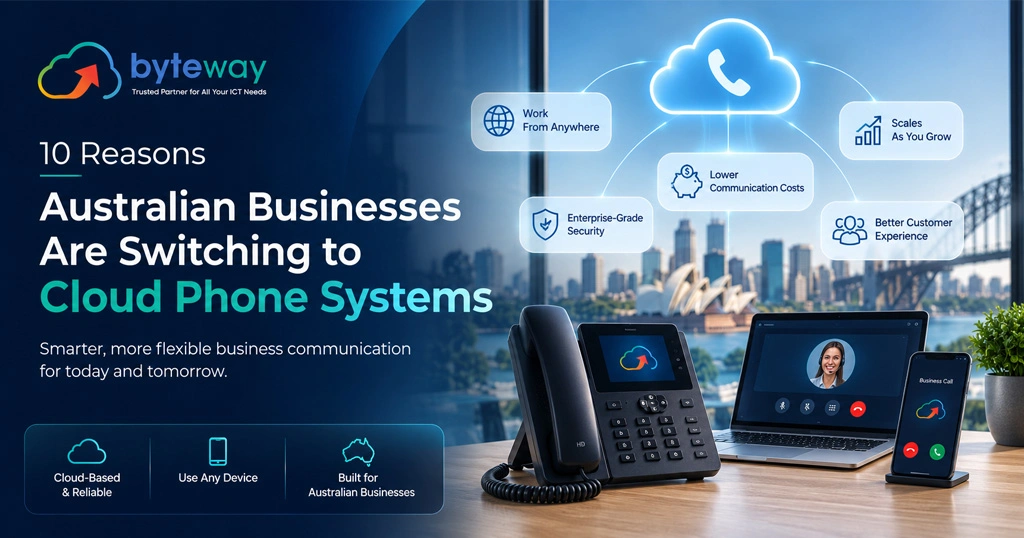
Byteway helps Australian businesses move to modern phone systems, and the shift to cloud phones has become one of the clearest trends in business technology, for good reasons and one unavoidable one. The old copper phone network is being retired, so change is coming whether a business plans for it or not. But the businesses switching are not doing it reluctantly; they are doing it because a cloud phone system genuinely does more for less. Here are the ten reasons behind the move.
1. The copper network is being retired
Start with the unavoidable reason. Australia’s copper phone network and legacy ISDN lines are being progressively decommissioned under the NBN migration, and in most areas you can no longer order a traditional copper line. Businesses still on old lines are on a countdown to disconnection. Switching to a cloud phone system now, on your own timing, is far better than a rushed migration when a line is cut off. This alone is prompting many businesses to move, and the other nine reasons make it an upgrade rather than a chore.
2. Lower running costs
Cloud phone systems are almost always cheaper to run than traditional lines. There is no separate copper line rental, calls (including national and often international) cost less, and there is no ageing on-site hardware to maintain. For a small business, moving to the cloud typically reduces the monthly phone bill while adding capability, which is a rare combination.
3. Work from anywhere, on any device
A cloud phone system is not tied to a desk or a building. Staff can make and take business calls from a desk handset, a laptop or a mobile app, using the business number, whether they are in the office, at home, or on the road. For the hybrid and remote working that is now normal, this flexibility is transformative, and it is impossible with a traditional fixed line.
4. Scale up or down in minutes
Adding a new staff member to a traditional phone system meant a technician and a wait. With a cloud phone system, adding or removing users is a quick change in software. For a growing business, or one with seasonal peaks, this means your phones keep pace with the business instead of holding it back, without service calls or new physical lines.
5. Features a traditional system can’t match
Cloud phone systems come with capabilities that old systems either lacked or charged heavily for: auto-attendants and call menus, voicemail-to-email, intelligent call routing, hold and transfer, call recording, video and messaging, and integration with AI voice agents that answer and book calls automatically. A small business gets the phone capabilities that used to belong only to large ones.
6. Better business continuity
A cloud phone system is more resilient than a fixed line, because it is not chained to one location. If your office loses internet or power, calls can automatically reroute to mobiles or another site, so you stay reachable. Paired with 4G or 5G failover, an outage that would have taken your phones down becomes something customers never notice.
7. Integration with your other tools
Modern phones do not sit in isolation. A cloud phone system can integrate with the tools you already use, your CRM, Microsoft 365 and Teams, and your customer systems, so calls connect to customer records and your communications work as one. This joined-up way of working is something traditional phone lines never offered.
8. A more professional image
A cloud phone system lets even a very small business present professionally: a proper auto-attendant, departmental options, hold music, multiple numbers, and no calls ringing out to a mobile voicemail. For a small business competing with larger ones, sounding polished and organised on the phone matters, and cloud systems make it easy and affordable.
9. Easier multi-site and unified communications
For businesses with more than one location, a cloud phone system unifies everything: one system across all sites, internal calls between locations, consistent numbers and routing, and central management. Traditional systems made multi-site telephony expensive and awkward; the cloud makes it straightforward, which is a major driver for growing businesses.
10. Future-proofing
Finally, the cloud is where the entire phone network is heading. Choosing a cloud phone system means choosing the option that will keep existing, keep improving and keep gaining features, rather than one being wound down. It is an investment that keeps paying off, instead of a technology on borrowed time. For a business planning ahead, that certainty is worth a great deal.
Byteway Expert Insight
The businesses that switch and love it are the ones that treated it as an upgrade, not just a forced migration off copper. They used the move to fix things that had quietly annoyed them for years: calls that could not follow staff home, a system that needed a technician for every change, no way to stay reachable in an outage. The businesses that find it painful are usually the ones that waited until a disconnection date forced a rushed switch with no planning. Our advice is to move by choice, plan the port so your numbers transfer cleanly, choose features that match how you actually work, and add failover so you are more reliable afterwards, not less. Done that way, switching to a cloud phone system is one of the easier technology wins a business can have.
How Byteway helps?
- We plan and run your switch to a cloud phone system, porting your existing numbers cleanly.
- We set up the features, integrations and failover that fit how your business actually works.
- We can manage your phones, internet and IT together as one accountable provider.
Make the switch on your terms
The move to cloud phones is happening across Australia, and the businesses that plan it get an upgrade, not a headache. Byteway handles the whole switch: porting your numbers, setting up the features you need, and adding failover so you come out more reliable. Book a cloud phone system consult.
Frequently asked questions
Why are businesses switching to cloud phone systems?
Because the copper network is being retired and cloud phones cost less, work from anywhere, scale instantly, add features and stay reachable through outages. Byteway helps Australian businesses switch to a cloud phone system on their own timeline, as an upgrade rather than a forced migration.
Is a cloud phone system cheaper than a traditional one?
Usually, yes. There is no copper line rental, calls cost less, and there is no ageing hardware to maintain, so most businesses reduce their phone bill while gaining features. Byteway helps businesses move to a cost-effective cloud phone system suited to their needs.
Can I keep my phone number when switching to the cloud?
Yes. Number porting transfers your existing numbers, including 1300 and 1800 numbers, with no downtime. Byteway manages porting as part of your cloud phone system switch so your numbers move across cleanly.
Does a cloud phone system work if the internet goes down?
With failover configured, calls reroute to mobiles or another site, so you stay reachable, and 4G/5G backup keeps you online. Byteway builds this resilience into your cloud phone system so an outage does not take your phones down.
Can staff use a cloud phone system from home or on the road?
Yes. A cloud phone system works from a desk handset, laptop or mobile app using your business number, from anywhere. Byteway sets up cloud phones so your team can work flexibly while keeping a professional business line.
Do I have to switch off my old phone system?
Eventually yes, because the copper network is being retired, so planning the move now avoids a rushed disconnection later. Byteway helps businesses transition from old systems to the cloud smoothly, on their own terms.
Key takeaways
- The copper network is being retired, so moving off traditional phones is coming regardless.
- Cloud phone systems cost less, work from anywhere, scale in minutes and add features.
- They stay reachable through outages, integrate with your tools and unify multi-site operations.
- Switching is an upgrade when planned, and a scramble when left until a disconnection date.
- Move by choice, port your numbers cleanly, and add failover to be more reliable afterwards.