

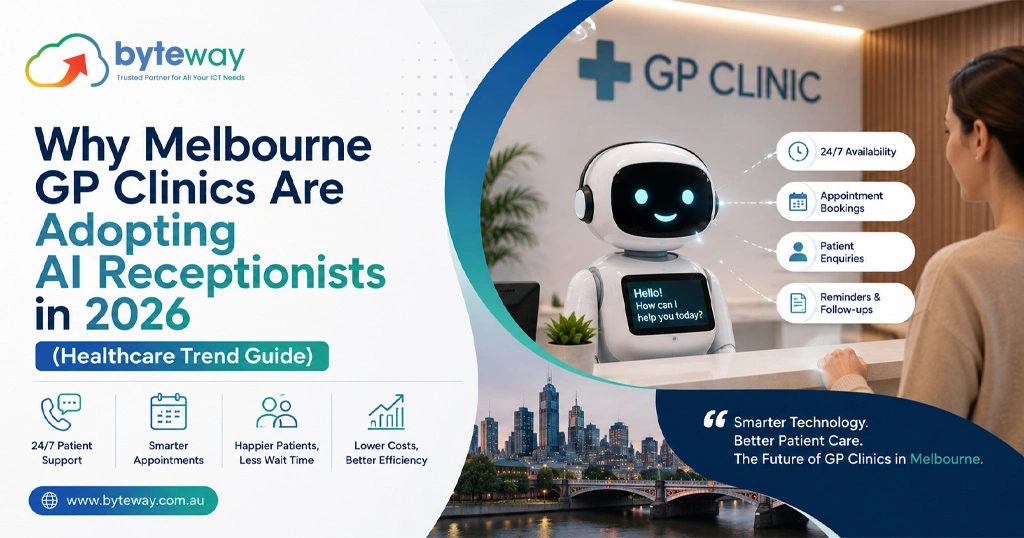
Byteway helps Melbourne GP clinics choose and set up healthcare technology properly, and one trend has grown fast in 2026: AI receptionists. More clinics are using AI voice agents to answer calls, book appointments and cover after-hours, driven by real pressure on reception and patient expectations. This guide explains what is behind the trend, and the compliance a clinic must get right before joining it.
In short, Melbourne GP clinics are adopting AI receptionists in 2026 to fix missed calls, ease overloaded reception, cover after-hours enquiries, and meet rising patient expectations for an instant response. An AI voice agent answers every call, books appointments and triages, freeing reception for the people in the clinic. Because clinics handle sensitive health information and are covered by the Privacy Act regardless of size, the trend only works when the agent is deployed with privacy, consent and call-recording handled correctly.
What’s driving the trend?
Missed calls, and lost patients. Reception cannot answer every call while managing a waiting room. Since most callers don’t leave voicemail and don’t call back, a missed call is often a patient who books elsewhere. An AI agent answers every one.
Reception overload. GP reception is one of the hardest jobs in healthcare, phones, walk-ins, billing and triage at once. AI agents absorb the routine call volume so reception can focus on the people in front of them.
After-hours demand. Patients call outside hours, and the alternative to an AI agent is usually voicemail. An agent books and triages around the clock.
Patient expectations. Patients increasingly expect to reach a practice instantly, book online-style and not wait on hold. Clinics that meet that expectation retain more patients.
Workforce pressure. With reception roles hard to fill, AI helps clinics maintain service without adding headcount they cannot recruit.
What an AI receptionist does for a GP clinic?
- Answers every call immediately, day and night
- Books, reschedules and cancels appointments in the practice system
- Answers common questions (hours, location, billing, what to bring)
- Triages and routes urgent calls to a person
- Takes clear messages and after-hours enquiries
- Keeps a human path for anyone who needs one
The compliance a clinic must get right
This is where the trend needs care. Clinics handle sensitive health information and are covered by the Privacy Act regardless of turnover. Before adopting, a clinic must handle:
- Consent and collection of sensitive information
- Call recording, where consent rules vary by state and a transcript counts as a recording
- Data location and access, since many tools process data overseas
- Vendor due diligence, because you remain responsible for the data
We cover this fully in our guide to AI receptionists and the Privacy Act for clinics. The short version: the trend is real and worthwhile, but a clinic should deploy through someone who sets up the compliance properly, not sign up to a consumer app.
Byteway Expert Insight
The Melbourne clinics adopting AI receptionists well share a mindset: they treat it as a clinical-grade system handling sensitive data, not a gadget. They fix the missed-call problem that was quietly costing them patients, and they do it with the privacy, consent and security set up correctly from day one. The clinics that struggle are the ones at the extremes, either refusing a genuinely useful tool out of vague compliance fear, or grabbing a slick app and pointing it at their phone line without asking where patient data goes. The trend rewards the middle path: adopt it, but deploy it properly.
How Byteway helps?
- We assess fit and configure an AI receptionist for your clinic’s call patterns.
- We handle the compliance, consent, call-recording, data location, vendor due diligence.
- We integrate it with your practice system and cyber security, with human handoff for urgent calls.
Join the trend, the right way
Byteway helps Melbourne GP clinics adopt AI receptionists that fix missed calls and protect patient data. Book a GP clinic AI receptionist demo. 👉 Book your demo
FAQs
Why are Melbourne GP clinics adopting AI receptionists?
To fix missed calls, ease reception overload, cover after-hours enquiries and meet patient expectations for instant response, all while facing workforce pressure that makes hiring reception hard.
Is an AI receptionist safe for a medical practice?
It can be, when deployed with privacy, consent and call-recording handled correctly. Clinics are covered by the Privacy Act regardless of size, so setup matters, which is why Byteway configures the compliance and integration before a clinic goes live rather than leaving it to a consumer app.
Will it replace our reception staff?
No. It handles routine and after-hours calls so reception can focus on in-clinic patients. It extends the team rather than replacing it.
Can it book into our practice management system?
A properly configured agent integrates with your booking system to book, reschedule and cancel directly, which is where most of the value is.
What about patient privacy?
Clinics handle sensitive health information and remain responsible for it. Consent, secure and appropriately located data, access control and vendor due diligence must be handled before adoption.
How do we start safely?
With a review of fit and a proper deployment that sets up compliance and integration correctly. Byteway assesses whether an AI receptionist suits your clinic, handles the privacy and consent setup, and integrates it with your practice management system.