

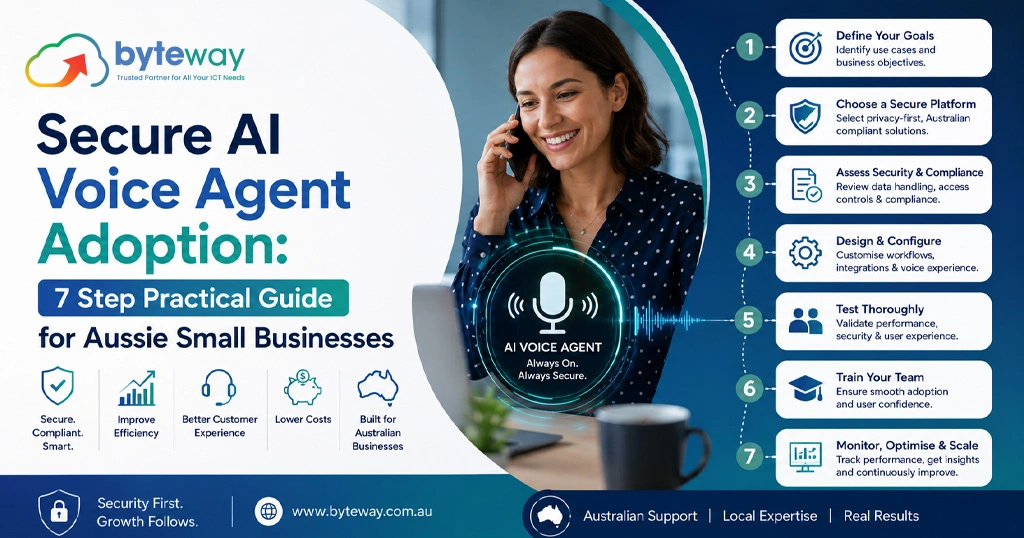
Byteway helps Australian small businesses adopt AI voice agents that answer every call without creating a privacy or security problem, and the difference between a smart deployment and a risky one comes down to process. An AI voice agent is genuinely useful, it catches missed calls, books jobs and covers after-hours, but it also handles your customers’ personal information, so it needs to be set up with care. This seven-step guide takes you through doing it securely.
If you want the whole thing in one line before the detail: adopting an AI voice agent securely means checking it genuinely fits, choosing the vendor on due diligence rather than the demo, controlling where the data goes and who can access it, handling call-recording consent for your state, integrating it properly, keeping a human path, and reviewing it over time. Skip those and you get a fancy voicemail with a compliance risk attached. Follow them and you get a booking system that earns its keep.
Step 1: Confirm it actually fits your business
Before anything technical, decide whether an AI voice agent solves a real problem for you. It fits best where you miss calls you cannot afford to lose: busy phones, after-hours enquiries, staff who cannot answer while working. If you already answer nearly every call, the case is weaker. Start from the problem, not the technology, so you are buying a fix rather than a gadget.
Step 2: Choose the vendor on due diligence, not the demo
Every AI voice agent demos well. What matters is what sits behind it. Before you commit, ask the vendor where your data is stored and processed, who can access it, whether it is used to train their models, what security they hold, and what happens to your data if you leave. A vendor who answers these clearly is one you can trust with customer information. A vendor who cannot is a risk, however slick the demo. The vendor’s practices become your risk the moment you sign.
Step 3: Control where the data goes
Many AI tools process data overseas. For an Australian business, especially one covered by the Privacy Act, sending personal information offshore is a cross-border disclosure you stay accountable for. Know where your callers’ data is stored and processed, and choose a configuration you are comfortable with. If you handle sensitive information, this matters even more.
Step 4: Handle call-recording consent for your state
This one catches businesses out, because the rules differ across Australia. Some states require all parties to consent to a call being recorded, and a transcript is generally treated the same as a recording. If your agent records or transcribes calls, it needs to obtain consent correctly at the start of the call for the state you operate in. Getting this wrong is not a minor issue, unlawful recording can be a criminal offence in some states.
Step 5: Lock down access and integration
The agent will produce bookings, messages and possibly transcripts, all containing personal information. Those outputs need to land somewhere secure, with access limited to staff who need it, protected by multi-factor authentication. Integrate the agent with your calendar or job-management system so calls become booked jobs and clean records, rather than a pile of data in an unsecured inbox. Good integration is where the value is; poor security around it is where the risk is.
Step 6: Keep a clear human path
A good AI voice agent knows its limits. For a complex request, an unusual situation, or a caller who simply wants a person, it should route to a human rather than forcing everything through the bot. The best setups feel like a capable receptionist who handles the routine and passes you the calls that need judgment. This protects both customer experience and the cases where a human genuinely needs to be involved.
Step 7: Review it over time
AI tools change, your business changes, and the rules evolve. Set a schedule to review how the agent is performing, what it is collecting, whether the vendor’s terms have changed, and whether the consent and security setup still holds. A one-off deployment is not governance. A reviewed one is.
Byteway Expert Insight
The small businesses that adopt AI voice agents well are not the most technical ones. They are the ones that treated it as a system handling customer data, not a novelty to switch on. The failure we see most often is the afternoon deployment: a business signs up to a consumer tool, points it at the phone line, and never asks where the data goes or how consent is handled. It works, which is the trap, because the compliance problem does not show up until later. Following these seven steps is not slow or expensive. It is the difference between a tool that quietly books you work and one that quietly becomes a liability.
How Byteway helps
- We assess whether an AI voice agent fits your business before you spend anything.
- We run the vendor due diligence, control data location and access, and set up call-recording consent correctly.
- We integrate it with your systems and cyber security, keep a human handoff, and review it over time.
FAQs
How do I adopt an AI voice agent securely?
Follow a clear process: confirm it fits, choose the vendor on due diligence, control data location, handle call-recording consent for your state, secure access and integration, keep a human path, and review over time. Byteway runs these seven steps for Australian small businesses so the agent helps without creating risk.
What should I ask an AI voice agent vendor?
Where data is stored and processed, who can access it, whether it trains their models, what security they hold, and what happens to your data if you leave. A vendor who cannot answer clearly should be avoided; Byteway runs this due diligence before recommending any tool.
Do I need consent to record calls with an AI agent?
It depends on your state. Some Australian states require all parties to consent, and a transcript counts as a recording. The agent must handle consent correctly for where you operate, which is part of how Byteway configures a deployment.
Where is my callers’ data stored?
That depends on the vendor, and many process data overseas, which is a cross-border disclosure you remain accountable for. Confirm data location before signing; Byteway checks this as part of setup.
Will an AI voice agent replace my staff?
No. It handles routine and after-hours calls and hands complex ones to a person, so it extends your team rather than replacing it. Keeping a clear human path is one of the seven steps.
Is this only for large businesses?
No. Small businesses often benefit most, because they have the least capacity to answer every call. The security steps are the same regardless of size, and Byteway sets them up for small teams.
Key takeaways
- Adopt an AI voice agent as a system handling customer data, not a gadget to switch on.
- Choose the vendor on due diligence: data location, access, model training, security, exit.
- Handle call-recording consent correctly for your state.
- Secure access and integration, keep a human path, and review over time.
Adopt AI voice the secure way
Byteway helps Aussie small businesses deploy AI voice agents that answer every call and protect customer data. Book a secure AI voice agent setup. 👉 Book your setup