
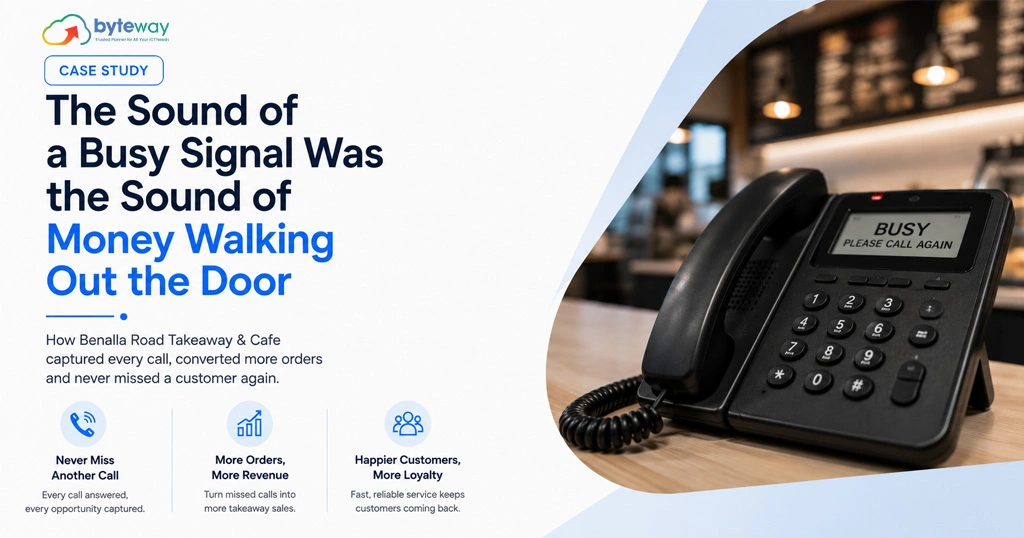
It’s 6:42pm on a Friday. The fryers are going, the grill’s covered, and somewhere behind the counter at Benalla Road Takeaway & Cafe, a phone is ringing into nothing. Byteway helped the cafe tackle this problem by upgrading its internet and replacing its single-line phone system with a Hosted Cloud Phone System, giving the business the capacity to handle peak-hour orders without busy signals.
One Phone Line, a Hundred Hungry Customers
Benalla Road Takeaway & Cafe sits on one of the steadiest strips in Benalla, Victoria, the kind of local spot where regulars know the staff by name and Friday night means fish and chips for half the street. It’s the sort of business built on volume and speed. Get the order taken, get it cooked, get it out the door.
For years, that rhythm worked. Then it started to skip.
The cafe was running on an old Loop phone system with a single line. One call in, one call out, nothing else. On a quiet Tuesday morning, that’s fine. On a Friday between 6pm and 8pm, when half the town wants dinner sorted in the next twenty minutes, one line is a bottleneck with a busy tone attached.
“You’d see it happening in real time. Someone would be mid-order on the phone, and you just knew there were people out there getting a busy signal, hanging up, and going somewhere else instead.”
That’s not a guess. It’s the exact pattern Australian food businesses run into when call capacity doesn’t match demand: the phone works fine right up until the moment it actually matters.
Did You Know?
A single missed call at a busy takeaway can represent $30 to $60 in lost revenue once you factor in the average order value of a family dinner run. Multiply that across a two-hour Friday rush, and a one-line phone system can quietly cost a small food business thousands of dollars a year in orders that simply never got placed.
The Internet Problem Nobody Could See
The phone line wasn’t the only thing holding the business back. The internet connection behind the scenes was slow and unreliable, the kind of connection that works fine until three things happen at once: a card payment, an online order notification, and a staff member trying to check stock levels.
That combination hit hardest exactly when the business could least afford it: during service.
Slow internet doesn’t announce itself the way a busy signal does. It just makes everything a little harder, a little slower, a little more frustrating, until one day you realise the whole operation has been running with a limp for months.
What Friday Night Actually Looked Like?
Picture it. Six-fifteen, Friday evening. The counter has three people waiting. The kitchen has four tickets up. The phone rings, gets answered, and while that order’s being taken, three more calls hit the same engaged tone.
Two of those callers try again in five minutes. One doesn’t bother.
That one customer, multiplied across a year of Friday nights, is a meaningful chunk of missed revenue for a business this size. It’s also a customer who might not try calling back next Friday either. Once someone finds a takeaway shop that actually answers, habits change fast.
Key Insight: In hospitality, a missed call rarely stays a one-off. It resets the customer’s default choice for next time.
The Turning Point
The team at Benalla Road Takeaway & Cafe didn’t wake up one day and decide they needed a “digital transformation.” They just wanted the phone to stop cutting people off, and they wanted the internet to stop dragging.
That’s the conversation that led them to Byteway.
Rather than replacing one problem with another, Byteway looked at the whole picture: an internet connection that couldn’t keep up, and a phone system that physically could not take more than one call at a time. Fixing one without the other would have left half the problem standing.
The plan that came out of that conversation was straightforward:
- Migrate internet services over to Byteway
- Upgrade the connection to Business NBN Fibre
- Replace the ageing Loop phone system with a Hosted Cloud Phone System
- Configure two concurrent phone lines instead of one
- Install Fenvil business handsets at the counter
Nothing about that list is flashy. All of it was aimed at solving the exact moment that had been costing the business money for years: the second call that used to hit a busy tone.
Two Lines Changed Everything
Here’s the part that matters most for any takeaway shop reading this: a hosted phone system doesn’t route through a single physical line sitting in the back office. It runs through the cloud, which means the business could go from one line to two without ripping out the wiring or waiting weeks for a technician.
Two concurrent lines meant two customers could be on the phone with Benalla Road Takeaway & Cafe at the exact same moment. No busy signal. No silent walk-away. Just two orders being taken instead of one and a lost sale.
Paired with Business NBN Fibre running underneath it, the new setup gave the cafe the two things it actually needed: enough phone capacity to match a Friday rush, and an internet connection fast enough to carry it without dragging down everything else running in the background.
Before vs After
| Area | Before | After |
| Phone Lines | One line, one call at a time | Two concurrent lines |
| Phone System | Ageing Loop system | Hosted Cloud Phone System |
| Handsets | Legacy equipment | Fenvil business handsets |
| Internet | Slow, unreliable | Business NBN Fibre |
| Friday Rush Calls | Busy signal during peak times | Both lines answer simultaneously |
| Missed Orders | Frequent during service | Rare |
| Call Quality | Inconsistent | Clear and stable |
What Friday Night Sounds Like Now?
Same time, same rush, different outcome. Six-fifteen on a Friday, three people at the counter, four tickets in the kitchen. The phone rings. It’s answered. It rings again a minute later, on the second line, and that gets answered too.
Nobody outside the shop hears a busy tone anymore. Two customers can place an order in the same sixty seconds, and both of them get their dinner sorted instead of one of them driving to a competitor three streets over.
Fewer missed orders. Better customer experience. Call quality that holds up even when the kitchen’s slammed. That’s the whole shift, and it shows up most clearly on the exact nights that used to be the problem.
Key Insights
- A single-line phone system caps how much revenue a takeaway can capture during peak hours, no matter how good the food is
- Internet reliability and phone reliability are connected problems, not separate ones, especially with a hosted system
- Two concurrent lines can double the number of orders a small food business can take during a rush, without adding staff
- Customers rarely tell you they got a busy signal. They just don’t call back
Business Lessons for Other Takeaway and Cafe Owners
If Benalla Road Takeaway & Cafe’s story sounds familiar, a few lessons carry over directly:
- A busy signal is a lost sale, not a delayed one. Most callers who hit an engaged tone during a rush won’t try again in the next five minutes.
- One phone line was never built for peak hospitality demand. It was fine for a quieter era of the business, not the current one.
- Internet upgrades and phone upgrades work best together. A fast connection with an outdated phone system, or a modern phone system on slow internet, only solves half the problem.
- Hosted systems scale without a rebuild. Adding a second line didn’t mean tearing out old infrastructure.
Implementation Timeline
- Week 1: Byteway reviewed the existing Loop system, internet connection, and call volume during peak service.
- Week 2: Internet services migrated to Byteway and Business NBN Fibre was installed.
- Week 3: The Hosted Cloud Phone System was configured with two concurrent lines.
- Week 4: Fenvil handsets installed at the counter and staff trained on the new system.
- Week 5: Full handover, with call quality and connection performance confirmed during a live Friday rush.
By the Numbers
- 1 line → 2 lines: the phone system’s simultaneous call capacity doubled
- 0 wiring changes needed: the hosted system runs over the upgraded internet connection, not new physical phone lines
- Peak-hour missed calls: reduced from a regular occurrence to a rare exception
Frequently Asked Questions
What is a hosted phone system?
A hosted phone system, also called a Hosted PBX, runs over the internet instead of a physical onsite exchange. It allows multiple calls to be handled at once and can scale up without new wiring.
Why couldn’t the old Loop system handle busy periods?
The Loop system supported only one phone line, so a second caller during peak times would hit a busy signal rather than reaching the business.
How did adding a second phone line help Benalla Road Takeaway & Cafe?
Two concurrent lines meant two customers could call and place orders at the same time, removing the busy signal that had been turning callers away during Friday and weekend rushes.
Why was a Business NBN Fibre upgrade part of the fix?
A hosted phone system depends on the internet connection underneath it. Business NBN Fibre gave the cafe the speed and reliability needed to run calls, card payments, and daily operations at the same time.
What handsets were installed?
Fenvil business handsets were installed at the counter as part of the upgrade.
Is a hosted phone system suitable for a small takeaway or cafe?
Yes. Hosted systems scale to the size of the business, so a small takeaway shop can run two lines just as easily as a larger operation runs ten.
How long did the upgrade take?
The process, from initial review to full handover, took around five weeks, timed to avoid disrupting the business’s busiest service periods.
Can other Benalla hospitality businesses get the same setup?
Yes. Byteway works with cafes, takeaway shops, restaurants, and other hospitality businesses across Benalla and regional Victoria on internet and phone upgrades tailored to their call volume.
The Bigger Picture
Every food business has a version of this story. A phone that can’t keep up. An internet connection that quietly slows everything down. A Friday night rush that should be the most profitable few hours of the week, undercut by infrastructure nobody thought to question.
Benalla Road Takeaway & Cafe didn’t need a bigger kitchen or a longer menu to fix its busiest problem. It needed a phone system built for how the business actually runs, and an internet connection that could carry it.
For any takeaway, cafe, or restaurant still running on a single phone line, the question worth asking is simple: how many customers called last Friday, got a busy signal, and just never called back?
Talk to Byteway about a free assessment, a Business NBN Fibre upgrade, or a Hosted Cloud Phone System demo built around your busiest hours.