

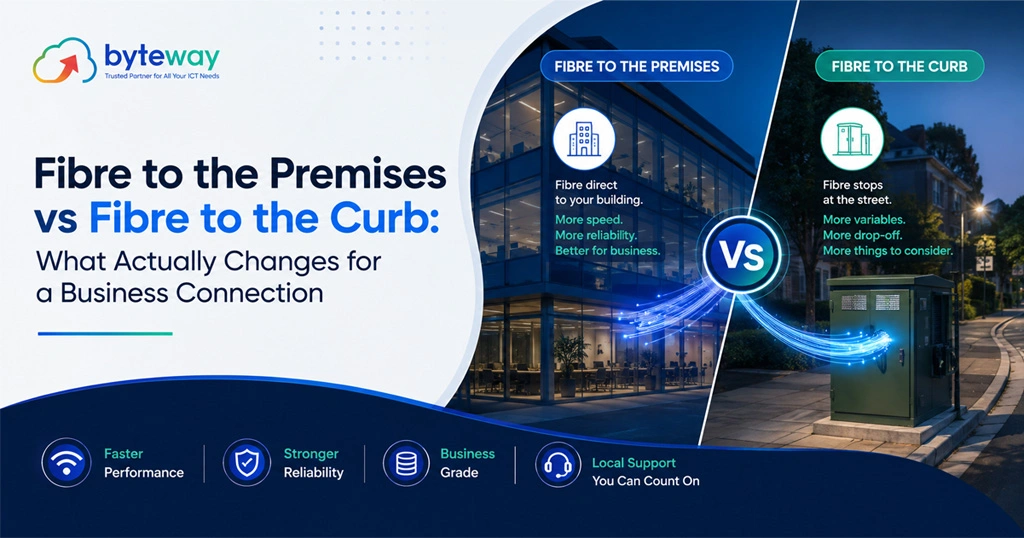
Byteway sets up and manages Business NBN connections for companies across Australia, and one question comes up constantly from businesses on Fibre to the Curb: is it worth moving to full fibre, and what actually changes if we do? The short version is that the two are closer on paper than in practice, and the gap has widened over the past year. Here is what genuinely changes for a business connection, in plain terms.
Both are called fibre, and both are good compared with the old Fibre to the Node. But they are not the same connection, and for a business the differences show up in the places that matter: top speed, upload capacity, reliability, and what you can do next.
Fibre to the Curb (FTTC) runs fibre to a small unit in a pit near your premises, then uses a short run of existing copper for the final stretch inside. Fibre to the Premises (FTTP) runs fibre the whole way in, with no copper at all. The practical result: FTTC is capped at the NBN 100 speed tier, while FTTP reaches NBN 500, 1000 and 2000. FTTP is also more reliable, with lower fault rates, and it is the only one of the two that supports higher-grade business fibre products. For most growing businesses, FTTP is the connection worth being on.
What is the difference between FTTP and FTTC?
The difference is where the fibre stops and copper takes over.
Fibre to the Curb (FTTC) brings the fibre to a small distribution unit, usually in a pit or under a pit lid on the street near your premises, often described as “the curb”. From there, the existing copper line carries the signal the last short distance into your building. So FTTC is mostly fibre with a copper final run.
Fibre to the Premises (FTTP) brings the fibre all the way into your building, terminating at an NBN connection box installed inside. There is no copper in the path at all.
That final copper segment in FTTC is short, which is why FTTC performs far better than the old node-based connections where copper ran much further. But “short copper” is still copper, and copper is the part that limits speed, degrades over time, and fails more often.
The speed gap is now much bigger than it used to be
This is the change most businesses have not caught up with, and it is the most important part of the comparison in 2026.
For years, FTTC and FTTP felt similar because both comfortably delivered the common NBN 100 plans. That is no longer the whole picture.
In late 2025, NBN Co significantly boosted its higher speed tiers, and it rolled those boosts out across FTTP and HFC connections only. The faster tiers, NBN 500, 750, 1000 and the newest NBN 2000, are available on FTTP. They are not available on FTTC.
FTTC is capped at NBN 100. That is the ceiling, and it cannot go higher without upgrading the connection to FTTP.
So the gap is no longer “both are fine, one is slightly better”. It is:
| FTTC | FTTP | |
|---|---|---|
| Maximum speed tier | NBN 100 | Up to NBN 2000 |
| Faster tiers (500/1000/2000) | Not available | Available |
| Final connection | Short copper run | Fibre all the way |
| Upload capacity | Limited by copper segment | Far higher, supports higher-grade products |
| Reliability | Higher fault rate | Lower fault rate |
| Future headroom | None, this is the ceiling | Substantial |
For a business that is comfortable on 100 megabits today, this might sound academic. It is not, for one reason: businesses grow into their connection. More staff, more cloud applications, more video, more data moving to and from the cloud. On FTTC you have no room to move up. On FTTP you can lift your speed with a plan change and no infrastructure work.
Why reliability matters more for a business than a household?
Speed gets the headlines. For a business, reliability often matters more, and this is another area where the two differ.
NBN Co has publicly stated that FTTC has higher fault rates than both FTTN and FTTP, and it is prioritising the retirement of FTTC partly for that reason, along with long-term uncertainty in the supply of FTTC equipment. In other words, the network operator itself treats FTTC as the less reliable, less future-proof technology.
That copper final segment is the weak point. It is susceptible to moisture, corrosion and degradation in a way fibre is not. After extreme weather, fibre services generally recover faster than copper-dependent ones.
For a household, an occasional outage is an annoyance. For a business, it is EFTPOS down, phones down if you run voice over the connection, staff unable to reach cloud systems, and customers turned away. The cost of unreliability is measured differently when it is your trading day.
What FTTP unlocks that FTTC cannot?
Moving to full fibre is not only about a bigger number on your plan. It changes what your connection can support.
Higher and symmetrical-capable speeds. FTTP supports the full range of speed tiers, and the higher upload capacity matters for any business that pushes data out: cloud backups, large file transfers, video, hosting, remote access. FTTC’s copper segment constrains upload in a way FTTP does not.
Higher-grade business products. The step up from standard Business NBN to premium business-grade fibre products, the kind that come with stronger service levels, generally requires fibre to the premises. FTTC is not the platform for that. If you ever want a connection with a service level agreement and guaranteed restoration times, FTTP is the starting point, and dedicated fibre is the tier beyond it.
Room for voice and multiple services. Running your phone system over the internet, and running it reliably alongside everything else, is easier on a connection with more headroom and no copper bottleneck.
Future headroom without more building work. Once fibre is in, moving up a speed tier is a plan change, not a construction job. On FTTC, the next real step up is the FTTP upgrade itself.
The upgrade path from FTTC to FTTP
Here is the practical good news. If your business is on FTTC, you can very likely move to FTTP, and the infrastructure upgrade is free.
NBN Co runs a fibre upgrade program that has made millions of FTTN and FTTC premises eligible for free full-fibre upgrades. Historically, FTTC premises had to order a higher speed plan to qualify. From July 2026, NBN Co removed that requirement for FTTC, meaning a large number of FTTC premises became eligible to upgrade to FTTP without being forced onto a high-speed tier first. NBN Co estimated around 600,000 single-dwelling FTTC premises would become newly eligible on that basis.
What the upgrade involves:
- NBN Co installs the fibre and a connection box inside your premises, at no charge for the infrastructure.
- The upgrade is initiated through your internet provider, even though NBN Co does the physical work.
- There can be a short changeover, so for a business it is worth scheduling around trading hours.
- Your in-premises equipment (router) needs to be capable of the connection, which for most modern business setups is not an issue, but is worth checking.
The reason to do this proactively rather than waiting: you control the timing, and you get onto the better, faster, more reliable platform on your own schedule.
A quick note on the copper retirement, without repeating ourselves
You may have heard that NBN Co is retiring copper for a large number of premises, with forced upgrades beginning in 2027. FTTC is one of the connection types in scope for that, precisely because it still depends on copper for the final run.
We have written separately about that program, who is affected, the timeline, and what multi-site businesses in particular should plan for. This article is about the technical and practical difference between the two connection types, so if you want the copper-retirement detail, that is a different piece. The short point here is simply that FTTC’s copper dependency is exactly why it is being phased out, which is one more reason not to treat FTTC as a long-term platform for a business.
Which connection does my business have?
Before deciding anything, confirm what you are on.
- Use the NBN Co address lookup. Enter your business address on the NBN Co website. It shows your connection type and whether a fibre upgrade is available.
- Ask your provider. They can tell you your connection technology and your eligibility.
- Physical check. FTTC typically uses an NBN connection device linked to a phone wall socket, plus your router. FTTP has an NBN connection box mounted inside the premises. This is a rough guide, so confirm with the address lookup.
If you are on FTTC and fibre is available, an upgrade to FTTP is usually the sensible move for a business, and often free.
Get on the right connection for where your business is heading
The honest summary is that FTTC was a reasonable connection for its time, and full fibre is simply the better platform for a business now: faster, more reliable, and with room to grow into rather than out of.
Byteway can check what connection each of your sites is on, confirm your FTTP upgrade eligibility, handle the upgrade through to a tested, working connection, and make sure your speed tier and equipment actually match how your business uses the internet. If a higher-grade connection with a service level agreement suits you better, we can advise on that too.
Book a business connection review. We will tell you what you are on, what you could be on, and whether it is worth moving.
Frequently asked questions
What is the difference between FTTP and FTTC?
FTTP runs fibre all the way into your premises with no copper. FTTC runs fibre to a unit near the street and uses a short copper run for the final connection. The copper segment is why FTTC is slower-capped and less reliable, though both outperform the older Fibre to the Node.
What is the maximum speed on FTTC?
FTTC is capped at the NBN 100 tier. The higher tiers introduced across 2025 and 2026, including NBN 500, 1000 and 2000, are only available on FTTP and HFC. To go faster than NBN 100, an FTTC premises must upgrade to FTTP.
Is FTTC good enough for a business?
It can be adequate for a small business with modest needs on an NBN 100 plan. But it cannot go faster than NBN 100, has higher fault rates than FTTP, and cannot support higher-grade business fibre products. Growing or cloud-reliant businesses are better on FTTP.
Is the FTTC to FTTP upgrade free?
The infrastructure upgrade is generally free under NBN Co’s fibre upgrade program, and from July 2026 the previous high-speed-plan requirement was removed for many FTTC premises. You pay nothing for the fibre installation. You initiate the upgrade through your internet provider.
Will upgrading to FTTP disrupt my business?
There can be a short changeover during the switch, so it is worth scheduling around your trading hours. For most businesses the disruption is minor with a little planning, and the result is a faster, more reliable connection with room to grow.
Do I need a new router to upgrade to FTTP?
Possibly. Your router needs to support the connection and any higher speeds you move to. Many modern business routers are fine, but it is worth confirming before the upgrade so you get the full benefit. Your provider can advise on suitable equipment.
Why is NBN retiring FTTC?
NBN Co has said FTTC has higher fault rates than FTTN and FTTP, and it faces long-term uncertainty in the supply of FTTC equipment. It is accelerating the move from FTTC to FTTP for reliability and efficiency, recovering and redeploying FTTC equipment where possible.
What is the difference between FTTP and dedicated fibre?
FTTP is full-fibre NBN, excellent for most businesses. Dedicated fibre is a higher-grade, uncontended business connection with symmetrical speeds and strong service level agreements, suited to businesses that cannot tolerate downtime or need guaranteed performance. FTTP is often the right platform to start from, with dedicated fibre as the step up.