

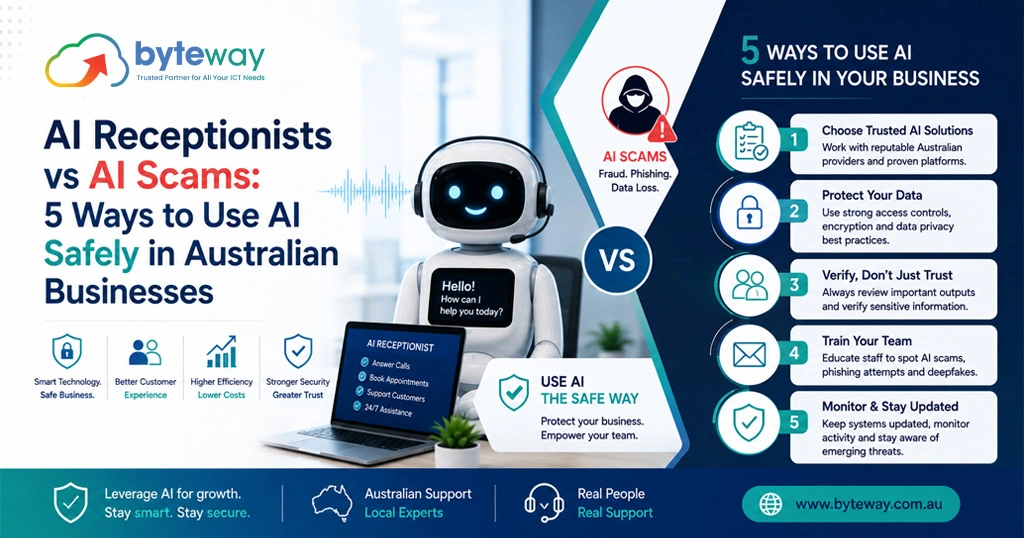
Byteway helps Australian businesses get the benefit of AI without inheriting its risks, and 2026 has made that balance sharper than ever. The same technology that lets a business run a helpful AI receptionist is being used by criminals to clone voices, fake video calls and write flawless scam emails. Most advice treats AI as only one thing, an opportunity to chase or a threat to fear. The truth is both, and using AI safely means playing both hands: adopting the good deliberately, and defending against the bad. Here are five practical ways to do exactly that.
The 2 Faces of AI for Your Business
On one side, AI is a genuine opportunity. An AI receptionist answers every call and books jobs around the clock. AI tools draft, summarise and speed up everyday work. Used well, this is real productivity, and businesses that adopt it thoughtfully pull ahead.
On the other side, AI has handed criminals a serious upgrade. The Australian Competition and Consumer Commission’s Scamwatch has warned that scammers now use AI to make scams more convincing, personalised and harder to detect, creating fake videos, cloning voices from short audio clips, and sending tailored messages built from information found online. Australians reported around $2.18 billion in scam losses in 2025, and AI is a growing part of why fraud is getting harder to spot. Voice cloning is the sharpest example: it targets the human shortcut of trusting a familiar voice, and the old advice to listen for a robotic tone or awkward phrasing no longer holds, because AI-generated audio has become convincing.
Both faces are real at once. Using AI safely is not choosing between them. It is capturing the upside while closing the downside, which the five steps below are built to do.
5 Ways to Use AI Safely in Your Business
1. Choose and deploy AI tools with privacy and due diligence
The opportunity side starts here. When you adopt an AI tool, an AI receptionist, an assistant, anything that touches customer or business data, you are trusting a vendor with information you remain responsible for. Before committing, ask where data is stored and processed, who can access it, whether it is used to train the vendor’s models, and how it handles consent and call recording, which varies by state. A tool chosen on features alone can quietly create a privacy problem; one chosen on due diligence delivers the benefit safely. This matters most in regulated sectors, and we cover it in depth in our guide to adopting an AI voice agent securely.
2. Govern how your staff use AI
Your team is almost certainly already using AI tools, whether or not you have approved them. That is fine, and useful, until someone pastes confidential or personal data into a consumer AI service that may retain it. Banning AI fails, because people use their phones. The safe path is governance: a clear policy on what can and cannot go into AI tools, and a sanctioned option people can actually use. This closes the “shadow AI” gap without killing the productivity, and we explain the approach in our piece on shadow AI in the workplace.
3. Verify anything urgent on a separate, trusted channel
This is the single most effective defence against AI-powered scams, and it costs nothing. Because AI can now fake a familiar voice, a video face and a perfect email, you can no longer trust that a message is genuine just because it looks or sounds right. The defence AI cannot beat is to verify through a channel it does not control: if you get an urgent request to pay an invoice, change bank details, or move money, confirm it by calling the person back on a number you already have, not one from the message. A cloned voice cannot survive you hanging up and dialling a number you saved last year. This is the same discipline that stops payment redirection fraud, and in the AI era it matters more than ever.
4. Train your team on AI-era scams
The warning signs have changed, and staff trained on the old ones are exposed. Spelling mistakes, robotic voices and clumsy phrasing used to give scams away; AI has erased all of them. The reliable red flags now are behavioural, not technical: secrecy, urgency, pressure to act immediately, a request to bypass normal checks, or a demand for an unusual payment method. Teach your people to treat those behaviours as the alarm, regardless of how genuine the voice, face or email seems, and to slow down and verify rather than react. A brief, current session on how AI scams actually work is one of the cheapest protections you can put in place.
5. Get the security fundamentals right underneath it all
AI does not replace basic security; it raises the stakes on it. AI assistants surface whatever a user can already access, so loose permissions become an instant oversharing problem, and stolen credentials give attackers AI-assisted reach. The fundamentals that protect you against ordinary attacks protect you here too: multi-factor authentication everywhere, tight access control, tested backups, patching, and monitoring. These are the foundation that makes safe AI adoption possible, and they connect to the wider AI and cloud security risks every business now faces.
Byteway Expert Insight
What we see is businesses picking one side of AI and getting caught by the other. Some race to adopt AI tools and never ask where the data goes, creating a privacy problem. Others are so wary of AI scams that they avoid useful tools entirely, and still get caught because they never trained their staff on the new warning signs. The businesses that get it right hold both ideas at once: AI is a tool worth using and a threat worth defending against, and the same disciplined approach covers both. Choose tools carefully, govern how they are used, verify anything urgent independently, train your people on how scams actually work now, and keep the security basics solid. None of it is exotic, and together it lets a business use AI with confidence instead of either fear or naivety.
How Byteway helps?
- We help you adopt AI tools, including AI receptionists, safely, with the privacy and vendor due diligence handled.
- We set up AI-use governance and staff training on AI-era scams, so productivity does not come with exposure.
- We put the security fundamentals in place, MFA, access control, backups and monitoring, through our cyber security and managed IT services.
Use AI with confidence, not fear or naivety
AI is the most useful and most dangerous technology most businesses will adopt this year, and the same disciplined approach handles both sides. Byteway helps Australian businesses adopt AI tools safely and defend against AI-enabled scams, so you get the upside without the exposure. Book an AI readiness and security review. 👉 Book your review
Frequently asked questions
How can Australian businesses use AI safely?
By choosing AI tools with proper privacy due diligence, governing how staff use them, verifying urgent requests on a separate trusted channel, training teams on AI-era scams, and keeping security fundamentals like MFA in place. Byteway helps Australian businesses adopt AI safely and defend against AI-enabled fraud.
What are AI scams and how do they target businesses?
AI scams use cloned voices, deepfake video and AI-written phishing to impersonate executives, suppliers or staff and trick businesses into paying fake invoices or changing bank details. Scamwatch warns they are increasingly convincing. Byteway helps businesses put the verification habits and controls in place that stop them.
How do I protect my business from AI voice cloning scams?
Verify any urgent voice request by calling the person back on a number you already trust, never one from the message, because a cloned voice cannot survive independent verification. Watch for behavioural red flags like secrecy and urgency. Byteway helps businesses build these verification habits into their processes.
Are AI receptionists safe for my business?
They can be, when deployed with privacy, consent and data handling done correctly, since they process customer information you remain responsible for. Byteway assesses and sets up AI receptionists so you get the benefit without creating a privacy or compliance problem.
Can staff use tools like ChatGPT safely at work?
Yes, with governance: a clear policy on what data can go into AI tools and a sanctioned option to use, which prevents sensitive information leaking into consumer services. Byteway helps businesses set up safe, governed AI use rather than an unenforceable ban.
What is the most important defence against AI-enabled fraud?
Verifying anything urgent through a separate channel you control, combined with staff who recognise behavioural warning signs and strong security fundamentals like MFA. Byteway builds these layers together so AI scams run into friction rather than an open door.