

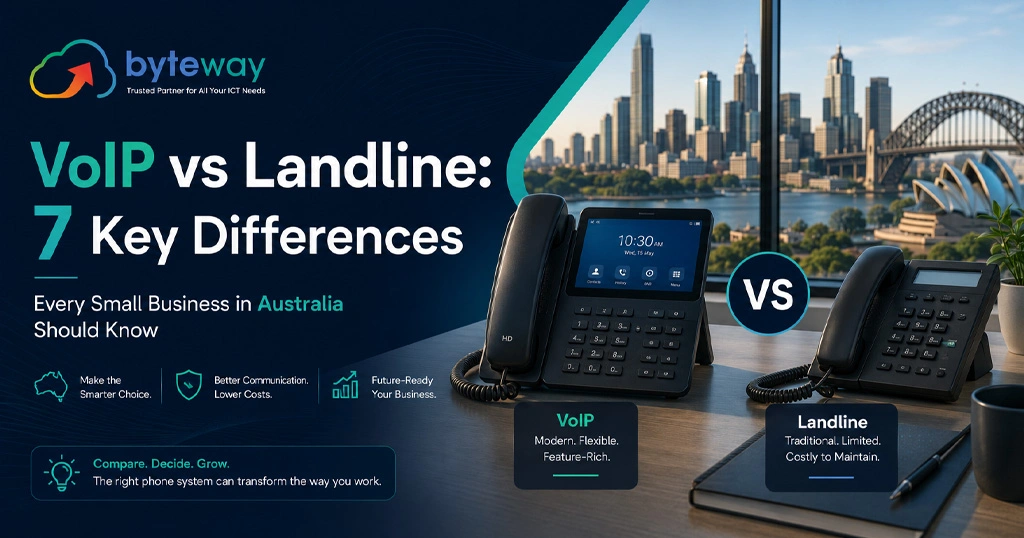
Byteway helps Australian small businesses move to modern phone systems, and the first thing worth saying about VoIP vs landline in 2026 is uncomfortable: for most businesses, the choice has already been made for you. The copper landline network is being switched off, so the honest comparison is not really “should I stay on a landline or move to VoIP,” it is “which internet-based phone service should I move to, and will I do it on my own terms or wait until the line goes dead.” This guide covers the seven differences that actually matter, honestly, including the one real advantage the old landline had.
First, The Honest Context: The Copper Landline is Going Away
Before comparing the two, you need the lay of the land, because it changes the whole decision. Australia’s copper PSTN, the network that carried phone calls for over a century, has been progressively retired under the NBN migration, along with legacy ISDN business lines. In most NBN-served areas you generally cannot order a brand-new copper line the way you could a decade ago, and existing copper services face disconnection.
That means the “landline” many small businesses believe they still have is often already a voice service delivered over the NBN, dependent on the internet whether they realise it or not. So for most premises, the real choice is no longer “keep the copper landline or switch to VoIP.” It is which internet-based voice service to use. With that context, here are the differences that matter.
The 7 Key Differences
1. How the calls actually travel
A landline sends your voice over a dedicated copper circuit through physical exchanges. VoIP sends it as data over your internet connection. That single difference drives most of the others: because VoIP rides your network rather than a fixed wire, it is far more flexible, but it does depend on your internet being sound. The important 2026 point is that, with copper being retired, the dedicated-circuit landline is the option that is disappearing.
2. Cost
VoIP is almost always cheaper for a small business. There is no separate copper line rental, calls (including national and often international) are cheaper, and you avoid the technician costs that come with traditional line changes. A landline carries the ongoing cost of ageing infrastructure that is being wound down. For most small businesses, moving to VoIP reduces the monthly phone bill while adding capability.
3. Features
This is where the gap is widest. A landline makes phone calls, and that is essentially it. VoIP does calls plus video, messaging, mobile and desktop apps, call routing and menus, voicemail-to-email, and integration with your other tools, right up to AI voice agents that answer and book calls automatically. For a small business, VoIP is not just a phone line, it is a communications platform that a landline cannot approach.
4. Flexibility and scalability
A landline is tied to your premises and needs a technician to add or change lines. VoIP follows your people to any device, home, mobile, another site, and scales up or down in minutes rather than days. Adding a new staff member is a few clicks, not a service call. For a growing or hybrid small business, this flexibility is one of VoIP’s biggest practical advantages.
5. Reliability and what happens in a power outage
Here is the one genuine advantage the old copper landline had, and it deserves an honest answer. A traditional copper phone was powered down the line from the exchange, so it kept working during a blackout, which is exactly why landlines were long recommended as emergency backup. VoIP depends on mains power: if the power is out, your modem, router and NBN connection device go down, and so does the phone, unless you have backup.
But two things balance this. First, that advantage has already largely disappeared, because most “landlines” now run over the NBN and need power too. Second, a well-designed VoIP setup has resilience the old landline never offered: calls automatically reroute to mobiles if the office connection drops, 4G or 5G failover keeps you online through an outage, and a small UPS keeps the hardware running. Configured properly, VoIP is more resilient for business continuity than a landline ever was, because it is not chained to one building. The power point is real, and it is a design consideration to solve, not a reason to cling to copper.
6. Keeping your existing number
A common worry is losing a phone number a business has had for years. You do not. Number porting moves your existing number, including 1300 and 1800 numbers, to a VoIP service, and a standard geographic number typically ports in around a week. Your customers notice nothing except that your phones now do more. Keeping your number is a standard part of moving to VoIP, not a risk.
7. Future-proofing and availability
This is the difference that overrides the rest. The copper landline is not a stable status quo you can sit on indefinitely; it is a service being decommissioned, and some legacy voice products have hard cut-off dates. VoIP is the direction the entire Australian phone network is moving. Choosing VoIP is choosing the option that will still exist and keep improving, rather than one on a countdown. The businesses that plan the move now do it calmly, on their own timing; the ones that wait risk a rushed migration when a line is disconnected.
When does a landline still make sense?
Honesty cuts both ways, so here are the genuine exceptions. A small number of specialised services still lean on traditional lines, such as some lift emergency phones, alarm panels and EFTPOS lines, though even these are steadily being transitioned to modern alternatives. If your business relies on one of these, it needs specific handling in any migration rather than being forgotten. For everyday business calling, though, the landline no longer wins on any dimension except the fading power-outage point, which backup solves.
Byteway Expert Insight
The mistake we see is treating the copper landline as a safe default and VoIP as the risky change, when in 2026 it is the other way around. The copper line is the option on a countdown, and the real risk is being migrated off it in a scramble when a disconnection date arrives, rather than planning the move. The businesses that handle this well treat it as a project, not an emergency: they plan the port so the number moves cleanly, choose a VoIP setup that fits how they actually work, add failover so the power-outage gap is covered, and train staff before the switch. Done that way, moving off the landline is not a leap, it is an upgrade that lowers the bill and adds capability, on your own terms. Our advice to any small business still on copper is simple: this is a countdown, so move by choice, not by force.
How Byteway helps?
- We plan and run your move from landline to VoIP, including porting your existing numbers cleanly.
- We design the setup for reliability, with 4G/5G failover and auto-reroute so an outage does not take your phones down.
- We can manage your phones, internet and IT together, so one provider is accountable for the whole thing.
Frequently asked questions
Is VoIP better than a landline for a small business?
For nearly every Australian small business in 2026, yes. VoIP costs less, does far more, scales instantly and keeps your number, and the copper landline is being retired anyway. Byteway helps small businesses move from landline to VoIP smoothly, on their own timeline.
Are landlines being phased out in Australia?
Yes. The copper PSTN and legacy ISDN have been progressively decommissioned under the NBN migration, and new copper lines generally cannot be ordered. Most existing “landlines” already run over the NBN. Byteway helps businesses plan the move off copper before a forced disconnection.
Does VoIP work in a power outage?
Not on its own, because it needs mains power for the modem and router, though most NBN-based landlines have the same limitation now. With 4G/5G failover, auto-reroute to mobiles and a UPS, calls keep flowing. Byteway builds this resilience in so an outage does not cut off your phones.
Can I keep my phone number if I switch to VoIP?
Yes. Number porting transfers your existing number, including 1300 and 1800 numbers, and a standard number typically ports in about a week with no downtime. Byteway manages porting as part of your VoIP migration so your numbers move across cleanly.
Is VoIP call quality as good as a landline?
On a business-grade internet connection with proper setup, VoIP call quality is indistinguishable from a landline for most users, and your NBN connection type affects it, with full fibre performing best. Byteway configures VoIP and your connection so call quality is reliable.
What about my lift, alarm or EFTPOS lines?
These specialised services can still rely on traditional lines and need specific handling in any migration rather than being overlooked, though they too are being transitioned to modern alternatives. Byteway identifies and handles these lines properly as part of moving your business off copper.
Move off the landline on your terms, not when the line goes dead
The copper landline is on a countdown, and moving to VoIP lowers your bill while adding capability, if you plan it rather than wait. Byteway handles the whole move: porting your numbers, setting up a phone system that fits your business, and adding failover so you are more resilient than the landline ever made you. Book a phone system and VoIP migration consult.
Key takeaways
- In 2026 the real choice is not landline vs VoIP; the copper landline is being retired, so it is which internet-based voice service to move to.
- VoIP costs less, does far more, scales instantly and lets you keep your number.
- The landline’s one real edge, working in a blackout, has faded and is solved by failover and a UPS.
- Specialised lines (lift, alarm, EFTPOS) need specific handling but are also transitioning.
- Plan the move on your own terms, before a disconnection date forces a rushed migration.