

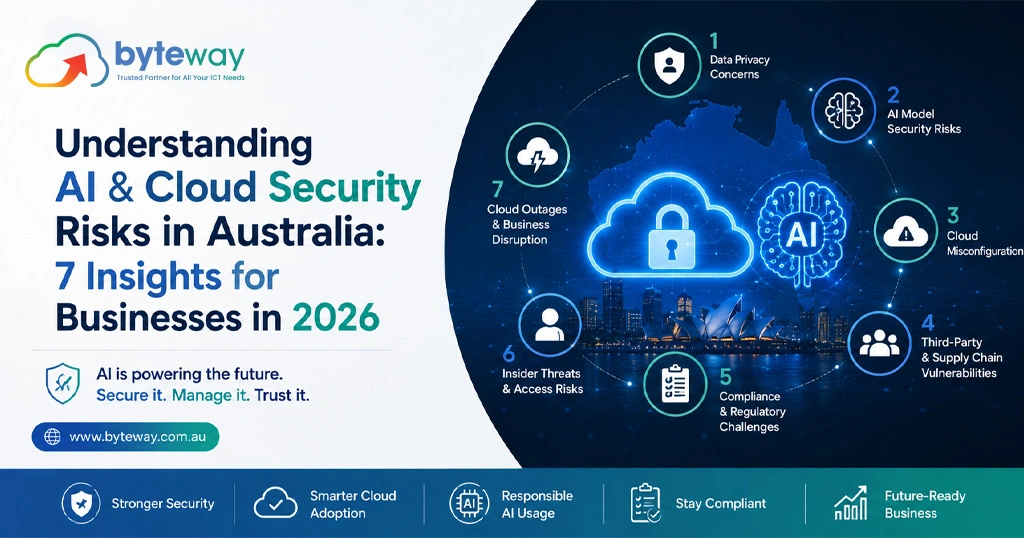
Byteway helps Australian businesses adopt AI and cloud tools without inheriting the risks that come with them, and 2026 has made that balance harder. The tools are more capable and more embedded, which means the security gaps are more consequential. Here are seven practical insights to help your business get the benefit of AI and cloud while managing the real risks.
The theme across all seven is worth stating up front: the biggest AI and cloud risks for Australian businesses are not exotic, they are configuration, access and governance. Staff using unsanctioned AI tools, cloud services left over-permissioned, AI surfacing data through permissions that already exist, weak identity controls, data stored offshore, and treating the cloud provider as responsible for security that is actually yours. Managing all of it comes down to governance, least-privilege access, strong identity controls, and knowing where your data lives.
Insight 1: Your staff are already using AI, whether you sanctioned it or not
Shadow AI, staff using tools like ChatGPT or Gemini for work without approval, is one of the most common exposures. Well-meaning staff paste confidential or personal data into consumer tools that may retain it. Banning it fails, because people use their phones. The fix is governance: a clear policy and a sanctioned tool, not prohibition.
Insight 2: AI exposes existing permission problems faster
AI assistants like Microsoft Copilot work within your existing permissions, they surface whatever a user can already access. If your file permissions have drifted over years, AI makes that oversharing instantly visible. The risk is not the AI; it is the permissions underneath it. Audit access before deploying AI broadly.
Insight 3: Cloud misconfiguration is a leading cause of breaches
Most cloud breaches are not clever hacks; they are misconfigurations, a storage bucket left open, a default setting never changed, an over-permissioned account. The cloud is secure by design and insecure by default settings. Regular configuration review is one of the highest-value security activities there is.
Insight 4: Identity is the new perimeter
In a cloud and AI world, the login is the front door. Weak or reused passwords and missing multi-factor authentication are how most breaches begin. Strong identity controls, MFA everywhere, conditional access, prompt removal of departed staff, matter more than any single product. If you do one thing, it is this: multi-factor authentication on every account. In cloud and AI environments the login is the perimeter, so most breaches start with a stolen or weak credential, and MFA closes the most common path in.
Insight 5: Know where your data actually lives
Many AI and cloud tools process and store data overseas. For Australian businesses, especially those covered by the Privacy Act, sending personal information offshore is a cross-border disclosure you remain accountable for. Before adopting a tool, know where your data is stored and processed.
Insight 6: The shared responsibility model catches people out
Cloud providers secure the infrastructure. You secure your data, access and configuration within it. Assuming “the cloud provider handles security” leaves the half that is yours unprotected. Know which half you own, because it is the half attacks target.
Insight 7: Third-party and vendor risk is your risk
Every AI or cloud vendor you use becomes part of your attack surface. A vendor’s breach can become yours. Due diligence, where is data stored, who can access it, what security do they hold, what happens to data if you leave, is not optional when you are trusting them with your information.
Byteway Expert Insight
The pattern across all seven is the same: the risk is rarely the technology itself and almost always how it is governed. AI and cloud are secure when configured and controlled properly, and exposed when adopted in a rush with nobody watching access, data location or vendor practices. The businesses that get the benefit without the incidents are not the ones avoiding AI and cloud. They are the ones treating governance as part of adoption, deciding who can access what, where data lives, and which tools are sanctioned, before the tools are embedded everywhere. It is unglamorous work, and it is what separates a productive AI rollout from a breach.
How Byteway helps
- We review your AI and cloud setup for the seven risks: shadow AI, permissions, misconfiguration, identity, data location, shared responsibility, vendor risk.
- We put governance, access controls and identity security in place.
- We connect it to your managed IT and cyber security, maintained over time.
Get the benefit of AI and cloud without the risk
Byteway helps Australian businesses adopt AI and cloud securely. Book an AI and cloud security review. 👉 Book your review
FAQs
What are the main AI and cloud security risks?
Shadow AI, AI surfacing data through existing permissions, cloud misconfiguration, weak identity controls, offshore data storage, misunderstanding shared responsibility, and third-party vendor risk. Most are governance and configuration issues, not exotic attacks.
Is the cloud secure?
Cloud infrastructure is secure by design, but insecure by default settings and poor configuration. Most cloud breaches come from misconfiguration and weak access control, which are your responsibility.
What is shadow AI?
Staff using AI tools without approval, often pasting sensitive data into consumer services that may retain it. The fix is a policy plus a sanctioned tool, not a ban.
Does using AI create new data risks?
AI mostly exposes existing risks faster, especially oversharing through permissions that already exist. Auditing access before deploying AI is essential.
Who is responsible for cloud security?
Both you and the provider. The cloud provider secures the infrastructure; you secure your data, access and configuration. Assuming otherwise leaves your half exposed, which is the half Byteway helps Australian businesses lock down.
How do we manage AI and cloud risk?
Govern adoption: sanctioned tools, least-privilege access, strong identity controls with MFA, known data location, and vendor due diligence, with regular configuration review. Byteway runs this as a single review across all seven risk areas and puts the controls in place.