

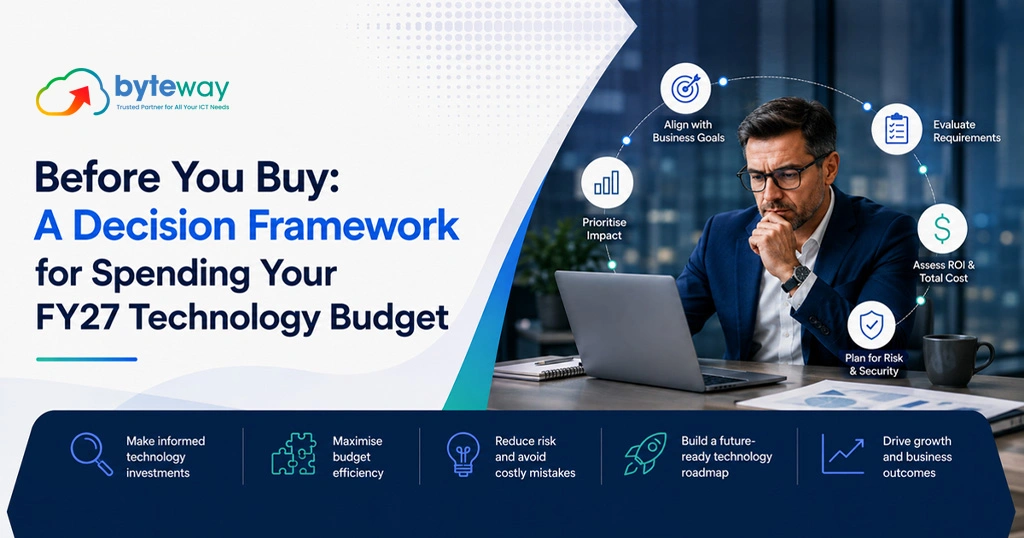
Byteway plans and manages technology for Australian businesses, and the most useful thing we do at budget time is not sell equipment. It is help a business work out what it actually needs before it spends anything. Most technology budgets are set the wrong way round, as a shopping list first and a plan second. This framework flips that. It gives you six questions to run every proposed FY27 purchase through, so your budget funds the things that genuinely move your business and skips the things that just looked good in a brochure.
A good FY27 technology budget is decided by need and risk, not by what is new or on sale. Run every proposed purchase through six questions: does it reduce a real risk, does it keep earning after you buy it, is it a foundation or a nice-to-have, what does it cost you to not do it, does it lock you in or keep you flexible, and is now genuinely the right time. Fund foundations first (connectivity, security, backup, identity), then productivity, then the rest. The businesses that get the most from their budget are the ones that spent it on what they needed, not what they were sold.
Why most technology budgets are set the wrong way?
The usual process looks like this. Someone asks each area what they want, a list of requests comes back, the list gets trimmed to fit the number, and that becomes the budget. It feels sensible. It is backwards.
That approach funds whatever is loudest, newest or most recently pitched, rather than what the business most needs. It treats a security upgrade and a nice-to-have gadget as competing line items of equal standing. And it almost never asks the most important question, which is what happens if you do nothing.
A better budget starts from need and risk, then finds the products, not the other way round. The framework below is how we help clients do that.
The 6 Questions to Run Every Purchase Through
Take each proposed FY27 purchase and put it through these six. If it struggles on the first three, it probably does not belong in the budget, however appealing it is.
Question 1: Does it reduce a risk that could actually hurt us?
Start here, because risk is where the real money is, in both directions. A purchase that prevents a serious loss is worth far more than its price tag.
Ask what could genuinely hurt the business: a data breach, an extended outage, a failed backup when you need it, a compliance gap. Technology that closes one of those is not a cost, it is insurance that also does a job. This is why cyber security and reliable backups tend to top a well-built budget even though they are the least exciting items on it.
Question 2: Does it keep earning after you buy it?
Some purchases pay you back every day. Others are spent and gone. Favour the ones that compound.
A faster set of laptops saves time on every task, every day, for years. Business-grade internet prevents downtime continuously. A modern phone system can lower your running costs after you buy it. Compare that with a one-off spend that solves a single moment and returns nothing after. The compounding purchases are almost always the better use of a budget.
Question 3: Is it a foundation or a nice-to-have?
Not every purchase sits at the same level, and treating them as equal is how budgets go wrong. There is a natural order:
- Foundations: connectivity, security, backup, identity and device management. Everything else depends on these.
- Productivity: the tools and hardware that make your team faster and your work better.
- Growth and nice-to-haves: everything that is genuinely optional.
Fund foundations first, fully, before anything below them. A business that buys a flashy tool while running on unreliable internet or with no tested backup has its budget upside down.
Question 4: What does it cost us to not do it?
This is the question most budgets never ask, and it is often the deciding one.
Work out the cost of inaction. What does an hour of downtime actually cost you in lost trading and idle staff? What would a data breach or a redirected payment cost, including the recovery and the lost trust? What does an ageing system cost you in slow days and frustrated people? When you price the do-nothing option honestly, a lot of “expensive” purchases turn out to be the cheaper path.
Question 5: Does it lock us in, or keep us flexible?
A purchase is not just what you buy today. It is what you are committed to for years.
Prefer choices that keep your options open: systems you can move away from, contracts that do not trap you, platforms that play well with others. Be wary of anything that makes you dependent on a single vendor with your data hard to extract. Flexibility has real value, because your business in FY28 will not look exactly like it does now.
Question 6: Is now genuinely the right time?
Timing matters, and FY27 has some specific timing pressures worth factoring in.
Some purchases are forced by external deadlines. If your connection is on copper being retired by NBN, or on FTTC that is being phased out, the timing is partly decided for you, and it is worth reading what actually changes between connection types before you plan around it. Microsoft’s 2026 licensing changes make a licence review timely. And the instant asset write-off, which the Government has announced it will make permanent (confirm the current legal status with your accountant, as it was announced but not yet law at the time of writing), affects the after-tax timing of hardware purchases. Let genuine deadlines pull purchases forward. Do not let an arbitrary “before June” feeling push you into buying the wrong thing quickly.
Putting it together: a simple priority order
Once each purchase has been through the six questions, sort what survives into this order and fund it top-down until the budget runs out:
- Fix anything that is a live risk. An unpatched system, no tested backup, no multi-factor authentication, a connection about to be cut off. These come first, always.
- Shore up the foundations. Reliable business internet, security, backup, identity and device management brought up to a solid standard.
- Invest in productivity. Hardware and tools that make the team measurably faster.
- Then the rest, if budget remains and it passed the six questions.
If you run out of budget before you clear the foundations, that is useful information. It means the nice-to-haves were never really affordable this year.
The Current FY27 Context Worth Planning Around
A few things specific to this year that a good FY27 budget should account for:
- Connectivity is changing. NBN is retiring copper and phasing out FTTC, so if your sites are on older connections, a connectivity decision may be made for you. Better to plan it than be scheduled into it.
- Microsoft licensing shifted in 2026. The price changes make a licence review genuinely worthwhile, and often it finds savings that fund other priorities.
- Fraud and scams are rising. Payment redirection and business email compromise are hitting Australian businesses hard, which pushes basic security controls up the priority list.
- The write-off is becoming permanent. Once it is law, the annual EOFY rush eases, letting you plan hardware purchases around need rather than the calendar.
None of these should drive your whole budget. All of them should inform it.
Common Mistakes to Avoid
- Shopping list first, plan second. Decide what you need, then find the products.
- Treating foundations as optional. Security and backups are not where you save money.
- Ignoring the cost of inaction. The do-nothing option has a price too, and it is often higher.
- Buying for the deduction, not the need. The write-off improves a good purchase; it does not rescue a bad one.
- Chasing the newest thing. New is not the same as needed.
- Locking in without checking the exit. Flexibility is worth protecting.
Byteway Expert Insight
The most valuable budget conversations we have with clients are the ones where we talk them out of something. A business comes in wanting a shiny new system, and two questions in it becomes clear the real problem is that their internet drops twice a week and their backup has never been tested. The shiny system would have sat on a shaky foundation. Fixing the foundation first is less exciting and far more valuable.
That is the whole point of a framework. It stops the budget being decided by whoever pitched most recently, and forces every purchase to earn its place against the same questions. The businesses that get the most from their FY27 spend are not the ones with the biggest budget. They are the ones who spent what they had on what they genuinely needed, in the right order. Our job is not to sell you the longest list. It is to help you build the right one, and sometimes that means a shorter list than you walked in with.
How Byteway helps you decide, not just buy?
Byteway helps Australian businesses plan their technology budget around genuine need and risk, then supply and manage what actually belongs in it. That means running your priorities through a clear framework, pricing the cost of inaction, fixing foundations first, and making sure every dollar funds something that earns its place, rather than selling you a shopping list.
Where we fit:
- We help you decide what your business actually needs this year, in what order.
- We price the risk and the cost of doing nothing, so the trade-offs are clear.
- We supply and set up the right equipment, matched to your needs, not a catalogue.
- We keep it running through our managed IT and cyber security services, so the investment keeps delivering.
The value is in the deciding, not just the buying. That is the part most providers skip.
Plan your FY27 budget around what you actually need
The best technology budget is not the biggest one. It is the one spent on the right things, in the right order, for reasons you can defend. That takes a plan before a purchase.
Byteway helps Australian businesses build that plan, deciding what technology genuinely belongs in your FY27 budget, then supplying and managing it so it keeps delivering. We would rather help you buy the right shorter list than sell you a longer one.
Book a FY27 technology planning session. We will run your priorities through the framework and help you spend your budget where it counts.
👉 Book your FY27 planning session
Frequently asked questions
How should a business decide what technology to buy?
Start from need and risk, not from a product list. Run each proposed purchase through a consistent set of questions: does it reduce a real risk, does it keep earning, is it a foundation or optional, what does inaction cost, does it lock you in, and is the timing right. Fund foundations first.
What should be the top priority in a technology budget?
Risk-reducing foundations: security, tested backups, reliable connectivity and identity controls. These prevent losses that cost far more than the technology. Productivity tools come next, and genuinely optional items last, only if budget remains.
How much should a small business spend on IT?
There is no universal figure, because it depends on your size, sector and risk. A more useful approach than a percentage is to fund your foundations properly first, then invest in productivity, then stop when the remaining items no longer justify their cost. Need should set the number, not a rule of thumb.
Should I wait for the instant asset write-off to be law before buying?
Confirm the current status with your accountant or the ATO, since the permanent measure was announced but not yet law at the time of writing. Either way, buy technology you genuinely need. Let the tax treatment improve the timing of a sound purchase rather than drive the decision.
How does the NBN copper retirement affect my budget?
If your sites are on copper or FTTC being phased out, a connectivity upgrade may be required within a set timeframe, so it belongs in your planning now rather than as a surprise later. Treat it as a foundation-level item, since so much depends on reliable internet.
What is the biggest budgeting mistake businesses make?
Building the budget as a shopping list before making a plan, and treating foundations like security and backups as optional extras. This funds whatever was pitched most recently rather than what the business most needs, and leaves the essentials underfunded.