

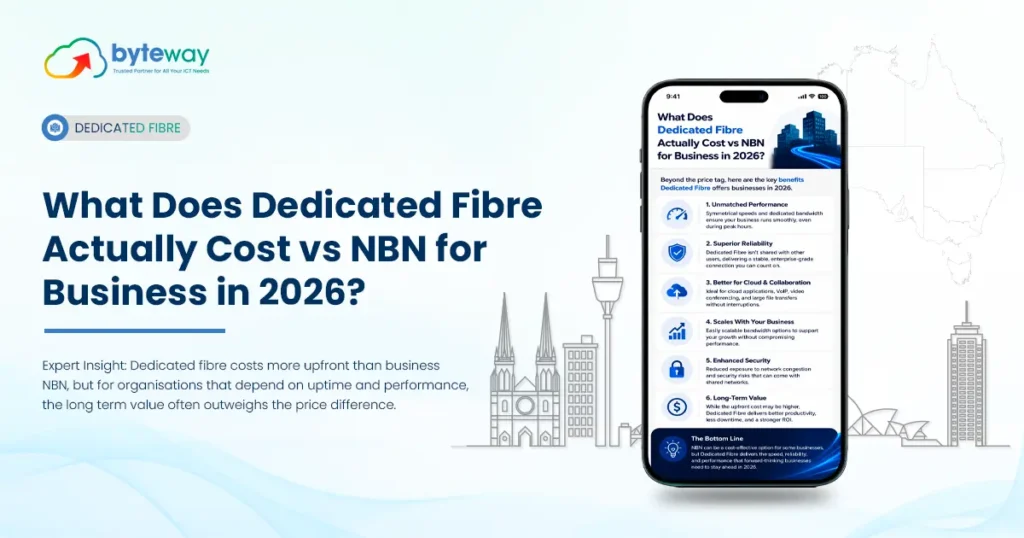
In Australia in 2026, dedicated fibre for business typically costs between $400 and $2,500+ per month, while business NBN runs about $85 to $250 per month. Entry-level dedicated-grade fibre (nbn Enterprise Ethernet) often starts around $400/month with $0 install on eligible sites. True private dedicated fibre (DIA) with construction can run from ~$800 to several thousand per month. Final pricing is always quote-based, because location decides the cost.
These are indicative 2026 ranges (ex GST) and will vary by address. Below, we break down each tier, what drives the price, and how to know which one you actually need.
How much does Dedicated Fibre Cost in Australia?
Here’s the honest range across the three main business connectivity tiers:
| Connection type | Typical monthly cost (ex GST) | Install | Best for |
|---|---|---|---|
| Business NBN | $85 – $250 | Low or $0 | Small business, general use |
| nbn Enterprise Ethernet | ~$400 – $1,000+ | Often $0 on eligible sites | SMBs wanting symmetric, SLA-backed fibre |
| True dedicated fibre (DIA / private) | ~$800 – $2,500+ | $0 on-net; $1,000s–$10,000s+ off-net | Uptime-critical, high-bandwidth, enterprise |
Most Australian businesses pay between $400 and $2,500 per month for dedicated fibre, depending on the tier and location. Entry dedicated-grade fibre (Enterprise Ethernet) starts near $400/month; fully private, uncontended DIA circuits with higher SLAs and possible construction sit higher. There’s no single sticker price because cost is driven by your address.
Why is Dedicated Fibre pricing so hard to find online?
This is the real reason competitors don’t publish numbers and it’s not (only) that they’re hiding them. Dedicated fibre pricing depends heavily on where your building is relative to existing fibre:
- On-net: fibre already runs to (or very near) your building. Cheaper, faster to install, sometimes $0 build. Common in CBDs, business parks and near data centres.
- Off-net: fibre has to be built to your site. This can add a one-off construction cost from a few thousand dollars into the tens of thousands, plus a longer lead time.
So the same 1Gbps service might be $600/month for a CBD office that’s on-net, and far more (plus a build fee) for a site that isn’t. That’s why every serious provider quotes per address. It’s not evasion — it’s physics and civil works.
Dedicated fibre vs business NBN: What’s the Real Difference?
They’re not the same product at a different price they’re different products. Here’s what you’re actually paying for.
| Factor | Business NBN | Dedicated fibre (DIA) |
|---|---|---|
| Bandwidth | Shared / contended | Dedicated / uncontended |
| Speeds | Often asymmetric | Symmetric (same up/down) |
| Consistency at peak | Can slow down | Consistent, guaranteed |
| Uptime SLA | Basic business SLA | Strong (e.g. 99.95%) with rebates |
| Fault response | Standard | Priority (e.g. 4-hour eSLA) |
| Latency | Higher, variable | Low, stable |
| Monthly cost | $85–$250 | $400–$2,500+ |
Dedicated fibre is better when uptime and consistent speed are business-critical; business NBN is better for cost-conscious general use. NBN shares bandwidth and can slow at peak times, while dedicated fibre gives you uncontended, symmetric speeds with a strong uptime SLA. Most small offices are fine on NBN; businesses that can’t afford downtime pay for dedicated.
The key phrase is contended vs uncontended. On NBN, you share capacity with other users, so speeds can dip when the network’s busy. Dedicated fibre reserves the bandwidth for you alone you get what you pay for, all the time.
What about NBN Enterprise Ethernet?
There’s a tier between cheap NBN and expensive private fibre that suits a lot of Australian SMBs: nbn Enterprise Ethernet.
It delivers symmetric, business-grade fibre over the nbn network, with SLA-backed uptime (commonly 99.95%) and priority fault response at a lower price than a fully private circuit. Better still, more than 97% of Australian businesses are now eligible for a $0 fibre upgrade to an eligible site, because nbn often covers the build cost.
Is NBN Enterprise Ethernet the same as Dedicated Fibre?
It’s dedicated-grade, but delivered over the nbn network rather than a fully private circuit. Enterprise Ethernet gives you symmetric speeds (100Mbps–1Gbps), a strong uptime SLA and priority support, usually from around $400/month often with $0 install on eligible sites. For many SMBs it’s the sweet spot between business NBN and full private DIA.
For most growing businesses that want fibre reliability without an enterprise budget, this is the option worth pricing first.
What Affects the Cost of Dedicated Fibre?
Five things move the price:
- Speed/bandwidth — the biggest lever. 100Mbps costs far less than 1Gbps or 10Gbps.
- Location (on-net vs off-net) — the second biggest. Construction to an off-net site is the main one-off cost.
- Contract length — longer terms (36 months) usually lower the monthly rate and can waive build fees.
- SLA level — a 4-hour fault-response eSLA costs more than a 12-hour one.
- Extras — 4G/5G failover, static IPs, managed router, multiple services over one link.
What are the Installation Costs for Dedicated Fibre in Australia?
This is where the surprises hide, so plan for it.
- On-net / eligible nbn Enterprise Ethernet: often $0 install, especially on 36-month terms or current $0-upgrade offers.
- Off-net private fibre: a one-off construction/build cost that can range from a few thousand dollars to tens of thousands, depending on how far fibre has to be trenched to your building.
Often $0 on eligible on-net sites (including many nbn Enterprise Ethernet upgrades), but off-net builds can cost thousands to tens of thousands as a one-off. The distance from existing fibre to your building is the deciding factor. Always get the install/build cost confirmed in the quote it’s the number most businesses forget to ask about.
Is Dedicated Fibre worth it compared to NBN?
It comes down to what an hour of downtime costs your business.
Choose business NBN if you:
- Run a small team with general web, email and cloud use
- Can tolerate occasional peak-time slowdowns
- Want the lowest monthly cost
Choose dedicated fibre (or Enterprise Ethernet) if you:
- Can’t afford downtime (trading, healthcare, logistics, real-time systems)
- Rely on heavy uploads, video, VoIP or cloud backup
- Need guaranteed symmetric speeds and a strong SLA
- Run an e-commerce site or data-heavy operation where latency costs money
A smart middle path many businesses take: business NBN with a static IP as a primary for smaller sites, and dedicated fibre for the head office or uptime-critical locations.
How to choose a Dedicated Fibre Provider with Transparent Pricing?
- Ask for a per-address quote — including the build/install cost, not just the monthly.
- Confirm on-net vs off-net — it changes both price and lead time.
- Check the SLA — uptime percentage, fault-response time, and whether rebates apply.
- Look at contract flexibility — term length, and what happens if you move premises.
- Ask about failover — 4G/5G backup keeps you online if the fibre is cut.
- Value the support — who answers at 2am when a line drops, and are they local?
Request a written per-address quote that separates the monthly fee from the one-off install/build cost, and confirms whether your site is on-net or off-net. A transparent provider will explain the SLA, contract terms and any construction cost upfront rather than quoting a vague “from” price. If they won’t itemise the build cost, keep asking.
Byteway Expert Insight
When Melbourne businesses come to us comparing fibre quotes, the confusion is almost always the same: they’ve been quoted wildly different monthly prices and can’t work out why. The answer is nearly always the build. One provider quoted an on-net price assuming fibre was already in the building; another priced in a construction job nobody explained. Same “1Gbps dedicated fibre,” very different real cost.
What we’ve learned is that the honest first step isn’t a price it’s a feasibility check on the actual address. Once we know whether a site is on-net, whether it qualifies for a $0 nbn Enterprise Ethernet upgrade, or whether it genuinely needs a private build, the right option is usually obvious. Plenty of businesses that think they need an expensive private circuit are actually well served by Enterprise Ethernet at a fraction of the cost. Pricing dedicated fibre well is less about finding the cheapest provider and more about matching the right tier to the address.
Is Byteway’s dedicated fibre competitive in the Australian market?
Yes because Byteway prices to the address and the right tier, not to a headline number. Byteway assesses whether your site is on-net, whether it qualifies for a $0 Enterprise Ethernet upgrade, or needs a private build, then recommends the option that fits your uptime needs and budget with symmetric speeds, strong SLAs, optional 4G/5G failover, and local support. The result is competitive because it’s right-sized, not oversold.
Where Byteway differs from a big-telco quote:
- Feasibility first — we check your actual address before quoting, so you’re not surprised by a build fee later.
- Right tier, not the biggest — many businesses save by using Enterprise Ethernet instead of a costlier private circuit they don’t need.
- One local team for fibre, phones, cyber security and IT support with 24/7 support when a line goes down.
No provider can quote a fixed dedicated-fibre price sight-unseen but a good one tells you honestly what your address will cost, and why.
Get a real number for your address
The only honest dedicated-fibre price is one quoted to your actual building because on-net or off-net changes everything. The good news: finding out is free, and many sites qualify for a $0 fibre upgrade.
Book a free connectivity assessment. We’ll check what’s available at your address, tell you whether you’re on-net, whether you qualify for a $0 Enterprise Ethernet upgrade, and give you a real, itemised range monthly and install with no obligation.
👉 Get your free connectivity assessment
Prices in this guide are indicative 2026 ranges (ex GST) and vary by location. Final pricing is always confirmed by a per-address quote.
Frequently Asked Questions
What is the average cost of dedicated fibre internet in Australia?
Most businesses pay between $400 and $2,500+ per month (ex GST) in 2026. Entry dedicated-grade fibre (nbn Enterprise Ethernet) starts around $400/month, while fully private DIA circuits with higher SLAs cost more. Location and speed are the biggest price drivers, so pricing is always quote-based.
How does dedicated fibre compare to NBN for business?
Dedicated fibre gives uncontended, symmetric speeds with a strong uptime SLA and low latency, while business NBN shares bandwidth and can slow at peak times. NBN costs $85–$250/month; dedicated fibre costs $400–$2,500+. NBN suits general use; dedicated fibre suits uptime-critical or data-heavy businesses.
What are the installation costs for dedicated fibre?
Often $0 on eligible on-net sites (including many nbn Enterprise Ethernet upgrades), but off-net builds can cost thousands to tens of thousands as a one-off, depending on distance to existing fibre. Always confirm the build cost separately from the monthly fee.
How much does dedicated fibre cost for a startup or small business?
Startups on a tight budget are often best served by business NBN ($85–$250/month) or entry Enterprise Ethernet (from ~$400/month with $0 install on eligible sites), rather than a full private circuit. The right choice depends on how critical uptime is to the business.
Is dedicated fibre worth it for an e-commerce or high-traffic site?
Usually yes. E-commerce and high-traffic operations lose money during slowdowns or outages, so the guaranteed symmetric speeds, low latency and strong SLA of dedicated fibre often pay for themselves. A failover connection adds further protection against downtime.
Do dedicated fibre plans offer flexible contracts and scalable bandwidth?
Many do. Longer terms (e.g. 36 months) usually lower the monthly rate and can waive build fees, while most fibre services let you scale bandwidth up as you grow without a new install. Ask providers about upgrade paths and what happens if you relocate.
Is dedicated fibre available for data centres and multiple cities?
Yes. Connectivity in or near data centres is often on-net and relatively cost-effective, and providers offer dedicated fibre across major Australian cities (Sydney, Melbourne, Brisbane, Perth) and regional centres. Multi-site businesses can link locations over one managed network.