

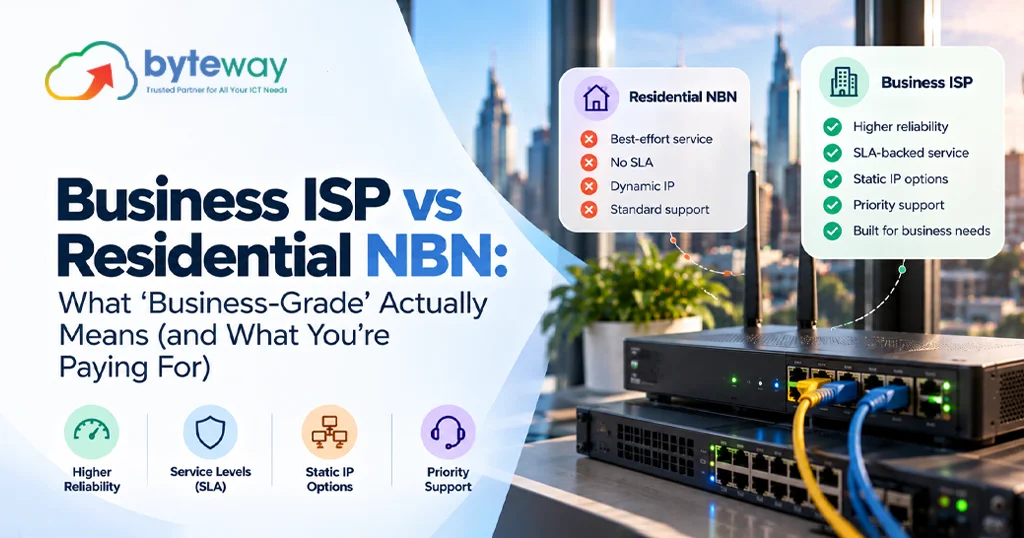
A business ISP is an internet provider that delivers a connection built and supported for business use, with a service level agreement, priority fault resolution, business-grade support and options like static IP and failover, where a residential NBN plan is a home service with none of those guarantees. The difference is not the speed on the box; it is what happens when something goes wrong and how the connection is treated. Byteway sets up business internet for Australian SMEs, so here is a plain-English guide to what “business-grade” actually means, what you are paying for, and, honestly, when a residential plan is fine.
Plenty of small businesses run on a residential NBN plan, sometimes for years, and wonder why they should pay more. The answer is not “faster internet.” It is that a residential plan makes no promises about being fixed quickly, offers no business support, and lacks the features a business connection depends on. Whether that matters depends on your business, which is exactly the honest way to decide.
What actually separates business from residential?
The differences that matter are not about the headline speed. They are:
Service level agreement- A business ISP commits to performance and, crucially, to fixing faults within a defined time. A residential plan makes no such promise, if it goes down, you wait your turn with every household in the area.
Fault-fix priority- Business connections are prioritised for resolution. On a residential plan, a business is just another home user in the queue, which during an outage is the difference between hours and days.
Support hours and quality- A business ISP offers business-grade support, reachable and capable, ideally when you trade. Residential support is consumer support, a queue and a script.
Static IP– Business plans can provide a fixed IP address, needed for remote access, hosted services, cameras and site-to-site links. Residential plans generally use changing addresses that break these.
Upload and consistency- Business plans often offer better, more consistent upload, which matters for cloud backup, video calls and hosted phones, where residential plans skew toward download.
Failover options- Business ISPs can add automatic 4G or 5G failover to keep you online through an outage, which residential services do not.
Put simply, “business-grade” means the connection is treated as business infrastructure, with guarantees and support to match, rather than as a home service you happen to use for work.
Side-by-side: The Typical Differences
| Residential NBN | Business ISP | |
|---|---|---|
| Service level agreement | None | Yes, with guaranteed performance |
| Fault-fix priority | Same queue as households | Prioritised resolution |
| Support | Consumer queue | Business-grade, responsive |
| Static IP | Generally no | Available |
| Upload / consistency | Download-skewed | Often better, more consistent |
| Failover option | No | Yes (4G/5G) |
| Treated as | A home service | Business infrastructure |
When residential is actually fine (the honest bit)?
Not every business needs a business ISP, and pretending otherwise would be dishonest. If your business uses the internet lightly, email, browsing, a bit of cloud, with no phones over the internet, no remote access to your premises, no payments depending on uptime, and you could tolerate being offline for a while without real cost, a good residential NBN plan may genuinely be enough for now. The honest test is what an outage would actually cost you and what you rely on the connection for. If the answer is “not much” and “not much,” residential is defensible. The moment your business depends on the connection, for phones, payments, cloud systems, remote access, or simply cannot afford downtime, the business-grade guarantees stop being a luxury and become the point.
Making the Switch
If you are on residential and your business has outgrown it, moving to a business ISP is straightforward and does not have to disrupt anything. The main gains you are switching for are the service level agreement and fault priority (so outages are resolved fast), business support, static IP if you need it, better upload, and the option of failover. A good provider handles the switch cleanly. The trigger to switch is usually a moment of pain, an outage that cost you, phones that dropped, a remote-access need you could not meet, but the better time is before that moment, on your terms.
Byteway Expert Insight
The conversation we have most often on this is with a business that has quietly run on a residential plan and hit the moment it no longer works, an outage during trading, a hosted phone system that needs reliable upload, a need for remote access the plan cannot support. Nothing was wrong with the residential plan until the business outgrew it. Our approach is not to tell every business it needs the most expensive connection; it is to look honestly at how the business uses the internet and what downtime would cost, and match the plan to that. For a light-use business, we will say residential is fine for now. For a business that depends on the connection, business-grade is worth every dollar, precisely for the day something goes wrong.
How Byteway helps?
We run a free internet health check: how your business actually uses its connection, what an outage would cost you, and whether you are on the right plan, residential or business-grade. If you have outgrown residential, we handle the switch cleanly, with static IP and failover where you need them, and manage it alongside your phones and IT.
Frequently asked questions
What is a business ISP?
A business ISP is an internet provider offering a connection built and supported for business use, with a service level agreement, priority fault resolution, business-grade support, and options like static IP and failover, unlike a residential plan. Byteway provides business internet for Australian SMEs.
What does “business-grade internet” actually mean?
It means the connection is treated as business infrastructure: guaranteed performance, fast fault resolution, proper support, and features like static IP and failover, rather than a home service with no guarantees. Byteway sets up genuinely business-grade internet.
Is business NBN really different from residential NBN?
Yes, the underlying network may be similar, but a business plan adds a service level agreement, priority fault-fixing, business support and business features. The difference shows most during an outage. Byteway helps businesses get the business-grade difference that matters.
When is a residential NBN plan enough for a business?
If your business uses the internet lightly, with no internet phones, remote access or uptime-dependent payments, and could tolerate an outage without real cost, residential may be enough for now. Byteway will tell you honestly when residential is fine and when it isn’t.
What do I gain by switching to a business ISP?
A service level agreement and priority fault resolution, business-grade support, static IP, better upload, and failover options, essentially, the connection being treated as business infrastructure. Byteway handles the switch cleanly when your business has outgrown residential.
Will switching to a business ISP disrupt my business?
Not when handled properly, a good provider manages the switch with minimal disruption. Byteway manages the move from residential to business-grade cleanly, including static IP and failover setup.
Get a free internet health check
Whether a residential plan is fine or you have outgrown it depends on how your business uses the connection and what downtime would cost, and that is worth checking honestly. Byteway runs a free internet health check and tells you straight. Get a free internet health check.