

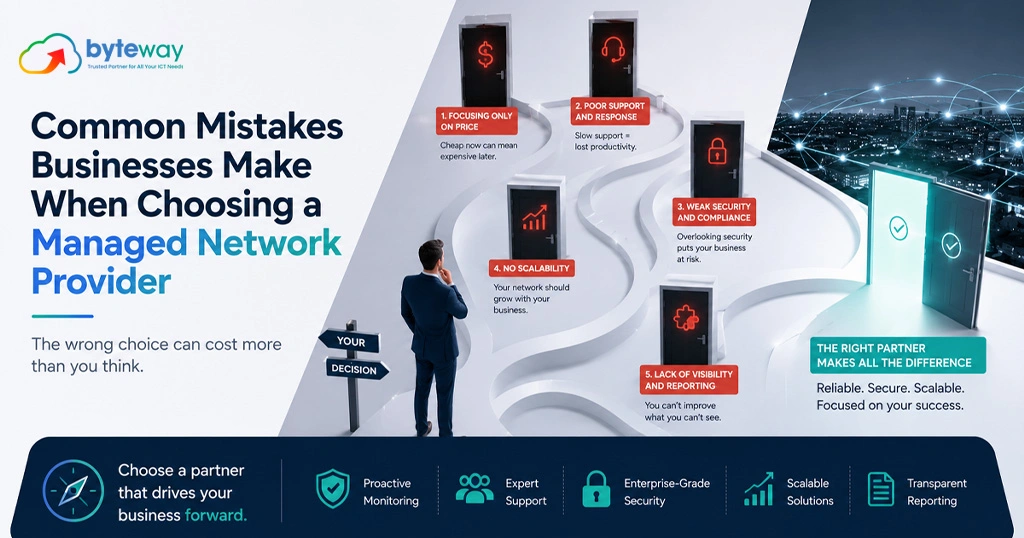
Byteway is a managed network and IT provider for Australian businesses, and we spend a surprising amount of time helping companies recover from the last provider they chose. Picking the wrong one is an expensive mistake and a painful one to unwind, because by the time the problems show, the provider holds your systems, your passwords and your documentation. This guide covers the common mistakes businesses make when choosing a managed network provider, so you can avoid them and choose a partner you will not need to escape.
The short version, before the detail: the biggest mistakes are choosing on price alone, not checking response times and service guarantees, ignoring security, signing into lock-in contracts with no clean exit, and hiring a reactive break-fix operator dressed up as a managed provider. The right choice comes down to a provider who responds fast, works proactively, secures your network, explains what is included in plain terms, lets you keep control of your own systems, and can grow with you. Choose for the day something breaks, not just the day you sign.
Why this choice matters more than it looks?
A managed network provider does not just fix things. They hold the keys to your business: your network, your data, your access, your documentation. When the relationship is good, you barely think about IT. When it is bad, you are stuck, because the pain of staying is matched by the difficulty of leaving. That is exactly why the choice deserves real scrutiny up front, and why the mistakes below are worth avoiding before you sign, not after.
The Common Mistakes
Mistake 1: Choosing on price alone
The cheapest quote is cheap for a reason, usually thinner support, slower response, less security, or scope gaps that become surprise bills later. IT and network management is not where you want the lowest bidder, because the cost of an outage, a breach or slow support dwarfs the monthly saving. Compare value and what is actually included, not just the headline number.
Mistake 2: Not checking response times and guarantees
When your network goes down, the only thing that matters is how fast someone fixes it. Many businesses never ask. Before signing, find out the provider’s response and resolution times, whether they are guaranteed, and what happens outside business hours. A great price with a two-day response is not a great deal when you are offline.
Mistake 3: Accepting a vague or missing service agreement
A proper managed provider gives you a clear service level agreement, response times, what is covered, what is not, and what you can expect. Vague promises like “we’ll look after you” are not commitments. If it is not written down, it is not guaranteed. Ambiguity in the agreement becomes an argument at the worst possible moment.
Mistake 4: Ignoring security capability
Your network and your security are one job, not two. A provider who manages your network but is weak on cyber security leaves the most important gap open. Ask what they do for security, multi-factor authentication, backups, monitoring, patching, and how they would handle a breach. In a year of record breaches, this is not optional.
Mistake 5: Signing into lock-in with no clean exit
Some providers make leaving deliberately hard: long contracts, your documentation kept in their heads, your systems configured so only they understand them. Before signing, ask what happens if you leave, do you own your data, your licences, your documentation, and how a handover would work. A confident provider has no problem with a fair exit. One who resists is telling you something.
Mistake 6: Hiring reactive break-fix dressed up as “managed”
“Managed” should mean proactive: monitoring your systems, catching problems before they cause outages, keeping things patched and maintained. Some providers simply wait for you to call when something breaks and label it managed. Ask what they do when nothing is broken. If the answer is “nothing,” you are buying break-fix with a nicer name.
Mistake 7: No proactive monitoring
Related, but worth its own point. A real managed provider watches your network and systems continuously, so a failing server, a security alert or a capacity problem is caught early. Without monitoring, your provider finds out something is wrong the same way you do, when it stops working.
Mistake 8: Poor communication and no real point of contact
If you cannot get a clear answer, a named contact, or a straight explanation without jargon during the sales process, it will be worse once you have signed. Good providers communicate clearly and treat you as a partner. Test this before committing; the sales experience is the best version you will get.
Mistake 9: Not checking track record or references
Businesses that would check references for any other major supplier skip it for IT. Ask for references, look at how long they have kept clients, and check they have genuine experience with businesses like yours. A provider who cannot point to happy long-term clients is a risk.
Mistake 10: Forgetting scalability and your whole environment
The provider that suits you now needs to handle where you are going, more staff, more sites, more complexity. And your network does not live in isolation; it connects to your internet, your phones and your other systems. A provider who only sees one piece can leave the seams unmanaged, which is where problems live.
Mistake 11: Overlooking the value of one provider for network, internet and phones
Many businesses end up with a different supplier for IT, another for internet, another for phones, and spend their time refereeing between them when something goes wrong and each blames the others. A provider who can manage the network, the business internet and the phones together removes that finger-pointing and gives you one accountable partner. This joined-up model is a genuine advantage worth weighing.
How to choose well?
Run any provider against a simple test: do they respond fast with guaranteed times, work proactively rather than waiting for failures, take security seriously, explain what is included in plain terms, let you keep control of your own systems and data, communicate clearly with a real point of contact, and can they grow with you. A provider who ticks those is one you can build on. The best of them will also help you decide what you actually need, rather than selling you the longest possible contract. For more on the difference between reactive and proactive support, see our guide on IT support versus managed IT, and if you are already with the wrong provider, our guide on switching providers covers doing it cleanly.
Byteway Expert Insight
The businesses that end up unhappy with a provider almost always chose on the wrong thing, usually price, occasionally a slick sales pitch, rarely on how the provider behaves when something breaks or when you want to leave. Those two moments, the outage and the exit, tell you everything, and they are exactly what the sales process glosses over. Our advice when choosing any provider, including us, is to ask the uncomfortable questions early: what are your guaranteed response times, what do you do about security, what happens if I want to leave, and who do I actually call. A good provider welcomes those questions, because the honest answers are a selling point. A provider who dodges them is showing you the future. Choose the partner who is comfortable being held accountable, because you will need to hold them to it.
How Byteway helps?
- We provide proactive, monitored managed network and IT with clear, guaranteed response times.
- We build security into the network, not bolt it on, and keep your documentation and data yours.
- We manage your network, internet and phones together, so you have one accountable partner instead of suppliers blaming each other.
Choose a provider you won’t need to escape
The right managed network provider makes IT something you stop worrying about. Byteway is a proactive, security-first, one-accountable-partner provider for Australian businesses, and we are happy to answer the hard questions first. Book a no-obligation managed network consult.
FAQs
How do I choose a managed network provider?
Assess response and resolution times, whether they are guaranteed, security capability, proactive monitoring, clear scope, exit terms and track record, not just price. Byteway encourages businesses to ask these questions and answers them plainly, because the honest answers are a selling point.
What is the biggest mistake when choosing an IT provider?
Choosing on price alone, which usually means thinner support, weaker security and surprise costs later. Byteway helps businesses compare on value and what is actually included, so the choice holds up the day something breaks.
What should be in a managed network provider’s service agreement?
Clear response and resolution times, exactly what is covered and what is not, security inclusions, and what happens if you leave. Byteway provides a plain-English service agreement so there is no ambiguity when it matters most.
Should security be part of managed network services?
Yes. Your network and security are one job; a provider weak on security leaves your biggest gap open. Byteway builds cyber security into its managed network services rather than treating it as a separate add-on.
Can one provider handle IT, internet and phones together?
Yes, and it removes the finger-pointing that happens when separate suppliers blame each other. Byteway manages network, internet and phones together as one accountable provider, which is a genuine advantage for businesses.
What if I’ve already chosen the wrong provider?
You can switch, and doing it cleanly means securing your data, documentation and access on the way out. Byteway helps businesses switch managed providers smoothly and take back control of their own systems.