

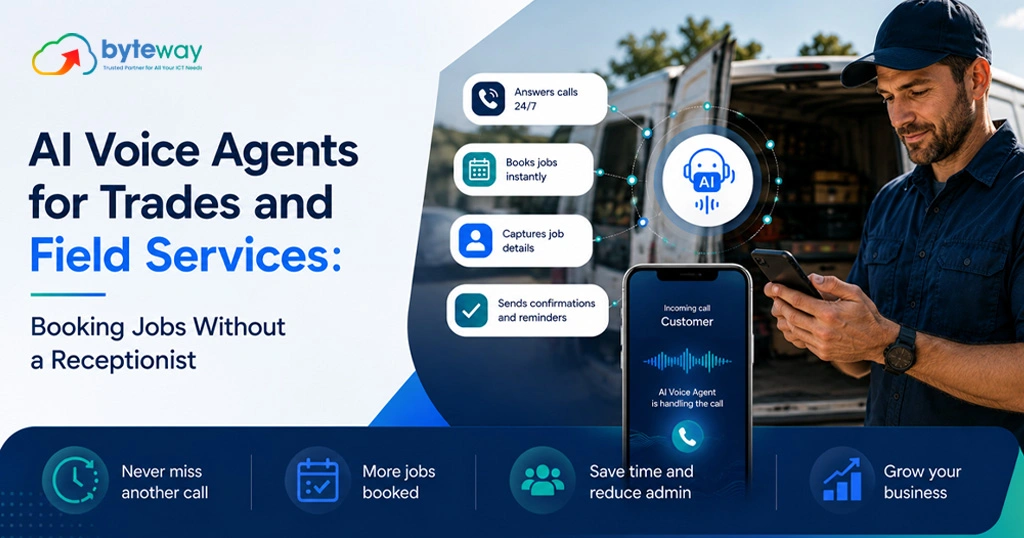
Byteway helps Australian trade and field-service businesses set up technology that actually fits how they work, and few problems are as costly or as fixable as the phone nobody can answer. When you are up a ladder, under a house or driving between jobs, every call that rings out is potentially a job going to the next business on the list. An AI voice agent answers those calls for you, books the work, and handles the after-hours enquiries you currently lose. This guide explains exactly how it works for a trade business, and how to set it up properly.
An AI voice agent is a smart phone-answering system that talks naturally to callers, answers common questions, qualifies the job, books it into your calendar, and passes urgent or complex calls to a human. For trades and field-service businesses, where the owner is usually on the tools and cannot answer, it captures the calls that currently go to voicemail and then to a competitor. It works around the clock, so after-hours emergency enquiries, often the most valuable, get answered instead of lost. Set up well, with the right CRM and calendar integration, human handoff and privacy handling, it functions like a receptionist that never misses a call.
The problem: you cannot answer the phone and do the job at the same time
Every tradie knows this bind. The phone rings while your hands are full, you are mid-task, or you are driving. You cannot answer. The caller does not leave a message, because most people do not. They just ring the next number.
The frustrating part is that the missed call leaves no trace. A failed ad campaign you can see. A missed call is invisible. The customer does not complain. They simply never appear in your calendar, and you never know they called.
The old fixes do not really fix it. Voicemail does not work, because callers with an urgent job do not wait for a beep, they hang up and move on. A human receptionist is expensive and only covers business hours. And a mobile you carry everywhere still cannot be answered when you are actually working, which is most of the day.
This is the gap an AI voice agent fills. Not by replacing you, but by answering the calls you physically cannot.
How an AI voice agent actually works? Step by Step
It is simpler than it sounds. A good agent handles a call in a natural conversation.
1. It answers immediately. No hold, no ringing out. The call is picked up straight away, which matters, because the business that answers first usually wins the job.
2. It talks like a person. Modern voice agents hold a natural back-and-forth. The caller explains what they need in their own words, and the agent responds sensibly rather than reading a rigid menu.
3. It works out what the job is. Blocked drain, no hot water, a quote for a rewire, a broken lock. The agent identifies the job type, the location, and how urgent it is.
4. It qualifies and prioritises. An emergency (burst pipe, no power, a lockout) can be flagged and routed differently from a routine quote request. You decide the rules.
5. It books the job or captures the lead. For straightforward work, it can book directly into your calendar. For anything that needs you, it captures the full details so you can call back with everything you need already in hand.
6. It hands off to a human when needed. Complex, high-value or genuinely urgent calls get routed to you or your team, rather than the agent trying to handle something it should not.
The result is that the caller gets answered and dealt with, and you get a booked job or a complete lead waiting for you, instead of a missed call you never knew about.
Answering after-hours calls: the ones worth the most
Here is the part trades underestimate. After-hours calls are often the most valuable calls you get.
A burst pipe at 9pm. No power on a Sunday. A lockout at midnight. These are urgent, high-intent callers who will pay for a fast response, and they are calling precisely because they cannot wait until Monday. If your phone rolls to voicemail, they do not leave a message. They keep dialling until someone answers.
An AI voice agent answers at 9pm and midnight the same as it does at 10am. It can take the emergency, gather the details, and either book it or alert your on-call person immediately, depending on how you set it up. For a business that offers emergency work, this is the difference between owning the after-hours market in your area and handing it to whoever picks up.
Booking jobs and qualifying leads
Two things separate a useful agent from a glorified answering machine: it books, and it qualifies.
Booking. When integrated with your calendar, the agent can offer available times and book a job straight in, so a routine call becomes a scheduled job with no effort from you. You come off the tools to find the work already in the diary.
Qualifying. Not every call is worth the same. A good agent gathers the detail that lets you prioritise: what the job is, where it is, how urgent, and often whether it is the kind of work you want. That means when you do call back, you are calling a qualified lead with the details already captured, not playing phone tag to work out what they need. It also lets you filter the time-wasters and telemarketers from the real jobs.
Done well, this does not just recover missed calls. It makes the calls you do handle more efficient.
CRM and calendar integration: where it gets powerful
An AI voice agent on its own is useful. Connected to your systems, it becomes genuinely valuable.
- Calendar integration lets it see your availability and book real appointments, not just request them.
- CRM integration means every call, lead and job detail lands in your customer system automatically, so nothing is lost on a scrap of paper and your follow-up is organised.
- Job management software integration, where supported, can push captured jobs straight into the tools you already run your business on.
The point of integration is that the agent stops being a separate thing you have to check and becomes part of how your business already runs. The job it books is in your calendar. The lead it captures is in your CRM. You just do the work.
This is exactly the kind of setup that benefits from being configured properly rather than out of the box, which is where working with someone who manages your wider IT and phone systems pays off.
Human handoff: the agent should know its limits
A well-designed AI voice agent is not trying to handle everything. The best ones are built to recognise when a call should go to a person.
Genuinely urgent emergencies, complex or high-value jobs, upset customers, or anything outside what the agent is set up to handle should route cleanly to you or your team. The caller should never feel trapped talking to a machine that cannot help them. A good setup always leaves a path to a human.
This matters for trust. Customers are far more comfortable with an AI receptionist when they know a real person is one step away if they need one. The agent extends your reach; it should not wall your customers off from you.
What about privacy? What trades need to know
Trades do not carry the same heavy privacy obligations as a medical clinic, but the topic still matters, and it is worth getting right.
An AI voice agent collects customer information: names, addresses, phone numbers, job details, sometimes payment discussions. A few sensible points:
- Call recording consent varies by state. Some Australian states require all parties to consent to a call being recorded, and a transcript is generally treated like a recording. If your agent records or transcribes calls, it should handle the required consent notification at the start of the call. This is easy to set up and important to get right.
- Know where your customer data goes. Many AI services process data overseas. Even if your business sits under the small-business turnover threshold for the Privacy Act, handling customer data responsibly is good practice and good for trust. Ask your provider where data is stored.
- Secure the details. The job details and customer information the agent captures should land somewhere secure, like your CRM, not an unsecured inbox.
- Choose the vendor carefully. Ask where data is stored, who can access it, and whether it trains the vendor’s models. A provider who helps you handle this properly is worth more than a cheap tool that leaves it to you.
None of this is a barrier. It is just worth setting up correctly, which is part of what a good provider does for you. For businesses that do handle sensitive information or have higher obligations, our cyber security and compliance team can advise.
Is it worth it? Do the maths on your own numbers
Ignore the inflated figures you see online. The honest way to know if an AI voice agent is worth it for your business is to calculate your own number.
Take a rough guess at how many calls you miss in a week, including after hours. Multiply by your average job value. Multiply by the share of enquiries you typically win. That is roughly what missed calls are costing you, and for most trades it is a bigger number than expected, because a single missed emergency or install can be worth hundreds or thousands of dollars.
Then compare it to the cost of an AI voice agent, which is a fraction of a receptionist’s wage. For most trade businesses that miss a meaningful number of calls, the maths is not close. But do it on your own figures, not someone’s marketing headline.
Byteway Expert Insight
The trades we help with this are almost never short of work because they are bad at the job. They are short of work they should have won because they could not get to the phone. The classic pattern is an owner-operator who is brilliant on the tools, flat out all day, and quietly losing a handful of jobs a week to voicemail without ever seeing it happen. When we actually count the missed calls, the number surprises them every time.
Our approach is to set the agent up around how the business really runs, not as a gadget bolted on the side. That means the after-hours emergencies route to the on-call person, the routine quotes get captured cleanly, the bookings land in the real calendar, and the customer data goes somewhere secure with call-recording consent handled for the right state. It is not about replacing the personal touch that trades run on. It is about making sure the call gets answered so you get the chance to provide it. Set up that way, it quietly pays for itself in recovered jobs, usually faster than the owner expected.
How Byteway helps trades deploy it responsibly?
Byteway helps Australian trade and field-service businesses choose, configure and manage an AI voice agent that fits how they work: answering calls, booking jobs, routing emergencies, integrating with your calendar and CRM, and handling customer data properly. We set it up around your business and keep it running, rather than handing you an app.
Where we fit:
- We work out whether an AI voice agent suits your business and how to configure it.
- We set up job qualification, after-hours routing and human handoff around how you actually operate.
- We integrate it with your calendar, CRM and phone system so bookings and leads flow automatically.
- We handle the privacy setup, including call-recording consent and secure data storage, and keep it maintained through our managed IT services.
We help you deploy it responsibly, so it recovers jobs without creating headaches.
Stop losing jobs to a phone you cannot answer
The work is out there. If you are on the tools all day, some of it is ringing out and going to whoever picks up next. An AI voice agent closes that gap, and set up properly it fits the way a trade business actually runs.
Byteway helps Australian trades and field-service businesses deploy AI voice agents responsibly: configured around your work, integrated with your systems, and set up to handle customer data properly. We help you choose and run the right technology, not just sell you a tool.
Book an AI voice agent demo for your trade business. We will show you how it would answer, book and route your calls.
Frequently asked questions
What is an AI voice agent for trades?
It is a smart phone-answering system that talks naturally to callers, works out the job and its urgency, books it into your calendar or captures the lead, and passes urgent or complex calls to a human. It answers the calls you cannot get to while working, including after hours.
Will an AI voice agent replace my receptionist or me?
No, it extends your reach. It answers the calls you currently miss and handles routine booking and enquiries, while passing complex, high-value or urgent calls to a person. Most trades use it to stop losing calls, not to remove the human option customers value.
Can it book jobs straight into my calendar?
Yes, when integrated with your calendar it can offer available times and book real appointments, so a call becomes a scheduled job automatically. It can also push lead and job details into your CRM or job management software, depending on your setup.
Does it answer after-hours calls?
Yes, around the clock. This is one of its biggest benefits for trades, because after-hours emergency calls are often the most valuable and most time-sensitive, and they usually go to voicemail otherwise. You can set urgent calls to alert your on-call person immediately.
Do I need to worry about privacy and call recording?
It is worth setting up correctly. Call-recording consent rules vary by Australian state, and you should know where your customer data is stored. A good provider handles the consent notification and secure data storage for you, so it is straightforward rather than a barrier.
How much does an AI voice agent cost, and is it worth it?
It costs a fraction of a receptionist’s wage. Whether it is worth it depends on how many calls you miss and your average job value. Calculate your own figure (missed calls times average job value times your win rate); for most trades that miss regular calls, the recovered jobs far outweigh the cost.