
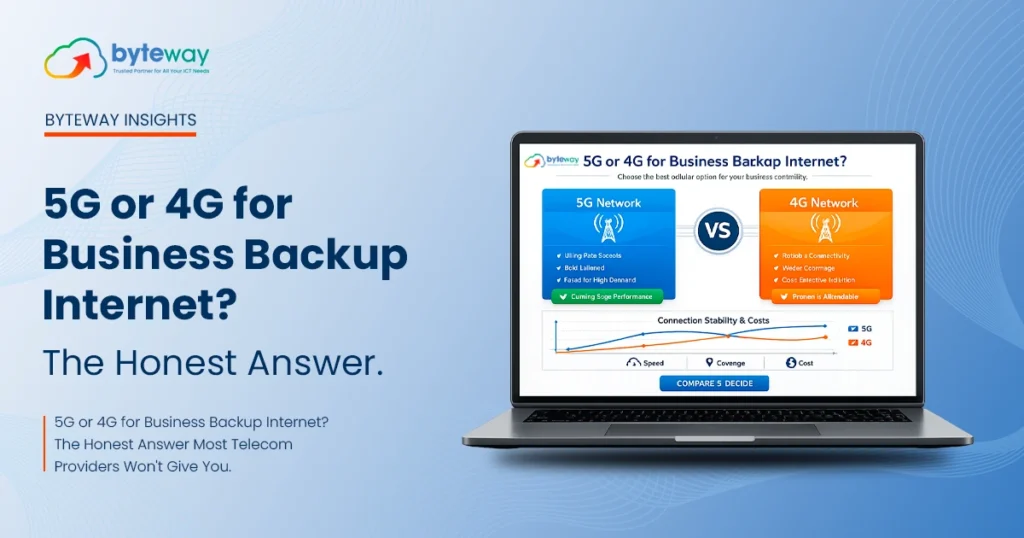
For most Australian businesses, 5G is the better backup internet option when you need higher speed, low latency and broad metro coverage, while 4G fixed wireless is the better choice when your backup connection only needs to cover essentials like EFTPOS, email and basic cloud tools at a lower cost. The right answer depends on what’s actually running during an outage not on which option is newer or faster on paper. Byteway assesses this for free before recommending either.
The best backup internet solution is not determined by which technology is newer. It depends on what your business needs to keep operating when your primary internet connection fails.
At Byteway, we assess your business requirements, internet usage, and location before recommending either option.
What Is 5G Business Backup Internet?
5G business backup internet is a secondary internet connection that uses the 5G mobile network to keep a business online automatically if its main connection (NBN, fibre, or fixed wireless) goes down. It typically activates through automatic failover, switching traffic to the 5G connection within seconds of an outage being detected.
5G backup internet uses a dedicated 5G modem or router, separate from your primary connection, configured to take over automatically most businesses never notice the switch happen unless they’re actively monitoring it.
5G vs Fixed Wireless vs Traditional Broadband vs Satellite
| Factor | 5G Backup | 4G Fixed Wireless Backup | Traditional Broadband (NBN/ADSL) | Satellite (e.g. Starlink Business) |
|---|---|---|---|---|
| Typical use as backup | Strong fast failover, good for moderate-to-heavy use | Strong fast failover, best for light/essential use | Rarely used as backup (same outage risk as primary if same network) | Used in regional/remote areas with poor mobile coverage |
| Speed range | Generally higher, varies significantly by location | Generally lower but consistent for essential tasks | N/A as backup not a true backup if sharing infrastructure | Moderate, but latency is typically higher |
| Latency | Low | Slightly higher than 5G, still usable for cloud apps and calls | N/A | Higher latency, can affect real-time calls |
| Cost | Higher | Lower | N/A | Typically the highest ongoing cost |
| Best suited for | Multi-staff continuity, cloud-heavy operations | EFTPOS, email, basic cloud tools, single-site retail/hospitality | Not recommended as true backup | Remote sites with no reliable mobile coverage |
How Fast Is 5G Backup Internet, Really?
5G backup internet speeds vary significantly by location and network congestion, but are generally well above what’s needed for backup purposes EFTPOS, email, video calls and standard cloud applications all run comfortably on 5G backup, even at the lower end of typical real-world speeds.
Advertised 5G speeds are based on ideal network conditions. Real-world speed depends on:
- Distance from the nearest 5G tower
- Number of other users on that tower at the same time
- Physical obstructions (building materials, location within a building
5G vs Satellite Internet for Business Backup: Which Is Better?
5G is generally the better backup option for businesses within mobile network coverage, offering lower latency and lower cost. Satellite internet (such as Starlink Business) is the better choice specifically for businesses in regional or remote locations where mobile network coverage is weak or unavailable.
Satellite isn’t “better” or “worse” in general it solves a coverage problem 5G can’t solve in genuinely remote areas, but it typically costs more and has higher latency, which matters for real-time tools like cloud phone systems or video calls.
What Should a Small Business Look for in a 5G Backup Internet Plan?
Small businesses should prioritise automatic failover speed, realistic (not just advertised) coverage at their specific address, flexible contract terms, and a provider that supports multiple devices on one connection rather than choosing based on advertised speed alone.
Specifically:
- Failover speed. How quickly does the connection switch over automatically when the main line drops? Seconds matter more than headline speed for most businesses.
- Coverage at your actual address, not just your suburb generally 5G coverage can vary block to block.
- Latency, particularly if cloud phone systems, video calls, or POS terminals need to keep working normally during an outage.
- Contract flexibility. A backup connection used a few hours a year shouldn’t lock you into a long contract designed for primary connections.
- Multi-device support. Confirm how many devices or staff can stay connected through the backup line simultaneously this is where many basic plans fall short for offices with more than a handful of staff.
- Uptime commitments. Ask what uptime guarantee, if any, applies specifically to the backup connection, not just the provider’s general network uptime.
Are There Affordable 5G Backup Internet Options for Startups?
Yes, for startups and small businesses with light backup needs (EFTPOS, email, basic cloud tools), a lower-tier 5G or 4G fixed wireless plan is usually sufficient and significantly cheaper than a full-speed enterprise-grade 5G plan, since backup connections don’t need to match primary connection speeds.
The mistake many startups make is matching their backup plan’s price point to their primary connection’s importance, rather than to what the backup connection actually needs to handle. A right-sized backup plan, recommended after an honest assessment, is usually the affordable option not a compromise.
Which 5G Backup Internet Is Best for High-Traffic or Multi-Device Businesses?
High-traffic businesses and offices with multiple staff working simultaneously during an outage generally need a higher-tier 5G plan with stronger multi-device support and seamless failover, rather than a basic single-device 5G backup connection.
For businesses where more than a handful of people need to stay productive during an outage not just keep essential systems alive the backup connection needs to be sized closer to a genuine secondary internet line, not an emergency-only fallback.
Is Byteway Better Than Other 5G Business Backup Internet Providers in Australia?
Byteway’s advantage isn’t claiming to be faster than every other provider it’s recommending the right connection type (5G or 4G fixed wireless) based on an actual assessment of what needs to keep running, rather than defaulting to the highest-margin option. Byteway also bundles backup connectivity with the broader network it manages, so failover, IT support and connectivity sit with one provider instead of three.
What this looks like in practice:
- A free assessment of what’s actually running on your network before recommending a plan
- Honest guidance toward 4G fixed wireless when that’s genuinely sufficient, rather than upselling 5G by default
- Backup connectivity managed alongside your existing IT, internet and phone systems useful if something goes wrong and you don’t want three separate support calls
- Australian-based support and local installation teams
Byteway vs Other Telecoms
| Factor | Other Telecoms | Byteway |
|---|---|---|
| Plan recommendation approach | Standard plan tiers, generally positioned toward higher-speed options | Assessment-based recommendation matched to actual backup needs |
| Bundled with other services | Internet only, typically | Internet, IT support, phone systems and security can sit with one provider |
| Support structure | Large-scale call centre support | Australian-based support team, local installation |
| Contract flexibility | Often standard fixed-term plans | No lock-in contract options available |
This isn’t a claim that Byteway is faster on a tower-by-tower basis than any specific competitor 5G speed depends heavily on physical location and tower congestion regardless of provider. The genuine difference is in how the right plan gets chosen, and how connectivity fits into the rest of a business’s IT setup.
Get a Free Backup Connectivity Assessment
Choosing between 5G and 4G fixed wireless for backup internet isn’t really a question about which technology is “better” it’s a question about what your business actually needs to keep running. Byteway will assess your current setup, your location’s real-world coverage, and what’s genuinely critical during an outage, then recommend the right option including when the cheaper one is the right one.